
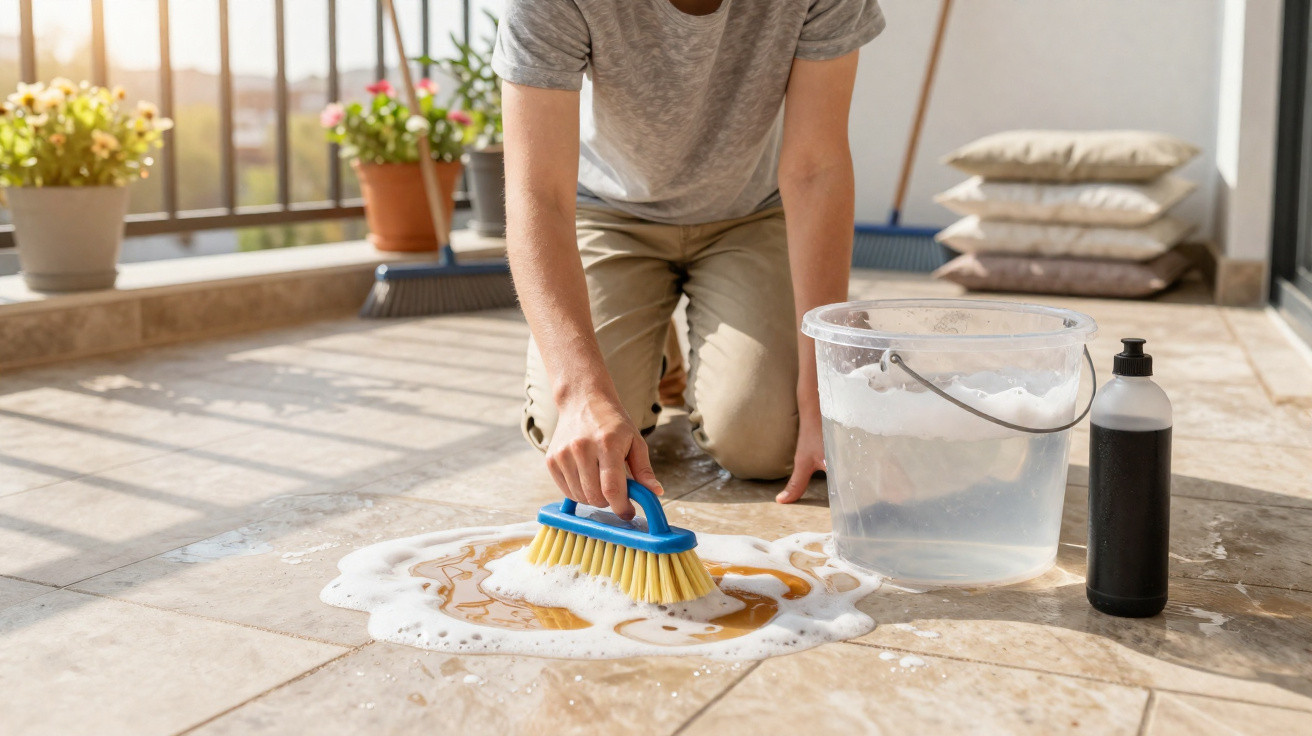
A straightforward household trick is often all it takes for a fresh start.
As soon as the temperature begins to climb, the outdoor space gets judged with brutal honesty. The garden table is stained, the paving has a greenish film, and the joints look more like a driveway than a place to relax. Many people immediately think of pricey specialist cleaners or a noisy pressure washer. In reality, a cheap, no-fuss household staple, some warm water and a bit of elbow grease are often enough to make the terrace look presentable again at the start of the season.
Why spring is the ideal time to clean the terrace
Getting started early in spring plays nicely with the conditions outdoors. Most of the dirt is still fairly new: dust, soot particles, leftover leaves, and the first signs of moss and algae. Much of it hasn’t worked deep into the surface yet and is still sitting on top.
That’s exactly what makes the job easier. At this stage, harsh chemical cleaners are often unnecessary. A mild cleaner with decent degreasing power is usually enough to:
- lift grey haze from stone or concrete slabs,
- remove dried-on food from the last barbecue,
- brighten up grimy joints,
- wash away pollen, soil and road grime.
A dry day without rain, and with no risk of frost, is best. The ground can then dry quickly after cleaning, and your effort will pay off for weeks.
The underrated all-rounder: liquid black soap cleaner
The star of this cleaning trick is an old household classic: liquid black soap cleaner made from plant oils. In shops it’s often labelled simply “black soap” or “black soap cleaner”. It contains no solvents, is biodegradable, and still shifts dirt remarkably well.
"Black soap cleaner works like a gentle degreaser that lifts even stubborn grime without putting the terrace or neighbouring beds under strain."
The cleaner is typically made from plant oils that have been turned into soap. That combination brings several advantages:
- breaks down greasy marks from the barbecue, oil or sun cream,
- removes dust and soot from air pollution,
- is kinder to plants along the terrace edge,
- doesn’t irritate dogs’ and cats’ paws,
- suits many materials: wood, tiles, concrete and many types of stone.
Because it’s highly concentrated, just a few spoonfuls in a bucket of water go a long way. A large container often lasts several seasons, which is a clear win for the budget.
Step-by-step: thoroughly cleaning the terrace in spring
For a proper spring clean, a structured approach is worth it. You waste less time and the finish looks far more even.
Preparation: remove the loose dirt
Start with a broom. Leaves, small twigs, grit and loose debris should be completely cleared before any water is used. Skip this, and you’ll simply spread muck around and make the whole job harder.
Mix the solution: how to get the dose right
For a heavily soiled terrace, use a bucket with about ten litres of hot water. Add roughly ten tablespoons of liquid black soap cleaner. The heat boosts the cleaning action, while the black soap tackles grease and surface build-up.
"A rule of thumb for spring cleaning: about one tablespoon of black soap cleaner per litre of hot water for heavily soiled areas."
Stir briefly so everything disperses evenly. Gloves are a sensible idea, especially if you have sensitive skin, even though this product is noticeably milder than many other cleaners.
Scrub methodically: don’t forget the joints
Now for the main work. A sturdy scrubbing brush or a stiff-bristled broom works best. Pour the cleaning solution generously over the surface and work in strips. Give extra attention to stubborn patches, dark joints or green-tinged corners.
If the terrace is very dirty, a short pause helps: leave the mixture to work for five to ten minutes, then scrub again. Dried-on grime comes away much more easily this way.
Rinse properly: avoid residue and slipping
After scrubbing, rinse thoroughly with clean water. A standard garden hose is sufficient. Make sure the water carries off all soap residue; otherwise a slight film can remain on the slabs.
If you like, finish by going over the surface with a floor squeegee, an old towel or a microfibre cloth. This reduces drying time and helps prevent water marks.
Fine-tuning: dosage for ongoing maintenance
For routine upkeep during the season, you usually need much less black soap cleaner. Here’s an example of a lighter mix:
| Use case | Amount of water | Amount of black soap cleaner |
|---|---|---|
| Light soiling, small terrace | 5 litres of lukewarm water | 3–4 tablespoons |
| Regular maintenance once a month | 8–10 litres of lukewarm water | 5–7 tablespoons |
| Heavy soiling after winter | 10 litres of hot water | 10 tablespoons |
If, after cleaning, the surface looks slightly streaky or feels a bit greasy, the solution was usually too strong or it wasn’t rinsed enough. In that case, a second quick rinse with clean water will sort it.
Take care with delicate materials and alternatives
When dealing with stubborn outdoor deposits, many people instinctively reach for household staples such as vinegar or bicarbonate of soda. That can work, but it also carries risks-especially on sensitive stone.
With natural stone, marble, quartz or granite, acidic or highly alkaline products can damage the surface. Staining, dull patches or rough, opened pores may follow, and that’s the sort of problem that’s difficult to undo.
"If you’re unsure, test any cleaner in an inconspicuous spot and avoid harsh products on natural stone and premium surfaces."
Bleach and chlorine-based cleaners don’t belong on a normal terrace either. They can erode joints, turn wood grey, harm plants and burden groundwater. Being too casual with a pressure washer is similarly problematic: an overly forceful jet can blast out jointing material, roughen timber and even cause small stones to fray at the edges.
Practical tips to keep the terrace cleaner for longer
If you don’t want to start from scratch again and again after the big spring clean, a few simple habits make a real difference:
- Sweep away loose leaves and soil regularly.
- Deal with barbecue grease promptly using a splash of black soap cleaner and warm water.
- Position plant pots so air can circulate underneath-otherwise dark rings form quickly.
- For timber, reapply decking oil or a wood stain in good time so moisture doesn’t penetrate too deeply.
- Use grilles or mats in problem areas, such as by the door, to stop dirt being tracked indoors.
In shady corners especially, it helps to do a quick pass every so often with a mild mix of water and black soap cleaner. That way, moss and algae don’t get the chance to spread.
What many people don’t realise: why the cleaner works so well
Its effect comes down to a simple principle: grease and dirt particles often cling together. The soap components surround those particles and make them water-soluble. That means the grime can be lifted off more easily during scrubbing and rinsing.
At the same time, the cleaner remains relatively gentle-an important point outdoors, where rain can carry wash water into the ground. If you want a reasonably eco-conscious approach without spending hours scrubbing, this is a solid middle ground.
On terraces that are heavily affected by algae or have been neglected for years, a second pass may be needed. In many cases, though, one thorough clean at the start of spring is enough to make the outdoor area usable again-and to enjoy the first coffee in the sun without an embarrassed glance at the floor.




Comments
No comments yet. Be the first to comment!
Leave a Comment