
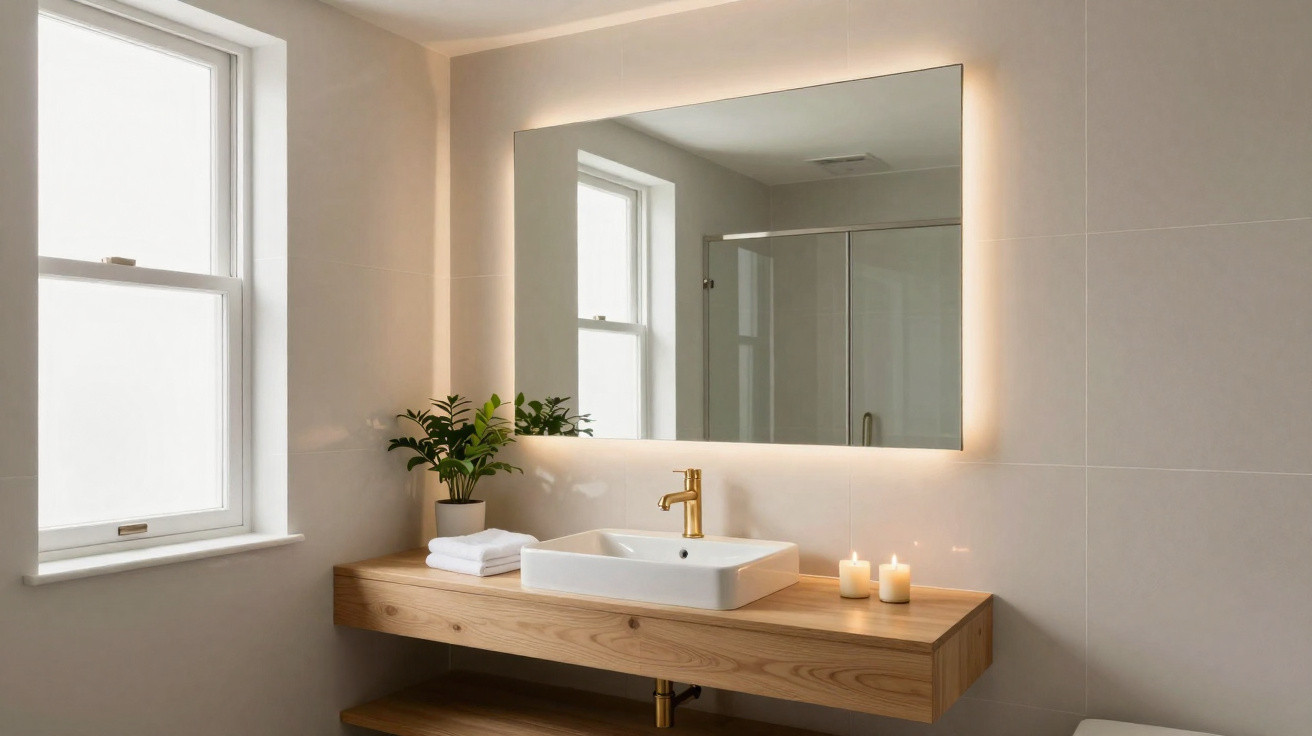
In both compact city flats and family houses in the suburbs, countless “blind” bathrooms rely on one gloomy ceiling bulb. The space ends up feeling like a box room, not somewhere you’d choose to start your day. Interior designers, though, say you can mimic daylight and even make the room feel bigger - without removing a single wall.
The real problem with tiny, windowless bathrooms
A bathroom with no window doesn’t simply read as small; it reads as closed off. It can feel as though the room is tightening around you.
The usual quick fix is white tiles paired with a strong ceiling light. In reality, that combination often makes the space look stark, flat and oddly clinical - particularly in winter. You can see everything, yet it doesn’t feel pleasant.
Designers now focus less on “lighting to see” and more on “lighting to breathe”. In a tight room, your mind is looking for two tricks at once: the sense that the walls are further away, and the suggestion that daylight is coming from somewhere believable.
The goal is not more light, but better light that tricks your eye into seeing space where there is none.
That’s why a deceptively simple pairing works so well: an oversized mirror plus carefully positioned daylight‑mimicking LEDs.
The high‑end hack: an oversized mirror as a fake window
When a room is small, many people automatically scale everything down - a petite vanity, smaller fittings, and a small mirror. That reflex is exactly what makes the bathroom continue to feel squeezed.
The first step is the one that feels backwards: choose a mirror that’s big - almost comically big.
Why size suddenly matters
A typical mirror mainly reflects your face. A much larger mirror changes how the whole room is perceived.
- It makes the wall feel twice as deep.
- It visually shifts the room’s edge outward.
- It bounces back fixtures, tiles and light, hinting at a second space you can’t actually enter.
As a minimum, aim for a mirror that matches the vanity unit’s width and sits above eye level. If you can, take it close to edge‑to‑edge: basin to ceiling, like a full‑height panel.
Think of the mirror as a window you can place wherever you like, not just a grooming aid above the sink.
In bathrooms with a design focus, this one change can create an instant “boutique hotel” vibe, even if the floor area is barely bigger than a cupboard.
The secret ingredient: “daylight” LEDs between 4000K and 5000K
The second part is about picking the correct light - not the most powerful one, but the right type.
Lighting specialists concentrate on colour temperature, measured in Kelvins (K). This tells you whether the light appears warm and yellow, cool and blue, or closer to midday daylight.
| Colour temperature | Effect in a bathroom |
|---|---|
| 2700–3000K (warm white) | Cosy but can look yellow and dingy, especially on white tiles. |
| 4000–5000K (neutral/daylight) | Crisp, clean and closest to natural daylight; flattering for most skin tones. |
| 6000K and above (cool white) | Very bluish, often associated with hospitals and offices. |
For windowless bathrooms, designers repeatedly return to the middle range: 4000–5000K, often marketed as “neutral white” or “daylight”. It gives the clarity of a bright day without the icy cast of very cool LEDs.
Pair an oversized mirror with 4000K “daylight” lighting and the wall begins to behave like a sunlit window.
The mirror does more than reflect you. It gathers that neutral white light and redistributes it, easing harsh shadows and making colours appear fresher - towels, tiles and your own complexion included.
Placement: why ceiling spots are your worst enemy
Even the best bulb can fall flat if it’s installed in the wrong place.
One ceiling fitting creates severe top‑down shadows. Under‑eye circles look more pronounced, cheeks can seem hollow, and the room’s corners drop into darkness.
Light the face, not just the floor
To make a bathroom feel calm and high‑end, place light around face height, close to the mirror.
- Vertical wall lights on both sides of the mirror provide balanced, front‑on illumination that flatters.
- Back‑lit mirrors with integrated LED strips add a gentle halo and reduce stark contrast.
- LED strips concealed along the top or sides of the mirror can wash the wall with soft light, making it feel larger.
Lighting designers also refer to the Colour Rendering Index (CRI), scored out of 100, which indicates how accurately a light source shows colours. In bathrooms, a CRI of at least 90 helps skin tones and finishes look true to life rather than dull, grey or skewed.
Good bathroom lighting should feel invisible: you notice how well you look, not the fittings themselves.
Three quick extras that boost the illusion
Once the oversized mirror and daylight LEDs are sorted, a few small changes can make the “fake window” effect feel much stronger.
- Choose satin or velvet‑matt paint for walls instead of completely flat finishes. It reflects more light without making the room glossy.
- Replace a dark shower curtain with glass, or at least use a pale, semi‑transparent fabric. Anything opaque that visually splits the room interrupts the light bouncing between mirror and walls.
- Add a tough houseplant such as a pothos or Zamioculcas zamiifolia. Under daylight‑style LEDs, greenery brings a subtle spa mood and softens all the hard surfaces.
None of this requires moving pipework or spending a fortune. Combined, these details encourage your brain to interpret the room as bigger, airier and far less boxy.
What this does to your mood on winter mornings
Light isn’t only about décor. It affects the body’s internal clock and how you feel.
Bright, neutral light in the morning helps support the circadian rhythm - the 24‑hour cycle that shapes sleep, alertness and hormone regulation. In a flat where natural light mainly reaches the living room, a well‑lit bathroom can become your first real hit of “fake sun”.
People who replace a yellowish bulb with a daylight LED in a small bathroom often say they feel more awake and less lethargic, especially in January and February. The space looks cleaner and more welcoming, which subtly changes the tone of your routine.
How to test the hack before you spend big
If you’re renting - or you simply don’t want to commit to major purchases - you can trial the idea first.
- Buy one or two 4000–4500K bulbs with a high CRI and fit them near your current mirror.
- Lean a larger, budget mirror panel against the wall behind the basin to imitate the look of an oversized mirror.
- Switch off the main ceiling light and rely only on face‑level lighting for a few days.
Notice how your skin appears, whether the corners feel brighter, and how you feel while getting ready. If temporary pieces already make a big difference, a permanent oversized mirror and proper fittings are likely to deliver the “high‑end” feel you’re after.
Related ideas for other cramped rooms
These same principles work well outside the bathroom. Any tight, low‑light area can benefit from a considered mirror‑plus‑daylight setup.
In a narrow hallway, placing a tall mirror opposite a doorway and adding a 4000K wall light can create the impression of extra depth. In an internal home office with no windows, a large wall mirror and a high‑CRI daylight lamp behind the monitor can ease eye strain and stop the room feeling like a bunker.
Once you understand how mirrors and colour temperature work together, every dark corner in your home becomes a design opportunity instead of a lost cause.
The method never really changes: pick a wall to become the “view”, install a generous mirror there, then light it as though sunshine is streaming in from the other side. Your eyes will do the rest.



Comments
No comments yet. Be the first to comment!
Leave a Comment