
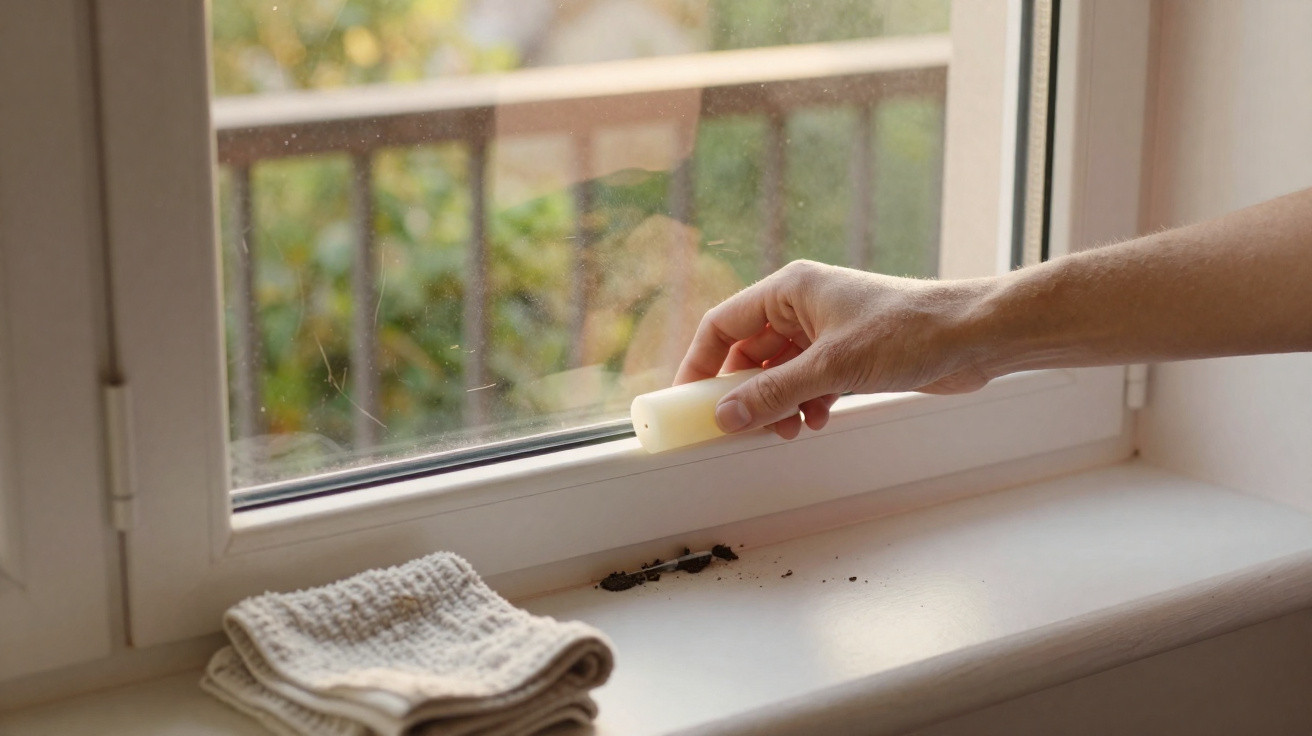
Candle wax can help a sliding window move more smoothly when dust, grit and built-up residue increase friction in the track. After a thorough clean, a plain white candle leaves a hard, dry film on the runner, cutting down direct contact between parts without creating an oily surface that quickly attracts dirt.
Why does candle wax make a window easier to slide?
Most standard white candles contain paraffin in a solid form. When you rub it onto a clean track, the wax fills tiny surface imperfections and creates a very thin layer that reduces friction as the sash opens and closes.
This tends to be most noticeable on aluminium windows that are still properly aligned but have started to feel stiff due to dried-on grime. Wax will not repair broken components, but it can restore smoother sliding when the issue is mainly at the contact point between the bottom of the sash and the channel.
- Lowers friction between the sash and the track;
- Makes opening easier without leaving the channel wet;
- Does not run into the sides of the frame;
- Usually holds less dust than oily products;
- Can be reapplied after the next clean.
Why must you clean the track before applying wax?
If you put wax over sand, hair or hardened dirt, the movement can get worse because the debris becomes trapped under the film. The best approach is to vacuum the corners, loosen dirt with a small brush, then wipe with a slightly damp cloth-making sure the sliding window track is completely dry before using the candle.
Correctly applying wax to sliding window tracks
Once the channel is clean and dry, take a dye-free white candle and rub the side of it along the areas where the sash slides. There is no need to heat, melt or light the candle, because contact pressure alone deposits enough paraffin onto the metal.
Afterwards, open and close the window a few times to spread the layer evenly. The same emphasis on clean surfaces also appears in methods used to restore the look of wooden furniture, where removing dust and grease beforehand has a direct impact on the finish.
- Vacuum the entire channel and the corners;
- Use a soft brush to lift any stuck-on residue;
- Wipe with a damp cloth and wait for the track to dry;
- Rub the white candle over the contact areas;
- Open and close the window to distribute the wax;
- Wipe away any visible excess with a dry cloth.
Why can oils and sprays make the problem worse?
Liquid lubricants can leave a sticky film that traps roadside dust, grit and particles carried in salty sea air. With ongoing use, this combination can turn into a dark paste in the channel and increase resistance again-particularly on frames exposed to wind or installed near busy roads and coastal areas.
When won’t wax fix a stuck sliding window?
Paraffin will not solve broken rollers, dented tracks, loose screws or misaligned sashes. If the window still feels heavy after cleaning and applying wax, makes metallic noises or drops to one side, the rollers and the frame’s fit will need to be checked.
It is also sensible to read the manufacturer’s guidance before applying any product to internal mechanisms or to models with special finishes. When the issue is simply accumulated dust and surface friction, candle wax works as a dry lubricant; when there is mechanical damage, forcing the window can further deform the track and affect how well it closes.





Comments
No comments yet. Be the first to comment!
Leave a Comment