
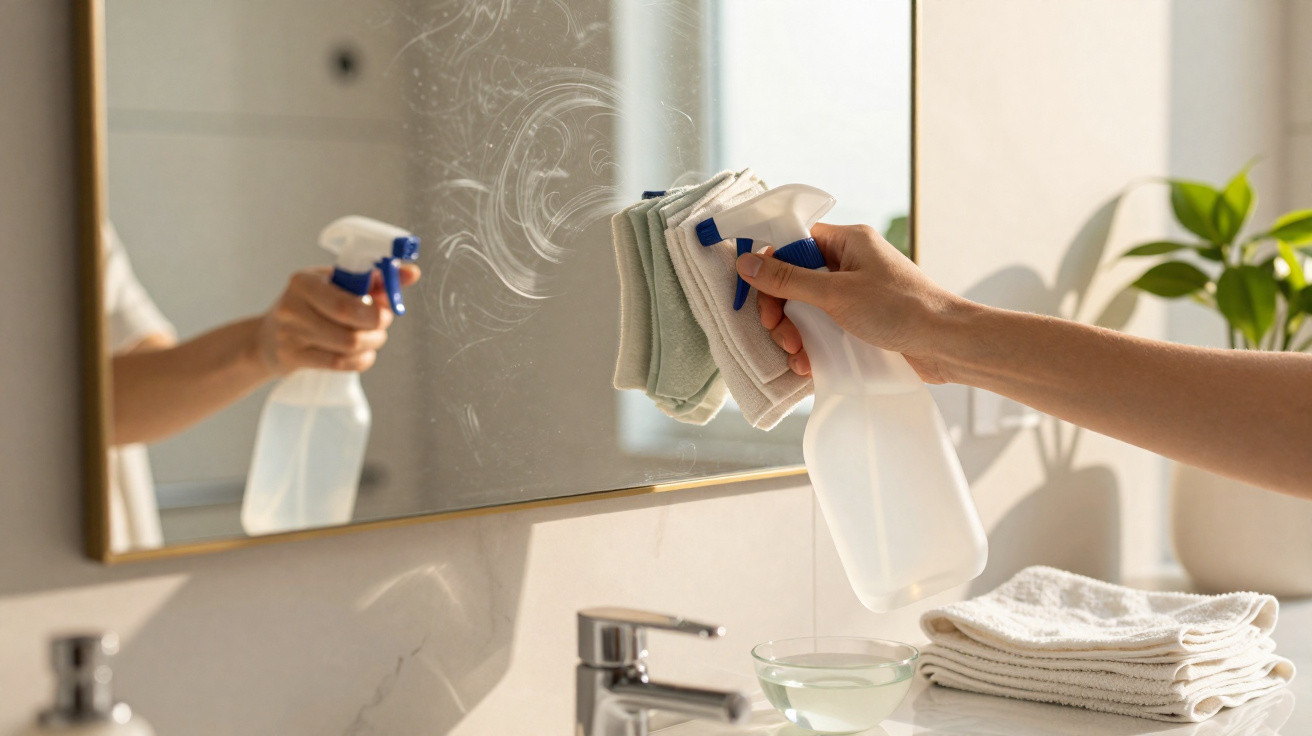
You mist the surface, you wipe it down, you stand back - and there they are again: faint crescents and hazy ghosts on the glass, as if the morning has left fingerprints behind. The bottle of glass cleaner may have promised “streak-free,” but the mirror keeps disagreeing once the light hits it. The cause is often not what you assume - and it’s not always just the product.
One morning, coffee in one hand and the spray bottle in the other, I gave the mirror a confident spritz and wiped in brisk circles. At first, the haze disappeared and the glass looked spotless. Then I shifted my head slightly and, in the sunlight, thin lines appeared across the surface. They seemed to change as the angle changed. I went back over it with more pressure, only for the streaks to relocate rather than vanish. That familiar, outsized irritation settled in - the kind where something minor suddenly feels bigger than it should. The culprit isn’t the mirror itself.
Why “clean” mirrors still streak
Mirror streaks aren’t simply leftover cleaner. More often, they come from an everyday mix that forms a nearly invisible layer on the glass: stray hair spray, a fine mist from toothpaste, vapour from hand soap, oils from skin, and even minerals carried in shower steam. Glass cleaner breaks down that film, but if your cloth can’t lift it away, the dissolved residue gets redistributed instead.
It’s not about obvious grime - it’s about a residue you can’t see. In a steamy bathroom, moisture in the air slows evaporation, so the detergent in the cleaner sits on the surface for longer and can dry into faint surfactant trails. Tip the mirror towards a bright window and those marks show up like a watermark.
The invisible residue behind mirror streaks
What builds up on the glass is routine, not dramatic - which is why it’s so easy to miss:
- Hair spray overspray settling from the air
- Toothpaste mist drifting from the sink area
- Hand soap vapour that clings to surfaces
- Skin oils transferred by hands and faces
- Minerals left behind by shower steam
Once this film is loosened, it needs to be removed from the surface - not smeared thinly across it.
Cloths, humidity and mirror-cleaning technique with glass cleaner
Take Mia, a hairstylist who prides herself on keeping her stations spotless. She tested three different glass cleaner brands and still noticed pale arcs on her salon mirror by lunchtime. Her routine was the issue: paper towels and a single pass. The paper towels left lint behind, and the hair spray floating in the salon air helped bind that lint into a new film. When she switched to a damp microfibre cloth followed by a dry one, the difference was immediate. In about two minutes, the mirror looked sharp and clear - the kind of fix that feels almost unfair, like a cheat code you wish you’d discovered earlier.
The underlying reasons are a blend of chemistry and physics. Surfactants in cleaners are designed to loosen grime, but that loosened layer has to be picked up and carried away. A cloth that has fabric softener residue on it won’t grip the film properly, so it tends to smear instead. Warmth and humidity in a bathroom also change how quickly different areas dry, which is why wipe marks can appear where the cleaner evaporated at uneven speeds. Spraying the mirror directly can soak the edges and increase the chance of liquid creeping behind the glass, which may damage the backing over time. And because light reflects unevenly off streaked areas, every swipe becomes more visible the moment the mirror catches the sun.




Comments
No comments yet. Be the first to comment!
Leave a Comment