
Many of us close the oven door and try to ignore what’s going on inside-right up until smoke, lingering odours and patchy baking make it impossible. A low-effort cleaning hack has been doing the rounds, claiming you can get your oven back to normal more quickly, without harsh sprays or hours of scrubbing.
Why a clean oven matters more than you think
An oven that’s coated in grime doesn’t just make the kitchen feel untidy. Each time you heat it, burnt-on fat gives off particles and smells that move around the cavity and over your meals. Those fumes can latch onto pastries, roasted vegetables and Sunday roasts, leaving a strange aftertaste that seasoning won’t cover.
It’s not only about taste, either. When the inside is greasy, heat distribution becomes inconsistent. One area can run hotter while another stays cooler, so a lasagne may blister on one side yet remain pale on the other. To hit the temperature you’ve selected, the thermostat can end up driving the oven harder and for longer, which increases energy consumption.
Engineers also flag the longer-term consequences. As carbonised layers build up, they can hold heat around elements and fans. That added strain may reduce the lifespan of components that are already expensive to replace.
Grease build-up can change how your oven cooks, how much power it draws, and how long it lasts.
Keeping on top of it-even in quick, regular bursts-helps prevent things getting worse. The hard part is choosing an approach people will realistically keep doing.
Why classic cleaning tricks often fail
In most homes, oven cleaning tends to cycle between three familiar choices: baking soda, white vinegar, or a heavy-duty supermarket oven cleaner. All can work in theory, but in everyday use there are downsides.
Baking soda and vinegar: effective, but slow
Baking soda can loosen fat if it’s left to sit on thick deposits. However, it takes time, moisture and a fair bit of persistence. For many, that means spreading a paste across the interior, waiting for hours or overnight, then scraping and rinsing repeatedly.
Vinegar can help with lighter grease and is useful for odours, but it often falls short against dark, baked-on residue. Its sharp scent also puts plenty of people off, particularly in smaller kitchens.
Chemical oven sprays: fast, but harsh
Powerful commercial sprays can break down stubborn build-up more quickly, but they can create other issues. Many rely on caustic ingredients that can irritate skin and lungs. Labels commonly advise strong ventilation, wearing gloves, and keeping the product away from seals and particular coatings.
Residue is another concern. Even after rinsing, some users still notice smells during the next few times the oven is used. Some parents choose to avoid these cleaners in households with young children or pets.
Self-cleaning cycles: energy-hungry solution
Pyrolytic ovens use extremely high temperatures to turn leftover food into ash. The appliance locks for the duration, and the cycle typically runs for two to three hours. It’s convenient, but it consumes a lot of electricity.
Repeated exposure to that level of heat can also put stress on door glass, seals and internal components. Many kitchens don’t have a pyrolytic model, and even when they do, owners often avoid running the function frequently because of the cost and the amount of heat released, especially in warmer months.
Between time-consuming pastes, strong sprays and energy-heavy cycles, many people simply delay the job until the oven feels unusable.
How a dishwasher tablet became an oven-cleaning star
In response to all that, a surprising contender has quietly taken centre stage: the everyday dishwasher tablet. Because it’s made to tackle burnt lasagne, dried egg and greasy plates, it contains a blend of enzymes, surfactants and alkaline agents that break down food soils quickly.
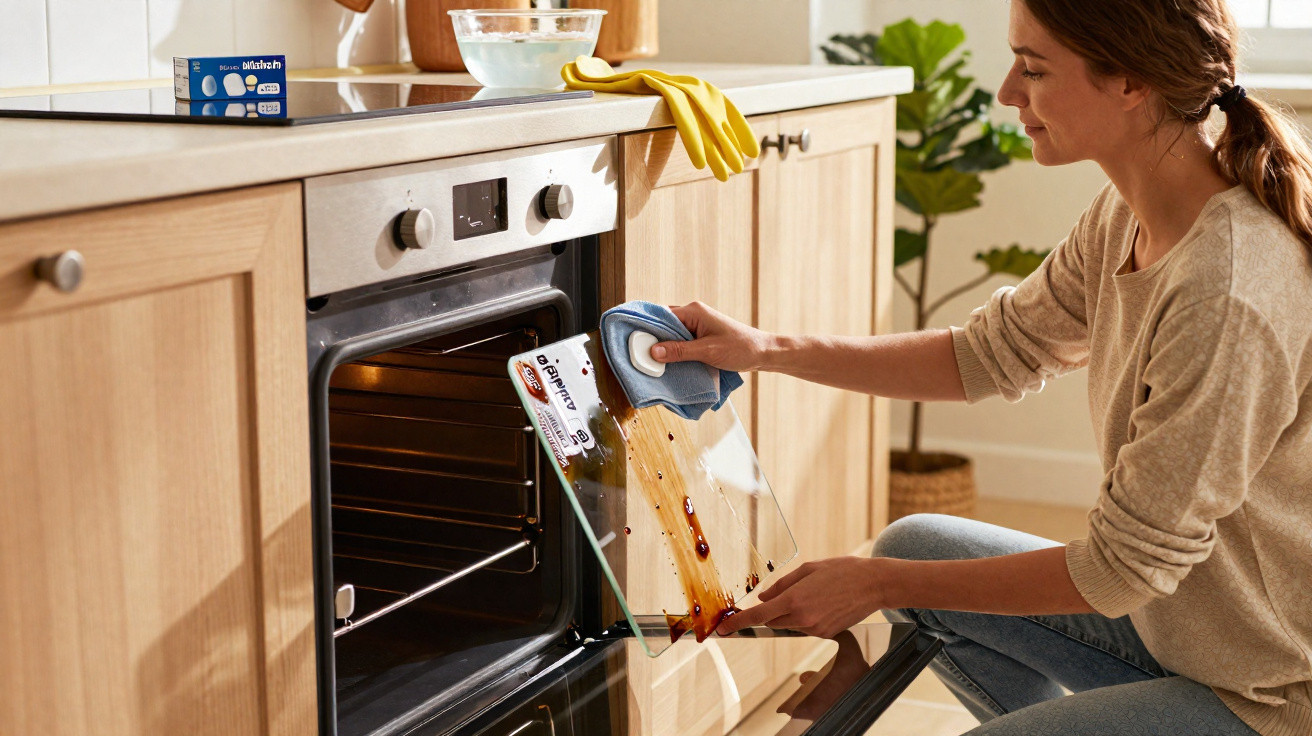
People started demonstrating the idea in viral videos and on home blogs, rubbing a softened tablet straight onto oven doors. The before-and-after clips can look almost too perfect: brown marks lifting away, glass turning clear again, and metal surfaces returning to their original shade.
Dishwasher tablets target the same kind of fats, proteins and starches that cling to your oven walls and trays.
What makes it work is the formulation. Enzymes act on proteins and starchy residues, alkaline builders help release fats, and gentle abrasives assist in lifting the softened layer without damaging enamel when you use normal pressure. Packed into a small, concentrated block, that combination turns out to be unexpectedly effective inside an oven.
Step-by-step: cleaning your oven with a single tablet
What you need
- 1 dishwasher tablet (the hard, powdery type, not a gel pod)
- Bowl or basin of warm water
- Soft sponge or microfibre cloth
- Pair of gloves if you have sensitive skin
The method
- Cool and empty the oven: Turn the oven off and allow it to become only slightly warm-never hot. Take out shelves, trays and any other accessories.
- Moisten the tablet: Dip the tablet into warm water for a few seconds. You want the outer layer to soften while the block still holds together.
- Rub the stains: Use the softened tablet like a rubber on brown marks, the door glass and the side panels. Work in small circular motions and don’t press hard.
- Let it sit: Leave the foam and loosened residue in place for 10–15 minutes. The ingredients keep working while you tackle another section.
- Rinse thoroughly: Go over everything with a clean, damp sponge several times until there’s no white film left behind. Buff dry with a cloth to minimise streaks.
For the metal racks, fill a basin or bathtub with hot water and add a tablet. Leave the racks submerged for around 30 minutes, then give them a light scrub with a sponge or brush. In most cases, the sticky layer should come away easily.
| Part of the oven | How to use the tablet | Typical contact time |
|---|---|---|
| Glass door | Rub gently with softened tablet, avoid edges of seals | 10–15 minutes before rinsing |
| Enamel walls | Work on dark patches, re-wet tablet if it dries | 15–20 minutes for thick, baked-on grease |
| Metal racks | Soak in hot water with dissolved tablet | 30–40 minutes before a light scrub |
Why this hack appeals to busy households
The appeal is straightforward: one inexpensive product that can handle multiple cleaning tasks. Many households already have dishwasher tablets to hand, so there’s nothing extra to buy and no large bottle to store under the sink.
It also suits short bursts of time. You might clean only the door one evening and deal with the racks the next day. Because you’re rubbing rather than spraying, it’s easier to control where the cleaner goes, so it’s less likely to end up in hinges or vents that are awkward to rinse out properly.
Smell and ventilation matter, too. Tablets generally give off far fewer fumes than strong aerosol cleaners, which can make a big difference in small flats or kitchens without powerful extraction.
Using one product for plates, trays and the oven itself simplifies shopping and storage while cutting down on chemical mixes at home.
Some newer tablet formulas also use more biodegradable ingredients, which can reduce their environmental impact compared with older oven foams that rely heavily on solvents.
Safety checks before you start
Dishwasher tablets are still chemical cleaners, so it’s sensible to take a few precautions before applying them inside your appliance.
- Check your manual: Some manufacturers recommend particular products or caution against abrasive cleaning on special finishes such as catalytic liners.
- Patch-test first: Choose a hidden spot on a side wall, rub gently with a softened tablet, then rinse. Check for dulling, marks or changes in texture.
- Protect seals and vents: Don’t scrub rubber door seals, heating elements or ventilation slots directly with the tablet.
- Rinse until neutral: If you can see a white haze or the surface feels slippery, cleaner remains. Keep wiping with clean water until everything feels smooth and bare.
If you have sensitive skin or allergies, wearing gloves can make the job more comfortable. Keep children and pets away while you’re cleaning and until the oven is completely dry inside.
What experts say about energy and performance
Repair technicians often stress that a clean oven is about more than appearance. A thin, even enamel surface responds to heat as expected, whereas thick, charred deposits can insulate certain areas and slow preheating. Over time, that change can add to energy costs.
Manufacturers also assess heat distribution in testing, using sensors placed across shelves. Build-up on fans and side panels can disrupt that pattern, which then shows up in baking results. Gentle, frequent cleaning tends to protect the oven’s original performance more effectively than rare, heavy-duty overhauls.
Small maintenance sessions, like a quick rub with a softened tablet after a messy roast, often prevent the need for deep, disruptive cleaning later.
Beyond the oven: other smart uses and limits
After seeing what it can do on oven glass, many people test dishwasher tablets in other places. Used carefully, they can help with stained baking trays, the base of badly burnt pans, or barbecue grates. The same rules apply: keep contact time short, use light pressure, and rinse thoroughly.
However, there are important limits. Tablets aren’t suitable for delicate non-stick coatings, lacquered finishes, painted fronts or aluminium, which may react poorly with alkaline products. They also won’t replace descalers for kettles, coffee machines or steam ovens, as those appliances generally require acid-based cleaners.
For anyone trying to cut down the number of bottles in the cleaning cupboard, the dishwasher-tablet approach fits a wider shift towards multi-purpose products that do several jobs well enough, rather than a different spray for every surface. That’s particularly appealing with tighter budgets and smaller homes.
Even so, professionals tend to recommend moderation. A dishwasher tablet can make a big difference when an oven is genuinely grimy, especially after heavy holiday cooking or batch meals. For day-to-day upkeep, wiping spills promptly with warm soapy water helps prevent layers forming and reduces how often you’ll need stronger methods.


Comments
No comments yet. Be the first to comment!
Leave a Comment