
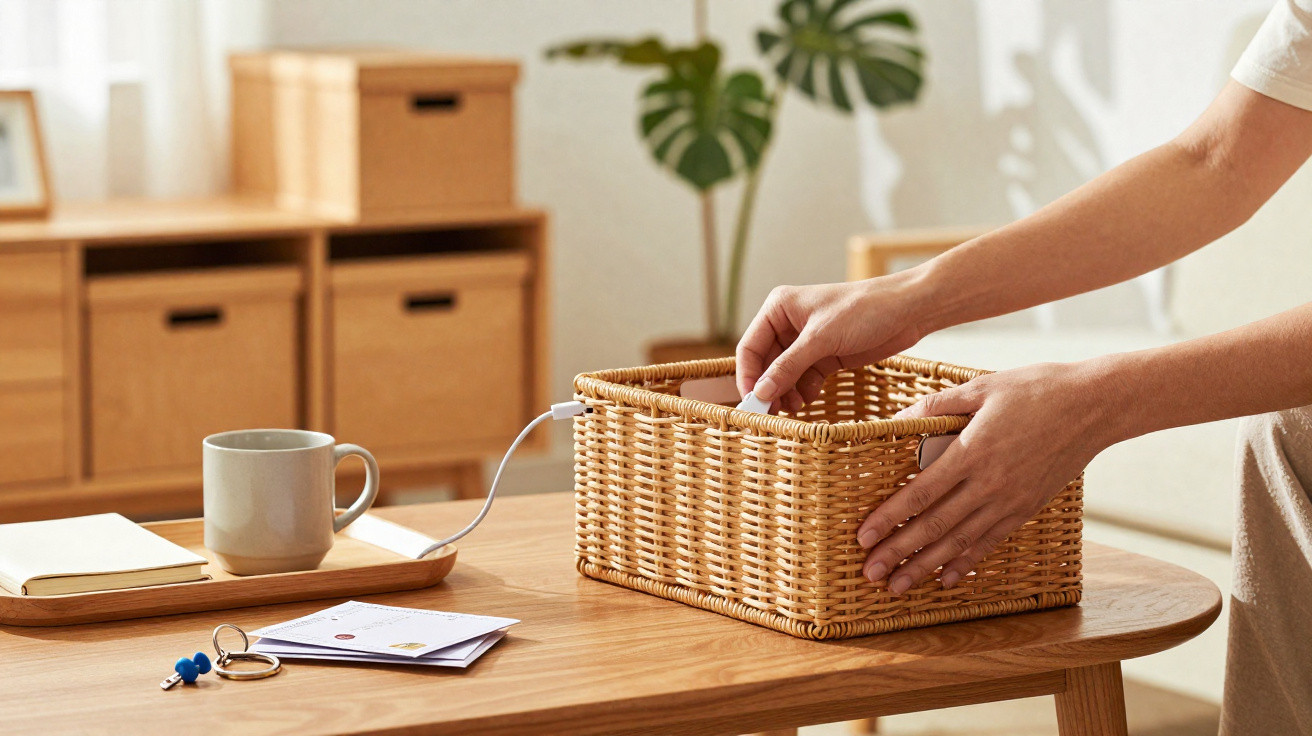
The worktops are clear, the floors have been vacuumed and the cushions are neatly plumped.
At first glance, your home looks as though it belongs in a magazine. Yet, as you move between rooms, your shoulders tighten without any clear explanation.
There is no obvious dirt to find. Even so, your attention keeps catching on the “stuff”: a charger curled up on the worktop, three partly used candles, or that basket of “random things” you gave up questioning months ago. Technically, everything has somewhere to go. It simply does not feel restful.
You settle on the sofa with the remote in your hand, but the room feels… busy. Not unclean. Busy. There is a low mental hum you cannot quite switch off.
You begin to suspect that your cleaning routine is not the issue. Perhaps it is the quiet disorder your brain registers, even when your eyes see a “clean” home.
Why your brain says “cluttered” when your house looks clean
A house can be spotless while still feeling visually noisy. Your brain does not just notice dust and crumbs; it also takes in shapes, colours, labels, stacks and even pictures hanging slightly askew. Every small object is like an open browser tab. One is manageable. Fifty can leave your mind overheating.
A tidy kitchen worktop holding ten everyday objects may meet any cleaning standard. But your mind interprets those objects as ten tiny prompts: make coffee, wash this, put that away, pay that bill. The outcome is a mental task list that never quite shuts down, even after the sponge has gone back beneath the sink.
This leaves you stuck in an odd middle ground: the room is not untidy enough to warrant a major clear-out, yet it is not peaceful enough for you to properly unwind.
During a video call, a woman proudly shows off her “cleaned” sitting room: vacuum marks across the rug, no rubbish in sight and freshly dusted shelves. Then the camera stays on the scene a little longer. Behind her, the TV unit is crowded with candles, remotes, holiday souvenirs, framed photographs, two speakers and a precarious stack of magazines.
The chat fills with praise. It genuinely looks clean. Still, a few people quietly say that merely looking at the background makes them feel tired. It is not because the room is dirty, but because the eye has nowhere to rest. There is no visual pause.
That is the curious reality of modern interiors: surface cleaning is often perfectly adequate, while visual clutter accumulates gradually. One mug received at Christmas. One additional plant pot. One new charging station. Each item may seem harmless and meaningful alone. Together, they create a faint buzz that you sense without being able to name.
From a cognitive viewpoint, your brain continually scans its surroundings for patterns and jobs to do. The more separate items it must process, the more energy it uses. Even when you insist that you are “not bothered by mess”, your nervous system is still carrying out quiet background work.
Researchers refer to this as visual load. Shelves crammed with objects, bold patterns, exposed cables and visible packaging all contribute to it. Your brain tries to sort everything into categories: useful, sentimental, junk, urgent or someday. When too many of those categories collide in a single room, you can feel unsettled without knowing why.
This is why an almost empty hotel room can feel calming straight away. It is not magic; it is the lack of decisions demanding your attention.
Small shifts that make a clean home feel genuinely calm
Begin with a straightforward exercise: the three-second scan. Stand in the doorway of a room and slowly look from left to right. Add anything you notice and identify within three seconds as “out of place”, “not sure why that’s there”, or “I’ll deal with that later” to a short list.
Next, choose only five of those items and assign each one a proper home. Not a “temporary basket” or a corner of the table, but a consistent place it can return to. You are not trying to declutter your whole life during one intense weekend. You are simply turning down the background noise by one level.
Small adjustments often transform how a room feels: use a tray to contain remotes and candles, a box for chargers, or a closed cupboard rather than open shelving. Your broom already takes care of crumbs. These changes deal with the steady visual pinging.
A frequent mistake is treating every surface as potential storage. The top of the fridge, the cistern behind the toilet, the hallway shoe rack: each can slowly become a display area for miscellaneous items that do not truly belong anywhere.
Another problem is “aspirational clutter”: piles of books you are not really reading, kit for hobbies you do not practise, or glossy magazines saved for a quiet Sunday that never arrives. These possessions can feel virtuous. They murmur, “One day, you’ll be that person.” But at present, they mostly say, “You’re behind.”
Try to be kind to yourself. Homes fill up with emotional possibilities and unfinished narratives. The aim is not to live in a white box. It is to keep the things that either support your life now or genuinely make your heart feel warm when you see them. Everything else can leave the stage quietly.
“My home stopped feeling cluttered the day I accepted that I wasn’t curating a showroom. I was curating my nervous system.”
To put this into practice, keep a small “visual noise” checklist in your mind:
- Restrict the number of items kept on each surface: choose 3 favourites, not 13.
- Conceal labels and packaging whenever possible, such as by decanting refills into plain jars or baskets.
- Keep similar objects together rather than spreading them between rooms.
- Leave at least one surface in every room almost bare, giving your eyes somewhere to rest.
- Whenever something new comes in, choose one item that can go out.
Let us be honest: nobody really manages this every day. There will be hectic weeks when the basket of random things overflows again, and that is alright. The aim is not perfection, but having an easy route back when your home begins to feel mentally “loud” once more.
Living with less noise, not less life
When your home finally feels uncluttered in your body as well as in photographs, something changes. You enter the kitchen without instantly noticing twenty little jobs waiting for you. You sit on the sofa and see the light rather than the stack of post.
You may still own exactly the same number of possessions. The difference is that most are stored away, grouped together or deliberately chosen. The room stops demanding so much from you. This is the unusual relief many people experience after properly decluttering: not pride, but quiet.
It is not about turning into a minimalist monk. It is about becoming a more thoughtful editor of the backdrop to your daily life. When editing text, you do not remove its soul; you take away what weakens the message. At home, it works in the same way: you remove what dilutes your feeling of rest, play and being fully present.
You may find that certain possessions suddenly feel heavier than their appearance suggests. A present you never liked. A pile of old work notebooks from a job that exhausted you. A mirror that always makes you wince. These objects are not neutral. Each time you pass them, your brain labels them, like a tender bruise you keep knocking.
In practical terms, begin with something modest: one shelf, one drawer or one tray on the coffee table. Ask yourself, “If this disappeared overnight, would I truly miss it, or would I just be temporarily unsettled?” That small question can free up many decisions that have become stuck. An item does not have to remain simply because it is already there.
There is also a more personal layer: identity. Many of us hold on to things because they seem connected to who we once were or who we hope to become. The guitar you never play. The pile of sketchbooks with only three pages completed. The box of craft materials bought in a burst of optimism. Releasing some of these things is not failure; it is an honest revision of your story.
A peaceful home is not one without character or history. It is one in which you can actually feel that history, instead of having to search for it beneath out-of-date leaflets and tangled leads. A shelf with five much-loved books and one photograph can reveal more about you than a bookcase crammed to its edges with “maybes”.
| Key point | Detail | Benefit for the reader |
|---|---|---|
| Visual clutter vs cleanliness | Feelings of untidiness often result from visual overload rather than dirt. | Helps explain why a “clean” home can still feel stressful. |
| Micro-decisions | Every visible object creates a small mental job or reminder. | Demonstrates how clutter quietly drains energy day after day. |
| Intentional editing | Curate surfaces, group belongings and give them proper homes. | Provides practical steps for making rooms feel calmer quickly. |
FAQ:
- Why does my house feel messy even right after I clean? Your cleaning tackles dirt rather than visual noise. When lots of items remain visible on worktops, shelves and floors, your brain continues to read “unfinished business”, so the space feels messy even though it is clean.
- Is it normal to feel anxious in a cluttered room? Yes. Visual clutter adds to the load on your brain and may trigger stress or irritability. That does not mean you are “dramatic”; it means your nervous system is responding to continuous micro-stimulation.
- Do I have to become a minimalist for my home to feel calm? No. You do not need bare rooms. You simply need fewer objects competing for your attention. Editing, grouping and concealing items can alter the atmosphere of a space without severe downsizing.
- Where should I start if everything feels like too much? Choose one small spot you look at daily: your bedside table, bathroom worktop or coffee table. Empty it completely, then return only what you truly use or love. One peaceful area can alter how the entire home feels.
- How do I stop clutter from coming back? Create two gentle routines: “one in, one out” whenever something new arrives, plus a five-minute evening reset for surfaces that gather miscellaneous objects. It will not be perfect, but it prevents visual noise from building up again.






Comments
No comments yet. Be the first to comment!
Leave a Comment