
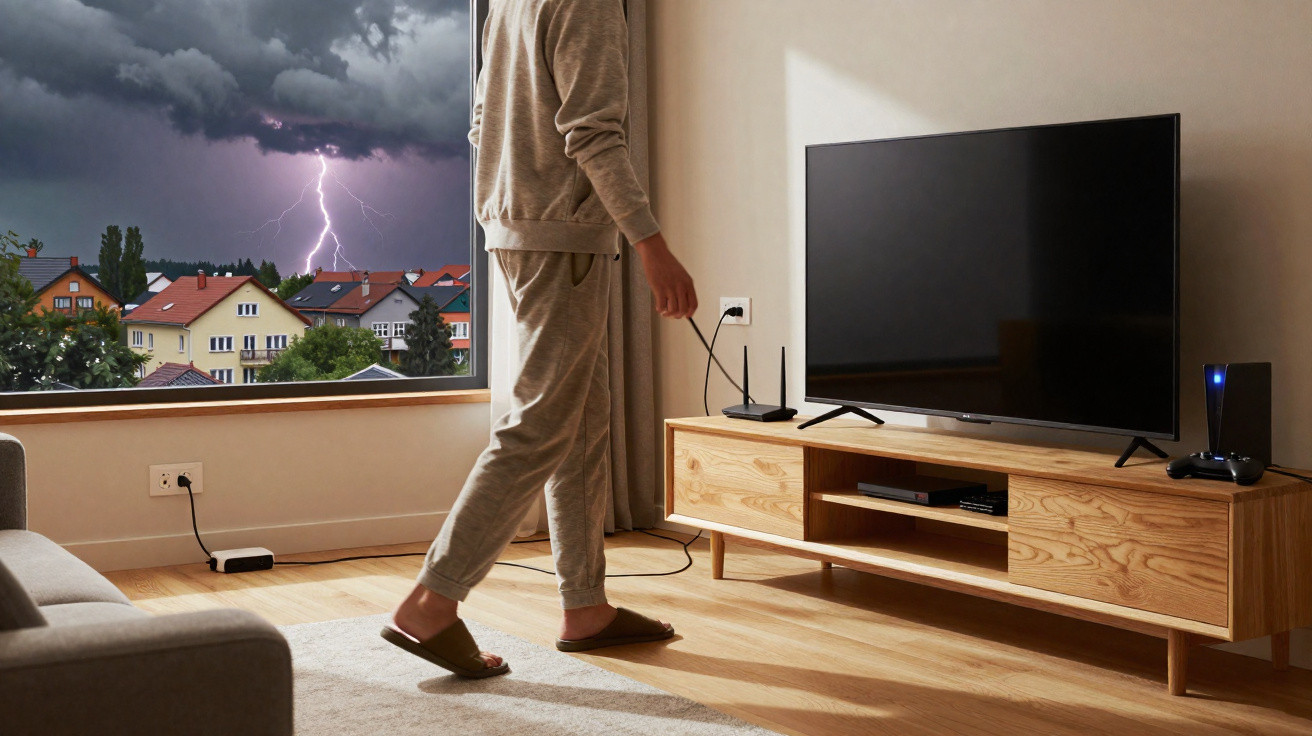
When the clouds close in and the first rumbles arrive, most of us think about windows, balconies and a leaking roof - not what might be happening to our electronics.
But summer storms can introduce a far less obvious risk inside your home: aggressive voltage surges that go after the devices you use daily, even if lightning never hits your property.
The hidden danger storms bring into your living room
A lightning storm is more than thunder and a bright flash. It can drive powerful electrical surges along the mains, telephone lines and even TV cabling. Once those surges reach a house, they slam into equipment that was never built to take that kind of hit.
Professionals typically point to three common outcomes during severe electrical weather: sudden voltage spikes, brief dips in supply, and fast, repeated micro-cutouts. Any one of these can strain the fragile components inside modern electronics.
"During a severe storm, a single high spike can kill an appliance in seconds – even if the lightning strikes streets away."
It’s easy to focus on the wrong culprits. Microwaves, lamps and small kitchen gadgets seem exposed because you can see them. In practice, the device that’s often most at risk in many homes sits quietly in the living room.
The appliance you really should unplug first
Technicians who handle storm-related failures week after week say the biggest risk is rarely the microwave or lighting circuits. It’s the television.
Today’s TVs - LED, QLED, OLED and similar flat panels - are essentially slim shells filled with sensitive circuitry. Their power supplies and control boards depend on steady, predictable voltage. A surge pushes abnormal electrical stress through tiny parts with virtually no capacity to absorb it.
When lightning hits near a neighbourhood, the local grid can receive impulses of thousands of volts. The strike doesn’t have to be on your building: a pulse moving through the network can be enough to burn the main board, ruin capacitors or destroy the internal power supply in an instant.
"One violent surge during a storm often turns a perfectly fine TV into a dead black rectangle that won’t power on again."
Repair centres frequently report that putting a surge-damaged TV right can cost around 40% to 70% of what a new set would cost. For many households, that makes repair poor value, forcing a full replacement instead.
After televisions, the next most common casualties following thunderstorms are modems, Wi‑Fi routers and TV set-top boxes. These devices combine mains power, network connections and aerial inputs in one unit, which increases the number of routes a surge can take.
Why “off” isn’t enough: what technicians actually recommend
Lots of people feel protected once they tap the remote and the screen goes dark. Unfortunately, that reassurance is misplaced. A TV left on standby remains connected to the mains and still linked to other equipment via cables.
Electricians and electronics repairers tend to give the same guidance: when a strong thunderstorm is approaching, the only dependable protection is complete disconnection.
- Unplug the TV from the wall socket.
- Remove the HDMI leads connected to consoles or set-top boxes.
- Disconnect the aerial lead or cable TV connection.
- Unplug the modem and router from both power and telephone/fibre/cable lines.
HDMI leads, aerial cables and broadband lines can all act as conduits for overvoltage. Even if the TV is “off”, a surge can arrive through a connected console or decoder and pass straight into the TV’s internal boards.
"If you can see lightning and hear close thunder, technicians say you should treat every cable into your TV or router as a potential entry point for a surge."
If you live in a city flat and rarely think about lightning, this may sound excessive. However, repair-service call-outs show the same trend repeatedly: one strong strike near a local distribution point can wipe out several households’ equipment along a single street.
Can stabilisers or UPS units save your devices?
Many homes use voltage stabilisers or basic surge-protected extension strips as a reassurance. They can help with small day-to-day variations, but intense thunderstorms can overwhelm what they were designed to handle.
Typical stabilisers use components intended for moderate swings. Surges caused by lightning can exceed those limits by a huge margin. In that scenario, the stabiliser may fail first, or it may still allow part of the spike through.
Uninterruptible power supplies (UPS) - the battery-backed units often paired with PCs - generally offer stronger protection, particularly better-quality models with proper surge circuitry. Certified surge protectors that use metal-oxide varistors provide another layer by clamping sudden peaks and effectively sacrificing themselves.
| Device | Helps against everyday fluctuations | Helps against nearby lightning |
|---|---|---|
| Basic stabiliser | Yes | Limited, often insufficient |
| Standard surge strip | Yes | Only for mild surges |
| Quality UPS with surge protection | Yes | Reduces risk, not absolute protection |
| Physical disconnection | N/A | Blocks surge paths completely |
For everyday resilience, these tools are valuable - especially where the grid is less stable. They can reduce harm from micro-outages, electrical noise and routine voltage swings that quietly shorten electronics’ lifespan over time.
But when the risk is a powerful nearby lightning strike, most specialists agree on one point: no off-the-shelf stabiliser can promise complete safety. Pulling the plug remains the only approach that truly breaks every electrical pathway.
The other devices that storms quietly destroy
Televisions draw attention because they’re expensive and prominent. Yet storm damage often appears first in less obvious equipment stacked beside them.
Modems, routers and your internet connection
Broadband routers sit where multiple lines meet: mains power, phone wiring, fibre or coax, and often Ethernet running to other rooms. Any of those connections can carry a surge.
After a major storm, telecoms providers commonly receive reports from customers who still have lights and cold food, but no internet. The router may refuse to power on, or its ports may be dead. The surge could have entered via the mains or along the communications line from the street cabinet.
In homes that depend on video meetings, remote work and smart-home systems, a failed router can disrupt far more than evening streaming.
Consoles, audio gear and hidden weak points
Games consoles and home cinema amplifiers pack high-density circuitry into compact spaces. They’re engineered for performance, not repeated punishment from violent surges.
A single spike can burn out a power module or harm storage and processing chips. Sometimes the device will still start once or twice, then die days later as stressed components finally fail.
Set-top boxes and soundbars add a further, less obvious risk. They often sit between multiple devices, linked by HDMI and optical connections. A surge that enters on one side can exit on the other, spreading damage through the entire chain.
Building a practical storm routine for your home
In areas where storms are frequent, many households adopt small habits that cut risk dramatically with minimal effort. A straightforward checklist helps once the thunder starts.
- Turn off and unplug the main TV, plus any consoles or boxes connected to it.
- Remove the aerial or satellite lead from the back of the television.
- Switch off and unplug the modem and router, including phone or fibre leads.
- Unplug desktop PCs and external drives holding irreplaceable data.
- Use quality surge protection or a UPS day-to-day for sensitive equipment.
"A minute to switch off and unplug can prevent days without internet, without television and a hefty repair bill."
A practical way to make this easier is to centralise connections: keep the TV, consoles and boxes on a single extension strip with a clear on/off switch, and ensure the aerial or cable connectors are easy to reach so they can be pulled quickly.
Why storm damage will matter more in the next decade
Homes are filling up with connected tech: smart speakers, networked security cameras, streaming sticks and smart thermostats. Each additional device brings more small circuit boards and plug-in adapters that don’t tolerate unstable voltage.
Climate data across several regions, including parts of the US and Europe, points to longer warm seasons and more frequent intense storms. Together, those trends increase the number of hours each year when strong surges can reach local grids.
Insurance may cover lightning-related damage, but claims often involve evidence, photos, reports and time. Even when you are reimbursed, it seldom compensates for lost data or the disruption of replacing essential kit at short notice.
Knowing how storms can push electricity through cables helps households act quickly and decisively. Spending a moment unplugging a handful of plugs and leads before the worst of the storm is a minor inconvenience - and it can protect hundreds or thousands of pounds’ worth of electronics many families now rely on every day.




Comments
No comments yet. Be the first to comment!
Leave a Comment