
The kitchen was undeniably lovely. Still, the woman walking me through it let out a long breath and admitted, “We never cook in here. It feels like a showroom.”
She scrolled through her phone and showed me dozens of saved kitchen photos that couldn’t have been more different from the one we were standing in: warm timber shelves, pans hung out in the open, mismatched mugs, and a padded window bench with a dog asleep in a tight curl.
Quietly, one household after another is pushing back against the spotless, empty, minimalist kitchen. People are craving rooms that feel lived-in rather than merely “Instagram-ready”. Comfort is coming first, and the change is moving faster than most trend forecasters expected.
Why Minimalist Kitchens Suddenly Feel Wrong
Step into a textbook minimalist kitchen and you can almost hear the sound bounce. No fridge magnets, no herbs by the hob, no pile of post beside the toaster-just crisp lines, concealed storage, and a faint sense you ought to polish away fingerprints before you even exhale.
These kitchens used to read as aspirational, like stepping into the pages of a design magazine. Lately, though, they can come across as chilly and a bit severe-like a hotel lobby where cooking is permitted, as long as you follow the rules. More and more homeowners are asking the same blunt question: where did the soul go?
In 2023, several large home retailers noted increasing sales of open shelving, coloured appliances and patterned splashbacks, while orders for glossy white cabinetry levelled off. Designers also describe a familiar pattern: clients arrive clutching minimalist Pinterest boards and leave with plans that are darker, softer and more inviting.
A London kitchen designer told me that around half her recent commissions revolve around “de-minimalising” fairly new renovations. In practice, that means letting everyday items live on the worktops again, bringing in texture, and even putting handles back on cupboards after the previous style wave removed them. The so-called dream minimalist kitchen often lasts barely five years before people start warming it up.
This isn’t only boredom with a look; it reflects how we live now. More of us work from home, eat at home, and use the kitchen as a social hub rather than a sterile prep station. When you’re in the room all day, ultra-minimalism starts to show where it doesn’t quite work.
Concealed storage is brilliant-until you’re forever opening and closing doors for basics you reach for constantly. Seamless white surfaces look sharp-until one scratch is the only thing you can see. And keeping a space in a permanent state of “no clutter, ever” is practically a full-time job. Let’s be honest: nobody truly does that every single day.
The Comfort-First Kitchen: How It Really Looks
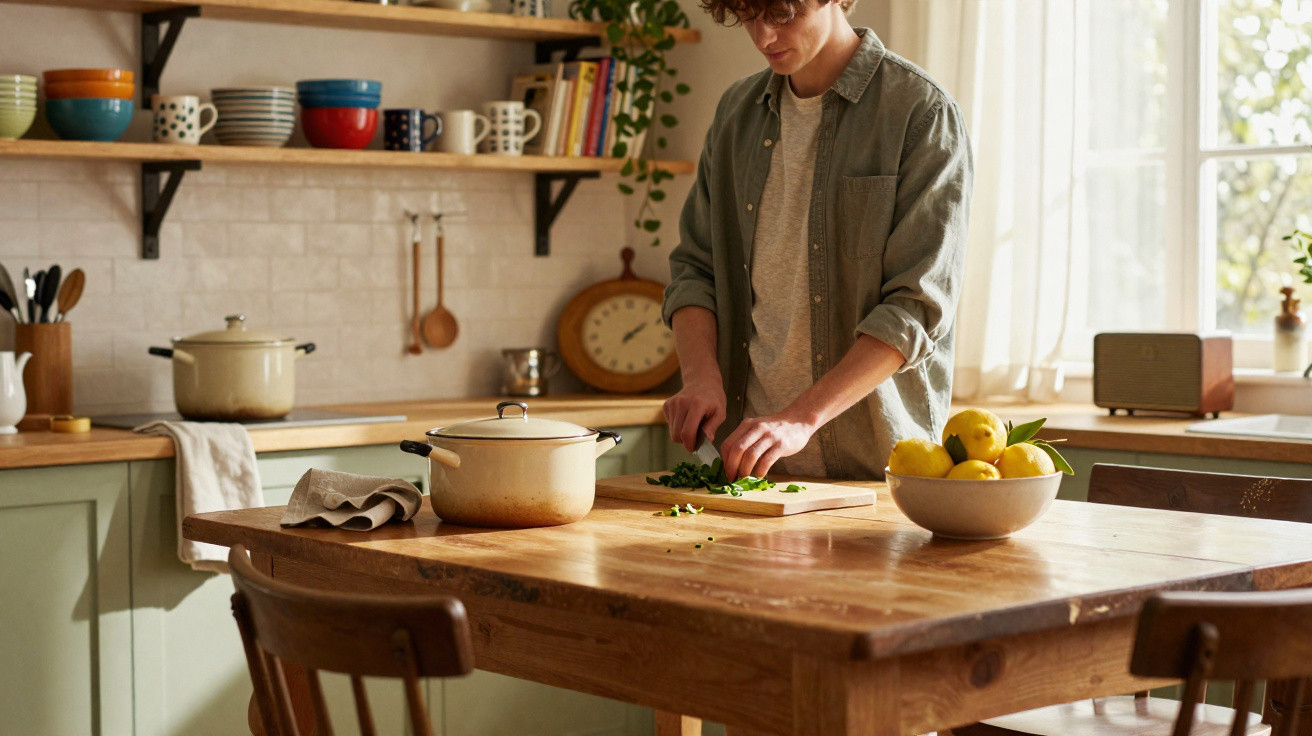
A comfort-first kitchen doesn’t photograph like a showroom. It looks as if someone could wander in at any moment with a mug of tea and a half-sliced lemon. You might spot cookbooks stacked sideways on open shelves, a small lamp on the worktop, and a basket of onions that never quite makes it back into a cupboard.
The palette tends to be gentler, richer, or simply less controlled: warm creams instead of bright whites; greens that feel herbal; timber that shows its grain. Lighting is rarely a single harsh ceiling point; it’s more often small pools of glow over the sink, the table, and the coffee corner. It feels more like a living room that happens to have an oven in it.
Consider Emma and Lucas, a couple in their thirties who traded their glossy grey kitchen for something deliberately less “perfect”. They swapped handleless units for Shaker-style doors, introduced a freestanding dresser they bought second-hand, and stopped hiding their coffee machine and jars away.
Friends keep telling them the room feels “warmer” and “more them”, even though on paper it’s less streamlined. They also say they cook more, for a straightforward reason: the things they use most are visible, within reach, and inviting. They don’t have to mentally switch the kitchen “on” every time they want to make food.
Surveys from US and European kitchen brands point to growing demand for what they describe as “soft functionality”: performance still matters, but cosiness and a bit of imperfection are welcome. That can look like mixed metals, a pan rack above the island, or even keeping the slightly battered wooden stool you’ve owned forever.
Putting comfort first doesn’t mean letting the room become messy or chaotic. It simply stops pretending real life never happens. A fruit bowl on the table isn’t a design offence. The fridge can display children’s drawings and the electrician’s number. The kitchen gets to tell the story of the people who live there.
Shifting Your Kitchen From Minimalist to Comfortable
The quickest route from minimalist to comfort-first usually isn’t knocking walls down-it’s adding layers. Begin with one area you genuinely use: the coffee corner, the chopping space near the window, or the breakfast bar.
Next, bring a few daily essentials out of hiding. Leave a wooden chopping board on the worktop. Keep a jar of wooden spoons by the hob. Add a small table lamp or a candle near the splashback. These are low-risk changes that soften the room immediately and alter how it feels to be in.
Textiles can do a surprising amount of work. Try a washable runner, seat pads, or even a linen curtain over lower storage instead of another flat-front door. Swap a shiny chrome bar stool for one with a padded seat. Think in layers-light, fabric, texture-plus a handful of personal objects that genuinely earn their spot.
Many people feel trapped between a “museum” kitchen and total chaos. They worry that if one thing is allowed to stay on the counter, the whole space will unravel. On an exhausting day, that fear wins, and the room stays frozen and underused simply to avoid the possibility of clutter.
A gentle guideline helps: visible, but intentional. If something stays out, it must either be used daily or bring you real joy. That’s all. A favourite ceramic bowl qualifies; five duplicate spatulas shoved into a plastic pot do not.
When you’re moving towards comfort-first, the biggest misstep is copying someone else’s cosy look without considering your own routines. If you never bake, you don’t need flour jars lined up on the counter. If you always eat at the island, spend money on truly comfortable stools rather than a formal dining table you resent dusting.
“The most comfortable kitchens aren’t the ones with the best finishes,” says interior architect Sofia Raman. “They’re the ones where you can walk in, kick off your shoes, and know exactly where the kettle is without thinking.”
- Start tiny: change one corner, not the entire room.
- Add one warm light source and one soft textile.
- Keep daily tools visible; store what you use once a month.
- Mix old and new: a vintage chair, a modern tap.
- Leave one “imperfect” object out, on purpose.
A Kitchen That Likes You Back
There’s a quiet sense of relief in admitting that a spotless, empty kitchen doesn’t automatically equal a better life. A comfort-first kitchen lets you leave the stand mixer out, chop on the board that never makes it back to its drawer, and enjoy colour even when the trend report insists on “taupe”.
On a winter evening, with something simmering and a lamp glowing in the corner, nobody cares whether your cupboard fronts are the latest flat-panel style. They care that there’s somewhere soft to sit, a mug close by, and a feeling that lingering is welcome.
Most of us have had the moment of walking into someone’s kitchen and thinking, “I could stay here for hours.” That reaction rarely comes from a space that looks untouched. It comes from small signs of life: the chipped mug that’s still cherished, the radio turned down low, the dog bowl tucked under the radiator.
Minimalist kitchens promised liberation from clutter. Comfort-first kitchens offer something more meaningful: a place where your real routines-mess and all-are allowed to exist. Where beauty comes from belonging, not from pretending.
As more homeowners choose warmth, softness and personal detail, the glossy white box is starting to feel like a brief phase rather than the whole story. The next kitchen you save might have less symmetry and more soul. And once you’ve experienced the ease of a room that seems to like you back, it becomes much harder to imagine going “back to minimal”.
| Key point | Detail | Why it matters to you |
|---|---|---|
| From showroom to lived-in | Minimalist kitchens are giving way to warmer, more personal spaces | Helps explain why your “perfect” kitchen can feel oddly cold |
| Layer, don’t demolish | Small changes (lighting, textiles, visible tools) can shift the mood | Offers realistic ideas without needing a full renovation budget |
| Design for your real habits | Comfort-first means reflecting how you cook, gather and relax | Guides you towards a kitchen you genuinely enjoy using every day |
FAQ:
- What exactly is a comfort-first kitchen?
A comfort-first kitchen is planned around how you actually live, not just how it looks in photos. It prioritises warmth, easy access and personal details over strict minimalism or overly trend-led finishes.- Do I need to rip out my minimalist kitchen to change the vibe?
No. You can soften a minimalist base with open shelves, warm lighting, visible everyday tools, textiles, and a few character pieces such as a vintage chair or a freestanding cabinet.- How do I stop a cosy kitchen feeling cluttered?
Use one simple filter: if it’s out, it must be used daily or genuinely loved. Group items on trays or boards, keep some clear surfaces, and reassess your worktops every few weeks.- Are white kitchens “over” now?
White hasn’t disappeared; it’s just being used differently. Many homeowners keep white as a backdrop, then add timber, colour and texture so the room feels less clinical and more relaxed.- What’s the first change I should make if my kitchen feels too cold?
Start with light and texture: add a warm-toned lamp or pendant, a soft runner or cushions, and bring one or two beautiful everyday objects out of the cupboards so you can see and use them.
Comments
No comments yet. Be the first to comment!
Leave a Comment