
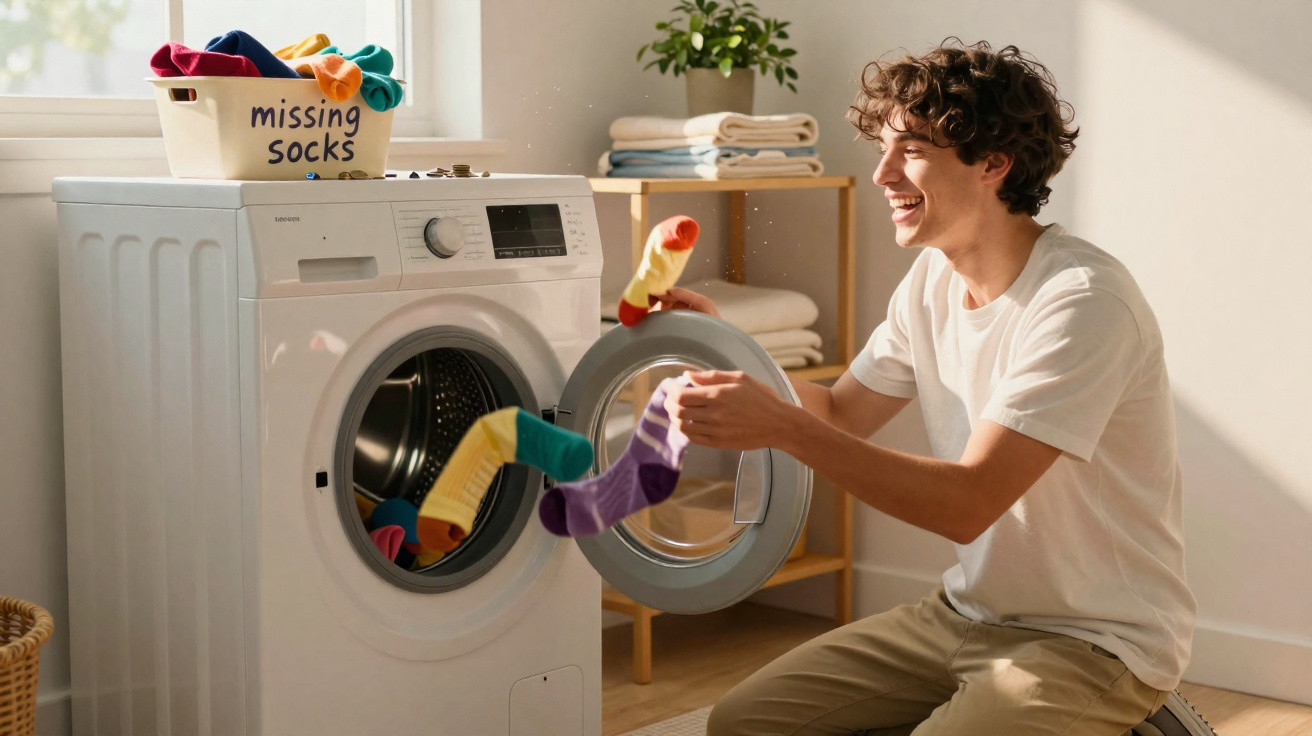
The washing machine door snaps closed, the drum starts to rotate, and for a moment it feels like everything is neatly under control.
Colours spin into a soft blur, suds creep across the glass, and somewhere inside, a dozen pairs of socks are tumbling together. About 40 minutes later, the door unlocks with a gentle hiss of steam. You haul out the washing in a damp heap… and there it is again: one solitary sock looking up at you, with its partner nowhere to be seen.
You check the drum, lift the rubber seal, and shake out the bedsheet like you’re working a crime scene. Still nothing. The missing sock is gone, as though the machine has swallowed it whole.
The oddest part? Washing machines aren’t meant to be able to do that.
Where your socks really go during the wash
If you bring up missing socks with a washing machine engineer, they don’t usually chuckle. They’ve opened up enough appliances to know the “sock-eating washer” isn’t only a household joke. In plenty of homes, small items such as socks and underwear really do slip into places they were never designed to reach. The drum, after all, isn’t perfectly sealed to the casing: there’s a gap, a rubber door seal, a drainage route, and a filter-effectively an obstacle course for tiny, determined bits of fabric.
During a fast spin, what’s happening is almost impossible to catch with the naked eye. The drum picks up speed, socks are pressed hard against the perforated metal, and some end up skimming the edge where the metal meets the rubber. A small percentage find a minuscule opening and begin to wander.
To us, they simply “disappear”.
Speak to any domestic appliance repairperson and you’ll hear the same slightly exhausted exhale. One engineer in London told me about a call-out where a machine blocked on every rinse cycle. The family insisted they were careful and that nothing unusual had gone in. When he opened the machine, he uncovered a whole clump of children’s socks jammed behind the drum-partly shredded and tangled up with coins and hairpins.
Back in 2016, a British study into laundry habits went viral after suggesting the average person loses around 15 socks each year. Over a lifetime, that adds up to more than 1,200 missing socks. Not all of them end up inside the washer, obviously. Some get swallowed by the sofa, some migrate under beds, and some hide in gym bags for months. Even so, engineers routinely pull out socks, baby clothes and bra wires from the hidden sections of machines-sometimes clogging the pump so badly that the motor burns out.
We like to believe we’re in charge of our appliances. What turns up inside those machines suggests otherwise.
Once you remove the mystery, the disappearing sock has a few different explanations. Mechanically, front-loading machines use a flexible door seal that joins the spinning drum to the outer tub. With high speeds, heavy loads and tangled fabrics, lightweight items can be pushed over the lip and into that gap. From there, they may slide into the drainage path, get drawn towards the pump, or remain trapped between the drum and tub until they gradually wear away.
Human habits play their part too-our memory is less tidy than we like to think. We almost never count socks as we drop them into the laundry hamper. We combine loads from different rooms. We shift clothes from hamper to basket, from basket to machine, from machine to dryer, from dryer to bed. At any one of those handovers, a sock can quietly fall out. We only spot the mishap at the very end, when the pair is broken.
Between the mechanics and the memory sits a kind of household myth-making: it’s easier to blame a “hungry” washing machine than to admit to the slow, everyday chaos of normal life.
How to outsmart the “sock-eating” machine
The most effective way to lose fewer socks is, frankly, unglamorous: build a simple, boring routine. Start before the wash rather than after it. Keep a small basket or fabric bag purely for dirty socks, placed exactly where you usually take them off. When it’s time to do laundry, clip each pair together with a dedicated sock clip or put them into a mesh laundry bag that fastens securely. The secret isn’t fancy kit-it’s repetition. Same place, same action, every time.
At the machine, avoid the urge to overload it. A drum crammed with jeans, bedding and tiny socks makes it much easier for small items to be forced into gaps. Leave enough room for fabrics to move properly. Do up zips and hooks on other garments too, so they don’t snag socks into strange knots.
It’s not exciting work, and it isn’t heroic. But it’s exactly what keeps your socks alive.
Of course, real life rarely looks like a perfectly organised TikTok laundry hack. You get home late, kick your socks off near the sofa, and tell yourself you’ll grab them later. Children scatter theirs around bedrooms like breadcrumbs. The laundry basket overflows, and someone shoves the whole pile into the machine just to make it vanish. Let’s be honest: nobody really does this every day.
The aim isn’t perfection-it’s cutting down the number of places a sock can disappear. That might mean keeping a “rescue box” in the utility room where single socks wait for their match. Or picking one day a month to pair everything up and let go of the true orphans. It could also mean buying more identical socks, so losing one stings a little less.
You’re not failing at adulthood because your socks don’t emerge in perfect pairs. You’re just living in a normal house.
One repair technician I spoke to put it with a shrug and a smile:
“People always think the machine is haunted. It’s not haunted, it’s just badly packed.”
Behind that blunt line are a few practical rules that genuinely help. If you own a front-loader, gently pull back the rubber door seal every few weeks and wipe away the grime. You’ll often discover the early signs of a sock graveyard there. Now and then, unscrew the filter cover (usually at the bottom front of the machine) and clear out any small items before they trigger a larger problem.
To keep it straight, here’s a quick mental checklist for every wash:
- Empty pockets of coins, tissues and hairpins that can trap socks
- Use a mesh bag for baby socks, sports socks or delicates
- Leave space in the drum; don’t cram everything in
- Run your fingers around the door seal after each cycle
- Keep one obvious place for lonely, single socks
The strange comfort of missing socks
There’s a quiet, shared humour in the missing sock problem. It’s small enough to laugh at, yet common enough to sting when you’re running late and every pair you grab is mismatched. On a bad day, that lone sock at the bottom of the basket can feel like evidence that you’re not keeping up. On a good day, it’s simply another domestic puzzle that makes you smirk.
At a deeper level, lost socks point to something we don’t often say out loud: our homes aren’t perfectly controlled systems. They’re lived-in spaces-full of movement, noise and half-finished routines. The washing machine is only one stage in a longer trip that starts when you drop your socks on the floor and ends when you pull on a clean pair. Every step along that route is another chance for distraction, error, and real life getting in the way.
That may be why “sock-eating” washing machines are such an easy story to pass around. They put a face on the low-level chaos we all negotiate daily. They turn a mechanical gap and a memory slip into a tiny legend we can share with children, partners and friends. Next time a sock goes missing, you might curse the washer, blame the cat, or just laugh and toss its lonely twin into the “maybe one day” pile.
Somewhere-inside a repair workshop, or in the back of your machine-there’s probably a small collection of lost socks that will never make it home. Yet the way we talk about them, swap tips, and send photos of wildly mismatched pairs in group chats says something unexpectedly tender about how we live together, and how we cope with the bits we can’t quite control.
| Key point | Detail | Why it matters to you |
|---|---|---|
| Where socks go | Caught in the seal, behind the drum, or lost along the way | Shows that “disappearing” has very practical causes |
| The role of habits | Simple routines before and after washing | Dramatically reduces the number of orphan socks |
| Key maintenance step | Regularly clean the machine’s seal and filter | Helps prevent costly faults and repeated blockages |
FAQ:
- Do washing machines really “eat” socks? They don’t chew them deliberately, but small socks can slip past the drum seal and end up stuck near the pump or in the outer tub, where they slowly break down.
- Why do I always lose just one sock, not both? Pairs rarely follow the exact same route through your home; one can fall behind furniture or sit in a gym bag while the other makes it into the wash.
- Can a lost sock damage my washing machine? Yes. If it reaches the pump or drain, it can block the system and overload the motor, leading to expensive repairs.
- What’s the easiest way to stop losing socks? Use a mesh laundry bag or clips for pairs, avoid overloading the drum, and keep a single, visible spot for unmatched socks.
- Is it safer to wash socks by hand? Handwashing avoids mechanical gaps but is less practical; for most people, using a mesh bag in the machine is a better long-term compromise.





Comments
No comments yet. Be the first to comment!
Leave a Comment