
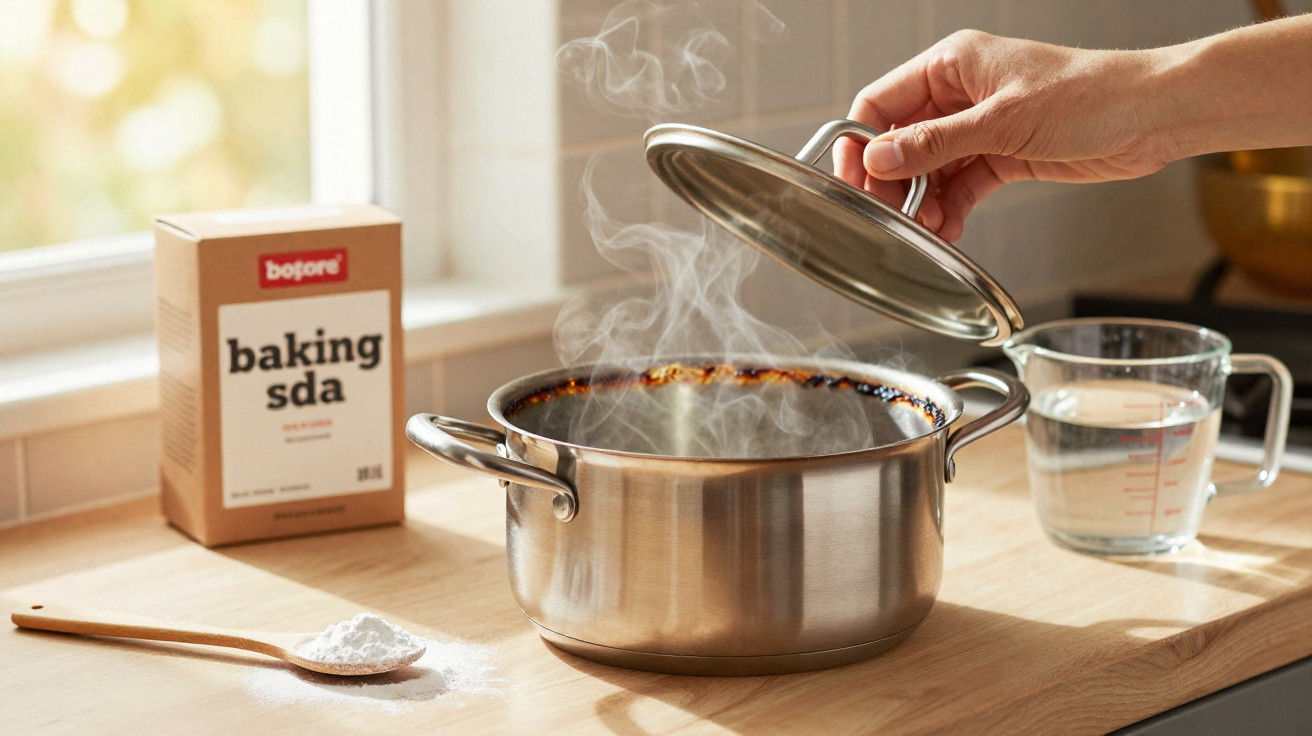
A frying pan can switch from star to disaster in no time: your phone vibrates, the sauce goes too far, and suddenly your meal has fused itself to the base like a sheet of blackened glass. What follows is predictable-soak, scrape, and a muttered promise to replace it soon. But the answer may already be in your baking cupboard.
I was standing there with a spoon in mid-air, already imagining the long soak and tomorrow’s wrist-aching penance with a scourer. Then I spotted that neglected box of bicarbonate of soda tucked behind the olive oil-the one that, in many homes, serves more as a deodoriser than a baking staple.
I dropped a couple of spoonfuls into water, set it on the hob, brought it up to a simmer and waited. Fine bubbles gathered, the edges of the burnt crust began to give way, and the pan looked as if it had finally let out a long breath after a hard day. The whole kitchen felt a touch more forgiving. Then the fizzing started.
The humble powder hiding in plain sight
Most kitchens already contain an unassuming little workhorse: bicarbonate of soda, also known as baking soda. When you add water and heat, it helps revive burnt pans with minimal effort-no aggressive scrubbing and no fuss. Baking soda plus hot water can undo hours of burnt-on misery in minutes.
Everyone knows that sinking feeling when a pan crosses the line and the carbonised layer seems there for good. A reader once sent me a picture of a stainless-steel pan after caramel misbehaved; after twenty minutes of gentle boiling with a tablespoon of bicarbonate, the glossy, tar-like ring released in soft, curling flakes. You could almost make out the delicate tap of loosened pieces knocking against the sides, like ice chiming in a drink.
The science is pleasingly simple. In hot water, bicarbonate of soda creates a mildly alkaline solution that helps weaken the stubborn bonds in burnt oils and sugars, steering them back towards a state where they’re willing to lift away. As the liquid warms, tiny gas bubbles form and slip beneath the grime, loosening its hold from underneath. With heat speeding everything up, the chemistry becomes a calm, watch-it-happen kind of rescue.
How to do it: the no‑scrub simmer
Pour in enough water to cover the burnt patch by about a centimetre. Add 1–2 tablespoons of bicarbonate of soda per litre, then bring it to a brisk simmer for 10–15 minutes. Turn the heat off, allow it to cool slightly, tip away the cloudy water, and wipe out the loosened bits with a soft cloth. No hard work-just an easy swish.
If there’s a stubborn ring left behind, run the simmer again or apply a thick paste of baking soda, leave it for ten minutes, then rinse away. Don’t reach for acids at this stage; vinegar may look impressive, but it neutralises the alkalinity that’s actually doing the heavy lifting. No steel wool. No aching wrists. And yes, it’s doable after dinner while the washing-up dries-although, realistically, not many of us manage that every day.
This approach is kind to stainless steel, enamel and durable ceramics, provided you use a little common sense. Teflon-style non-stick coatings don’t love high heat, so keep the simmer gentle and avoid any paste that tempts you to press and scrub. For seasoned cast iron, start with a plain water simmer to avoid stripping the seasoning; afterwards, dry thoroughly and oil.
“I thought the pan was done for,” wrote Hannah from Leeds. “It looked like charred treacle. Ten minutes of bubbling water and bicarb, and it slid off like a sticker.”
- Do not combine with bleach-different purposes, risky combination.
- Avoid lengthy soaking on bare aluminium; move quickly and rinse thoroughly.
- Rinse and dry straight away to prevent a faint white film.
- If your pan has a copper exterior, try a small test patch first.
- Keep vinegar for a separate rinse if limescale marks won’t shift.
Keep it away from bleach.
What’s really happening-and why it feels so good
The transformation is understated but deeply satisfying: a milky swirl in the water, a waft of warm, clean smell, and that reassuring clink as burnt fragments detach and drift. It’s like watching a knot ease apart on its own. In a life that often demands constant effort, a solution that works while you simply lean on the counter feels like found time.
On paper, bicarbonate looks plain-just a safe, food-grade alkaline powder. In real kitchens, it’s perfectly suited to the messes we make: scorched sugar, oily browning, the remnants of last night’s overconfidence. There are plenty of glossy branded cleaners that do a good job, but the everyday box is cheap, accessible and effective. The method is simply three parts: water, heat and patience.
It’s also a welcome way to avoid harsh tools that slowly wear cookware down. Over months, abrasive pads can micro-scratch steel and enamel, and those tiny marks add up. The simmer method protects the finish, helping pans heat more evenly and last longer. Your next risotto will benefit in a quiet, practical way.
And once you’ve tried it, the mood in your kitchen shifts a bit. You’re less wary of caramel, roasted tomatoes or sticky glazes, because the worst-case scenario isn’t the bin-it’s a pan of water and a spoonful of powder. That sense of permission changes how you cook and how you move around the kitchen, nudging you towards bolder choices and, often, better-tasting dinners.
| Key point | Detail | Why it matters to the reader |
|---|---|---|
| Alkaline simmer | Bicarbonate in hot water loosens burnt oils and sugars | No scrubbing, preserves pan surfaces |
| Gentle on cookware | Safe for stainless, enamel, ceramic; take care with non‑stick and cast iron | Extends lifespan of favourite pans |
| Simple routine | 1–2 tbsp per litre, 10–15 minutes at a simmer | Easy habit, fast path from disaster to dinner |
FAQ:
- Can I do this on non‑stick pans? Yes-use a gentle simmer rather than a hard boil, and avoid any abrasive wiping. Keep it brief, then rinse and dry. Repeated high-heat treatments can shorten the life of the coating.
- What about cast iron with seasoning? Start with plain water. If it still needs help, add a small amount of bicarbonate for a short simmer, then rinse, dry completely and re‑oil to restore the seasoning. Don’t leave it soaking for hours.
- Should I add vinegar for more fizz? Skip the theatrics. Acid cancels the alkalinity that helps break down burnt-on grease. If you want to deal with mineral water marks, use vinegar later as a separate step.
- How much powder is too much? One tablespoon per litre is enough; use two for heavy scorching. Adding more won’t make it faster and may leave a residue that takes extra rinsing to remove.
- Will this work on copper or aluminium? It can, but take care. With bare aluminium, keep the simmer short and rinse promptly. With copper, test an inconspicuous area first-finishes vary and can discolour if left too long.



Comments
No comments yet. Be the first to comment!
Leave a Comment