
Drying clothes indoors on cold, rainy days is a common headache in many households. High humidity, limited ventilation and tight living spaces can encourage musty smells and make laundry take much longer to dry. That is why simple, practical ways of arranging a clothes airer have been getting more attention, particularly in places with damp winters and compact homes.
What is the Japanese “hanging rainbow” technique for drying clothes?
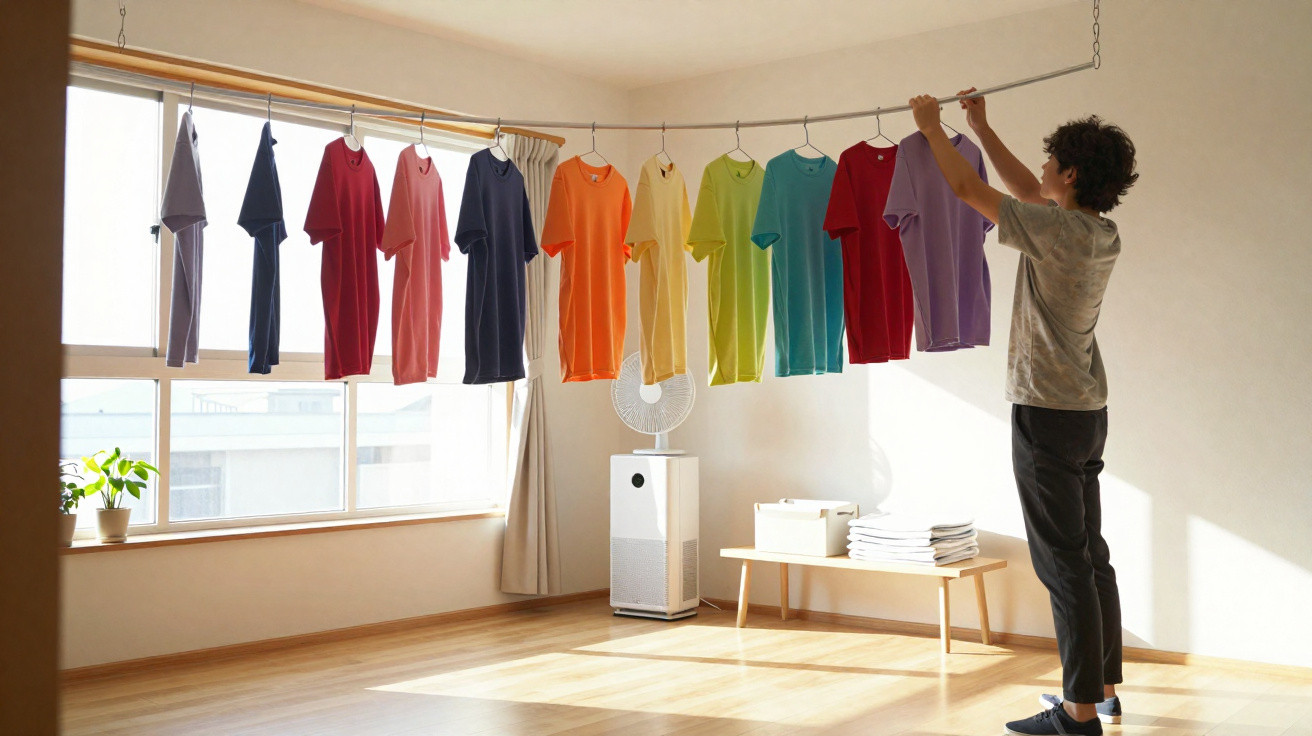
Among the most talked-about approaches, one method developed and popularised in Japan stands out for being straightforward and not requiring any expensive kit. The system, known as the “hanging rainbow”, changes the usual way people spread laundry across an indoor airer, putting airflow first.
With this method, the longest items go on the outer edges, while shorter pieces sit in the middle. In terms of shape, it resembles an upside-down “U”, creating an open channel that helps air move through and moisture escape more quickly, even in small rooms.
How does the Japanese technique improve indoor drying efficiency?
The improvement comes mainly from better airflow between garments. On a standard airer where everything hangs at the same height, the fabric forms an almost continuous wall that traps dampness. With the arched arrangement, gaps appear at different levels, making it easier for air to travel both across and up through the laundry.
Where you position the airer also makes a noticeable difference. Specialists suggest placing it where air can be exchanged more easily-near windows, doors or natural draught routes such as hallways-and pairing the method with hangers so clothes are held flatter, with fewer layers folded over each other.
How to apply the Japanese drying method step by step
To use this way of arranging laundry at home, you simply need to adjust where you put the airer and how you hang each item. It helps to consider the room, the length of each piece and the spacing between them, always leaving enough clear area for air to circulate around the fabric.
Following a few easy steps makes it simple to set up the “hanging rainbow” in practice:
- Choose the right room: prioritise a space with a window or a door left slightly open, and avoid bathrooms with poor ventilation.
- Arrange clothes by length: place trousers, dresses and towels at the ends, with shorter items in the centre.
- Leave gaps between items: keep a few finger-widths of space side to side and, with towels, let one end hang slightly lower to open a path for air.
- Use hangers strategically: hang shirts, tops and hoodies on hangers, avoiding stacking too many items on top of one another on damp days.
- Manage drying time: take clothes out of the washing machine as soon as the cycle finishes and, if needed, turn items inside out during drying.
How to prevent a musty smell when drying clothes indoors
Stopping that damp odour depends both on how you hang your washing and on how you manage the room. Leaving laundry sitting in the washing machine allows it to pick up smells from the closed drum, so it is best to move items straight to the airer as soon as the cycle ends.
It is also wise not to run too many loads that dry in the same room at once, because a large amount of wet fabric increases the level of water vapour in the air. On very rainy days, it can help to boost airflow with a fan aimed at the airer or to use dehumidifiers, reducing the risk of mould on clothes and walls and helping fabrics last better through the winter.




Comments
No comments yet. Be the first to comment!
Leave a Comment