
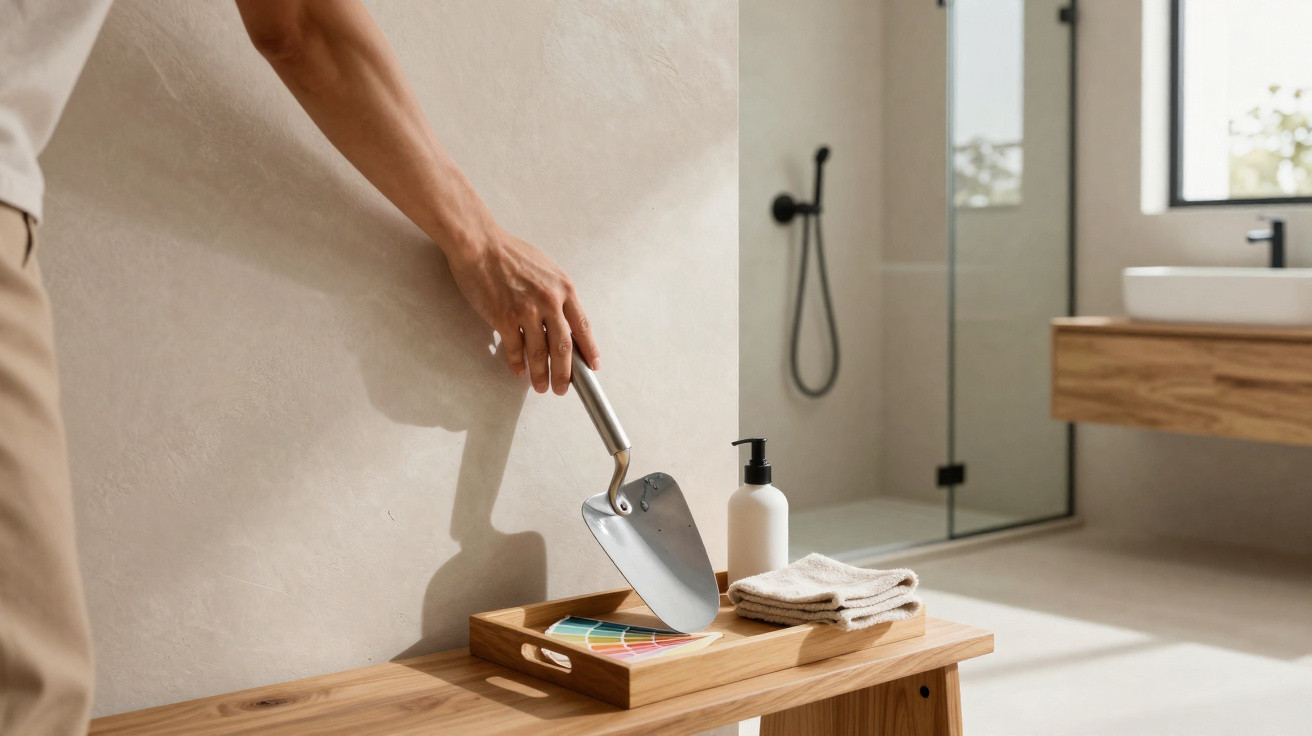
Microcement has been appearing more and more in bathrooms, kitchens and utility rooms because it creates a seamless surface, without grout lines that tend to collect moisture, mildew and dark staining. As it can be laid over certain existing floors and wall tiles, it can also cut down on demolition, rubble and loss of space during refurbishment.
Why is microcement replacing tiles and mosaic tiles?
Tiles and mosaic tiles rely on joints to space the pieces out, and those narrow gaps often trap soap residue, grease and moisture. Microcement instead covers the area with very few visible joins, producing a consistent finish across walls, floors, worktops and shower zones.
The material is a thin cement-based system combined with resins, pigments and protective top coats. The cement acts as the binder that gains strength as it reacts with water, but the final performance depends on the complete system used-not on the cement alone.
- Cuts down the number of visible joints;
- Can be applied to floors, walls and worktops;
- Delivers a continuous finish in a range of shades;
- Makes cleaning easier in splash-prone areas;
- Avoids fiddly cutting of small pieces around niches and corners.
How does a continuous surface make cleaning easier?
Without a grid of grout spread across the room, cleaning can usually be done with a soft cloth, water and a neutral cleaner suitable for the chosen finish. This reduces the frequent need to scrub each joint, although corners, drains and junctions with sanitaryware still need attention to prevent moisture build-up.
Can the coating be applied over old tiles?
In many projects, microcement can be installed directly over ceramic or porcelain, as long as the tiles are firmly bonded, level, clean and free from leaks. The joints are levelled out, and the substrate is treated with bonding and reinforcement products before the finishing layers are applied.
Doing it this way avoids stripping out the entire old covering and lowers the amount of waste that has to be taken off site. Because the layers are thin, there is typically very little change to floor height or room dimensions, though doors, drains and any level changes should be checked before work starts.
- Check for any loose tiles or hollow-sounding areas;
- Fix cracks and leaks before application;
- Remove grease, dust and residues from the surface;
- Level out the lines of the old covering;
- Confirm clearances at doors, skirting boards and drains;
- Follow the drying time required between coats.
Why is specialist workmanship essential?
Water resistance depends on correct substrate preparation, the right waterproofing for the location and proper application of sealers. Inconsistent thickness, cracking or unprotected spots can let moisture through. For that reason, wet areas call for a trained professional and a system that is suitable for showers, floors and walls exposed to water, as is the case in projects that adopt new solutions for the shower area.
Does microcement really save money on a refurbishment?
Savings tend to be greatest when the existing finish can be kept. Less demolition can mean fewer skips, lower waste transport costs, reduced need for bedding materials for re-laying, and fewer days spent breaking out floors and walls. Even so, the budget still needs to allow for preparation, waterproofing, finishing and specialist labour.
A continuous finish does not make tiles and mosaic tiles unsuitable for every project, but it is an alternative for anyone who wants less grout and a refurbishment with minimal disruption to what is already there. When the base is sound and sealing is carried out correctly, microcement offers a thin build-up, simpler cleaning and an even finish in moisture-prone areas.



Comments
No comments yet. Be the first to comment!
Leave a Comment