
You can wash them, fold them and pull them tight across the mattress… yet they still end up looking a bit tired. The reason whites fade is straightforward, and the habit that keeps them crisp and luminous for years is even simpler.
It began, improbably, on a wet Tuesday - the kind of day when the washer rumbles away and you end up boiling the kettle twice. I lifted a bundle of linen from the drum and noticed that familiar flat tone you can’t quite label: not beige, not grey, just… not-white. I pictured hotel beds that seem to glow under dull ceiling lights and thought, what are they doing that we aren’t? Then I heard a housekeeper’s voice in my head, laughing: “It’s not magic, love. It’s chemistry.” I tried it once, and the change was like putting clean sheets over your eyes. The trick, it turns out, sits quietly in a plain tub under the sink - a small secret hiding in full view.
Why sheets go grey - and the unglamorous fix
Most white sheets don’t “get stained” so much as they slowly collect a film. Tiny amounts of body oil, microscopic skin cells, traces of skincare, minerals from hard water and a little detergent left behind. Each wash leaves a faint layer, and over time those layers stack up. Hotel bedding stays brighter because they remove that build-up before it sets into the fibres. The surprise is that you don’t need commercial equipment - you need the right pre-wash and the right chemistry. Once you spot it, you can’t ignore it: that grey cast isn’t dirt, it’s residue.
In Leeds, I met a couple who relied on colour-safe oxygen bleach and nothing fussy. Their approach was steady and simple: a cold soak on Friday evening, a hot wash on Saturday morning, and line-drying if the weather allowed. Their sheets didn’t look brand new; they looked clean in a way that felt new. Current public health guidance leans towards using a 60°C cycle for bedding from time to time, rather than on every wash. Combine that occasional heat with a thorough oxygen soak and the dull shadows lift from the cotton as cleanly as steam clears a mirror.
What’s going on is plain chemistry. Oxygen bleach - the powder sold as sodium percarbonate - dissolves and releases oxygen into the water. That oxygen breaks down the organic compounds that yellow and flatten the look of cotton. Washing soda shifts the pH upward, helping oils turn into a form that rinses away more easily. Meanwhile, the enzymes in a decent detergent digest proteins and starches that oxygen alone won’t fully tackle. As for chlorine bleach, it’s best left for other jobs when it comes to cotton sheets: it can weaken fibres, react with iron in hard water and push whites towards a brittle, lemony shade. Slow and gentle beats harsh and fast.
The secret in practice: a soak that rewrites the wash
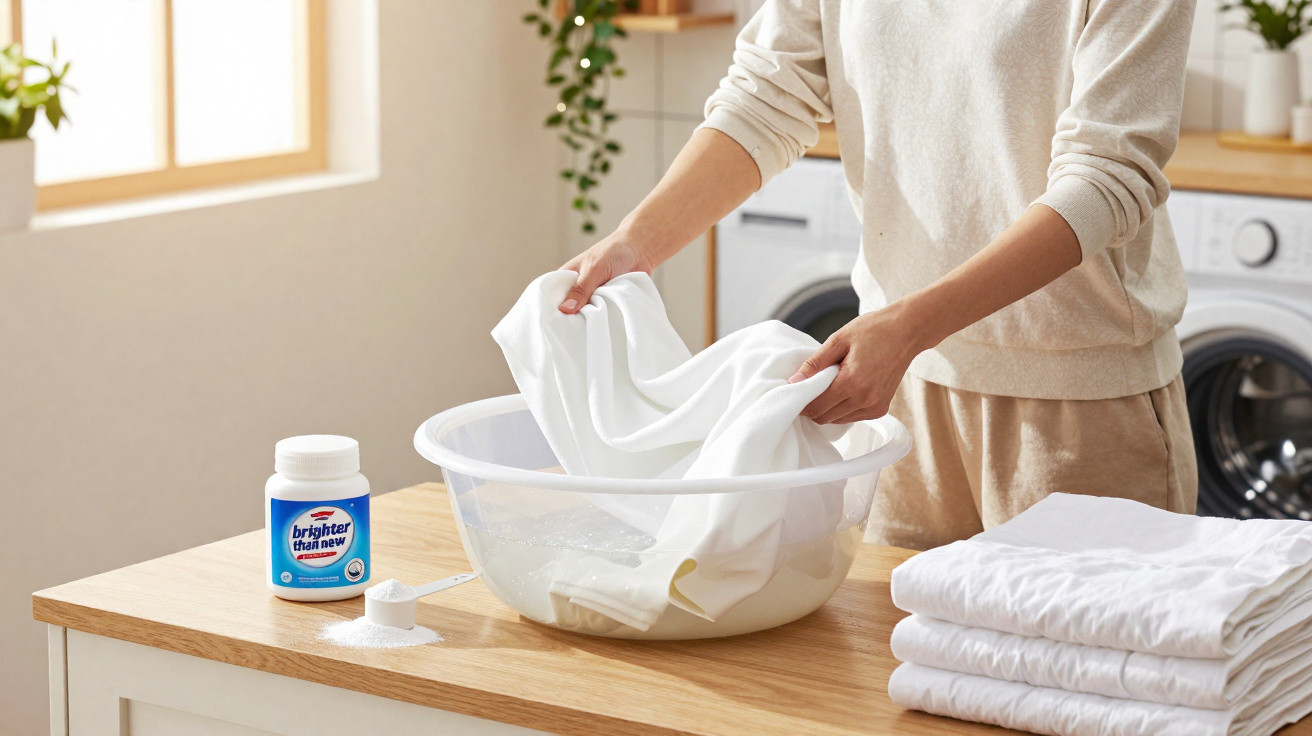
The habit that keeps sheets white for years is this: a gentle oxygen-bleach soak before the main wash. Take a clean tub or bucket and fill it with cold or cool water. Mix in 1–2 tablespoons of sodium percarbonate per 4 litres (roughly a sinkful), plus 1 tablespoon of washing soda if your water is hard. Stir until it dissolves. Push the sheets under the surface so they’re fully submerged, then leave them for 4–8 hours - or overnight when life gets in the way. After that, wash at 40–60°C with an enzyme detergent on a long cotton programme. If your water is very hard, include a water softener. Dry outside in sunlight when you can - UV is free brightening.
The mistakes that undo good washing often look harmless. Packing the drum too full so the sheets can’t move, then wondering why they come out creased and slightly dull. Adding more detergent than needed, which can cling to fibres and gradually grey them. Using fabric softener on cotton sheets, leaving a waxy coating that traps odour and contributes to that greyed-down look. We’ve all been there: the laundry basket is overflowing and the “quick wash” button feels irresistible. Let’s be honest: nobody keeps a hotel-grade routine every single week. Go for reliable habits rather than perfection, and plan one deeper treatment each month.
“Think of oxygen bleach as a quiet reset for white cotton. It doesn’t shout like chlorine. It just lifts the years off, then slips down the drain.” - Pauline Ward, laundry trainer
- Do this: Pre-soak with oxygen bleach, then wash hot with an enzyme detergent.
- Avoid this: Fabric softener, overloading, and mixing chlorine bleach with vinegar or acids.
- Bonus: Line-dry in sun when possible - sunlight is a free whitener.
Keeping the glow without turning laundry into a second job
Long-lasting whites come down to rhythm, not effort. Keep two sets in rotation so one can soak while the other is on the bed. Store a measured scoop in the oxygen-bleach tub so you can dose it without thinking. Every sixth or eighth wash, run a 60°C cycle to sanitise and give the fibres a reset. And once a month, clean the washing machine: an empty hot cycle with a machine cleaner or soda crystals helps prevent grey sludge from finding its way back onto your sheets. The goal isn’t perfection; it’s a routine you’ll actually repeat.
| Key point | Detail | What it means for you |
|---|---|---|
| Oxygen-bleach pre-soak | Sodium percarbonate, cool water, 4–8 hours | Removes the build-up that dulls white |
| Right wash cycle | 40–60°C long cotton, enzyme detergent, soft water | Deep clean without fibre damage |
| Finish smart | Skip softener, sun-dry, regular machine clean | Prevents re-greying and keeps sheets crisp |
FAQ:
- What exactly is oxygen bleach? It’s sodium percarbonate, a powder that releases oxygen in water. It lifts organic residues and brightens without the fibre damage linked to chlorine bleach.
- Can I use vinegar with it? Not at the same time. Oxygen bleach works best in neutral to alkaline water. Use vinegar only in a separate extra rinse to help with mineral feel, never with chlorine bleach.
- Is 60°C necessary every wash? No. Use 60°C occasionally to sanitise bedding or during illness. Most cycles can be 40°C if you pair them with a proper pre-soak.
- Will this work on microfibre or linen? Yes for most white linen and cotton blends. For microfibre, use a shorter soak and skip washing soda. Always spot-test delicate weaves.
- My water is very hard - what now? Add a water softener to each wash, consider a citric-acid descaler for the machine between loads, and increase the pre-soak time slightly.




Comments
No comments yet. Be the first to comment!
Leave a Comment