
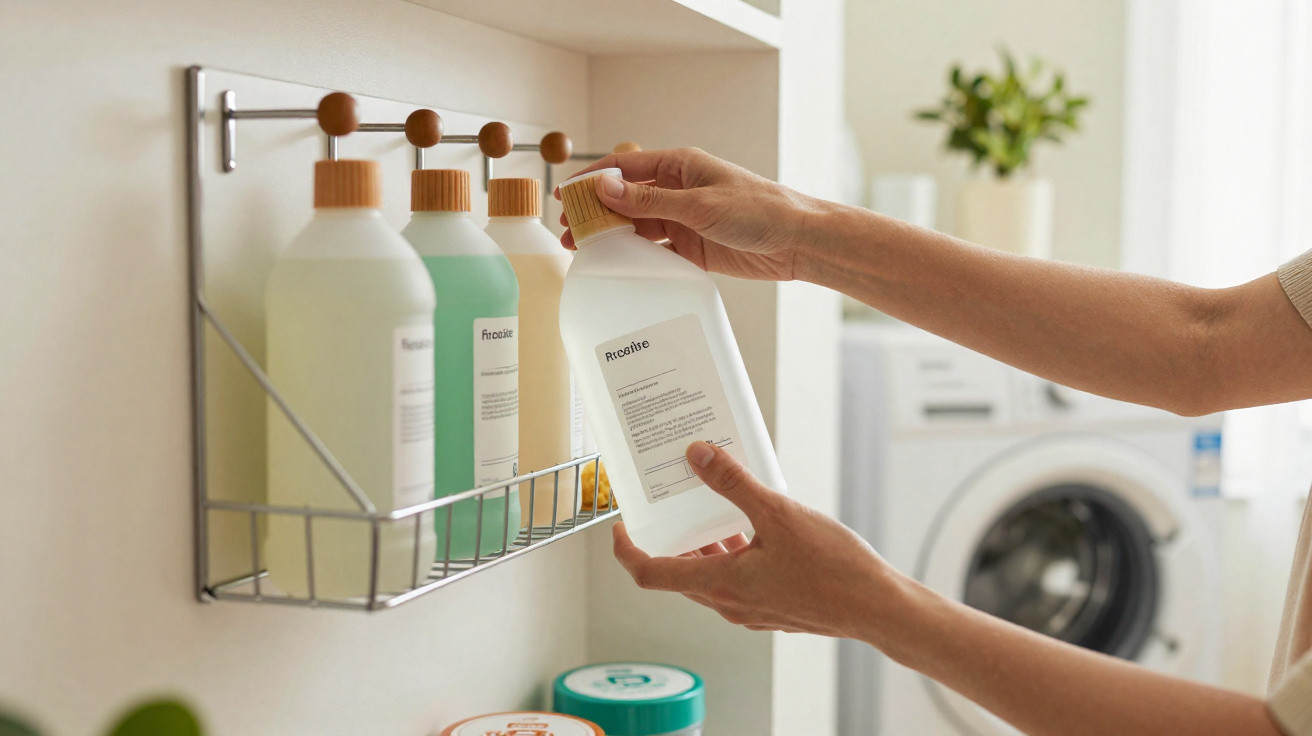
The laundry room is where good intentions often go to sulk. When locating detergent takes longer than starting the wash, the problem isn’t just clutter-it’s a setup that slows you down. Here’s how to make the room work for you, so the essentials are always easy to grab.
The machine was already chiming that urgent end-of-cycle tune when I stepped in and stopped short. Where had I put the detergent this time-cupboard, basket, on the floor? A sock clung to my elbow, lint floated down like snow, and the bottle I needed had vanished behind a stacked wall of stain removers. The drum thudded like a heartbeat. Everyone knows that moment when a “simple” job suddenly steals ten minutes. The solution starts with what you can spot first.
Make what you need obvious at a glance
Most laundry spaces get arranged by type of product, not by how quickly you can reach what you use. That’s how detergent ends up tucked behind spare softeners, and you find yourself digging around with wet cuffs. Change the aim: set things up so the bottle you use most is the first thing your hand meets. Add visual cues along the front edge of shelves. Choose clear bins with short labels you can read from three steps away. Large text, minimal effort. Skip lids on everyday containers. The room should “reply” before you even think to ask.
Take Maya, who runs three loads after dinner. She’d parked her detergent on the top shelf “for safety”, which meant stretching on tiptoe while the rinse cycle waited. One weekend, she shifted it into a waist-height open bin marked WASH, added a simple shelf tag reading MAIN DETERGENT to the front lip, and dropped a cheap turntable (lazy Susan) under the stain sprays. Her time from door-to-pour fell to under ten seconds. The laundry stayed the same. What changed was how fast she could fetch what she needed. Tiny layout tweaks save hours over a year.
Think of it like a supermarket aisle. Items face out. The label sits where you look first-on the edge, not hidden on a lid. Your eyes don’t want to interpret a rainbow of bottles; they want one clear cue. Sort by “reach rate”: daily, weekly, rarely. Daily belongs front and centre, weekly to the sides, and rarely used items up high or down low. Store items by frequency, not by category. That way the product you reach for most becomes the default, and backups stop taking the best spots. The room quietly points you in the right direction.
Design the room so detergent is always one move away
Place your main detergent where your hand naturally goes when you’re standing at the machine. For most people, that’s between knee and chest height, within arm’s reach, and clear of any cupboard door swing. Use an open bin or a wall-mounted pocket beside the washer’s controls. If space is limited, slot in a slim pull-out trolley between appliances. Keep detergent at eye level at the closest reach point. One move, pour, finished. A turntable beneath stain products turns the “where is it?” search into a quick flick.
Be realistic: hardly anyone keeps this perfect every day. That’s fine-the target isn’t perfection, it’s speed. Two common traps are decanting and over-labelling. Only decant if it genuinely makes the product easier to pour, not because it looks good online. Stick to one label per bin, not five. Make it big, black, and plain. Pick containers with handles you can grip with damp hands. If you use pods, keep a smaller lidded jar for the daily supply and store the large refill pack low down. Your back will appreciate it at 10 p.m.
Plan in terms of steps and stopping points. Where do you stand while measuring detergent? Where does your hand go after you shut the lid? Put a small tray or drip mat under the bottle to catch drips. Keep a microfibre cloth on a magnetic hook for fast wipe-downs.
“Good storage isn’t hidden; it’s honest. If you can’t see it in three seconds, it might as well not exist.”
- Front-edge labels beat labels on top.
- Open bins beat closed boxes for everyday items.
- In small spaces, one backup per product is enough.
- Add light right where your detergent sits.
Keep it flexible and future-proof
Seasons shift, products get replaced, and routines evolve-so build a setup that can stretch with you. If possible, use adjustable shelving, or add removable shelf risers to lift the front row. Fit a battery-powered motion light under the cupboard so labels light up as you walk in. Create a landing spot: a shallow tray for scoops, caps, and a measuring spoon tied on with string so it doesn’t disappear. Label the edge, never the top. When bottles get turned around, your brain can still read the right word. The result is less friction, every time.
Consider pre-sorting to cut down on mental effort. Set up three breathable hampers-LIGHTS, DARKS, TOWELS-so anyone can drop items in and move on. Keep a small “Oops Kit” within reach: a denture-cleaning tablet for mystery marks, a permanent marker for sock-matching dots, and a stain cheat sheet taped inside the door. Clip the end of a nearly empty detergent bag or softener pouch with a binder clip to squeeze out the last doses. Put a small bin for dryer lint exactly where your hand hovers when you pull the filter. The fewer side trips, the quicker the whole job.
Simple rituals help you locate things without thinking. Begin every load with the same mini-sequence: set the basket down, grab detergent, flip the cap, pour, place the cap on the tray, then return the bottle to the precise spot behind the edge label. No decisions-just actions. Keep refills behind the active bottle, not beside it, so your hand always lands on the current one first. If the room is shared, print a single-line “How we do laundry here” card and tape it at eye level. It doesn’t need to be pretty; it needs to be unmistakable. The room becomes your guide, not a nag.
You don’t need a Pinterest-perfect pantry to move faster-you need clarity. When the everyday bottle is visible, within reach, and labelled where you naturally look, seconds turn into smooth, easy progress. The room stops arguing with you. Other people will have their own tweaks-magnetic shelves on the side of a washer, a chalk pen straight on the bottle, a tiny sand timer to teach kids the All-In-One routine-and that’s exactly the point. The best laundry room isn’t decorative; it’s considerate. Change one shelf, one label, one reach point, and see how it feels next week.
| Key point | Detail | Why it helps the reader |
|---|---|---|
| Place by reach rate | Daily items front-centre; weekly at the sides; rarely used up high/low | Find detergent in seconds without hunting |
| Edge-first labelling | Large, simple labels on the front shelf lip or the bin edge | Read from a distance; no lifting lids |
| One-move rule | Detergent at eye/hand level, beside the controls, in an open bin | Shorter path from door to pour, fewer spills |
FAQ:
- How do I stop losing the detergent cap? Give it a home: a small tray or silicone coaster next to the bottle. If you decant, tie the scoop to the handle with twine or a key ring.
- Is decanting detergent into glass jars worth it? Only if it makes pouring easier. If it’s purely for appearance, don’t bother. Safety matters with children and pets; choose shatterproof containers.
- What if my laundry room is basically a hallway? Go vertical: magnetic shelves on the washer side, a slim pull-out trolley, and edge labels. Keep only that day’s items within arm’s reach.
- How many backups should I keep? One per product in small spaces. Store extras elsewhere. Keep refills behind the in-use bottle to avoid grabbing the wrong one.
- Pods or liquid-what’s faster? Pods are grab-and-go and reduce mess. Liquid is better for precise dosing and pre-treating. Pick the format that suits the speed of your routine, not just habit.



Comments
No comments yet. Be the first to comment!
Leave a Comment