
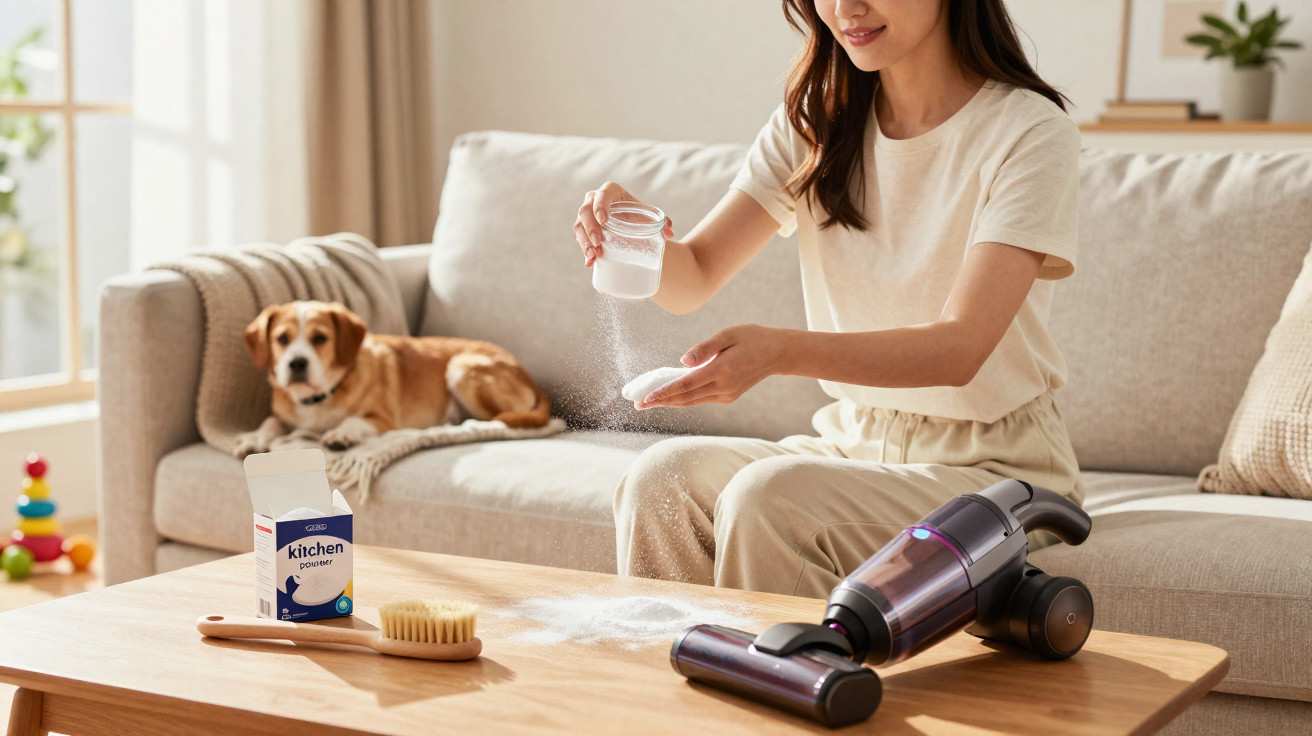
Many people reach for a room freshener spray or light a scented candle in a panic. For a moment the room smells of vanilla or “Fresh Cotton”, but the stale odour stays trapped in the upholstery. There is, however, a simple kitchen staple that does not just mask smells: it neutralises them within the fibres themselves - often in around half an hour.
Why fabric sofas start to smell so quickly
A fabric sofa behaves like an oversized sponge. Whatever happens around it gets pulled into the fibres. In smaller homes, especially with an open-plan kitchen, a whole range of everyday smells can build up over time.
- Cooking fumes from roasting, deep-frying or frying-pan meals
- Coffee steam and spilled drinks
- Damp from wet clothes or a window left open during rain
- Pet hair and small traces of urine from a dog or cat
- Cold smoke from cigarettes or shisha
- Sweat if the sofa is regularly used as a guest bed
Over time, this turns into a stubborn combination of grease, moisture, bacteria and organic residues. The fibres hold on to these particles, so even if you air the room out, the smell remains lodged in the fabric.
Before any cleaning method or odour trick can really work, it helps to pinpoint the source. Is it only one corner? A specific cushion? The section nearest the kitchen? Or was there a clear “incident”, such as a spilled glass or a pet mishap?
How to prep the sofa for odour removal
If you spray something straight on to the upholstery, you can easily end up spreading dirt and moisture around. A quick preparation check makes the result far better:
- Remove throws, blankets and loose cushions.
- Wash removable covers in the machine, following the care label.
- Vacuum the upholstery, seams and back thoroughly - ideally with a soft brush attachment.
- Lift out crumbs, pet hair and dust carefully, including under and between the cushions.
This first step alone often reduces odour, because dust, hair and greasy residue are removed and the fabric can “breathe” again.
The kitchen powder that neutralises odours in a sofa
The real game-changer is already in many kitchen cupboards: bicarbonate of soda (also known as baking soda). The fine powder has a porous structure and acts like a magnet for odour molecules.
Its effect comes down to three things:
- It binds odour molecules within the powder.
- It buffers acids that are often involved in unpleasant smells.
- It absorbs excess moisture from the fibres.
A welcome bonus: bicarbonate of soda works dry. The upholstery does not get wet, there are no water marks, and it is generally considered low-risk around children and pets - as long as they do not swallow the powder in large amounts.
If your fabric is particularly delicate or very dark, it is worth testing first on a hidden area to check whether the fibres become dull or any discolouration appears.
How to use bicarbonate of soda correctly on a sofa
For a large two-seater, one standard pack of bicarbonate of soda from the supermarket or chemist is usually enough. If you are only treating a small area, you will need less.
The basic method:
- Lightly sprinkle bicarbonate of soda over the completely dry, pre-cleaned sofa. For a large sofa, allow around 200 grams.
- Use your hand or a soft upholstery brush to work it gently into the fibres - do not scrub.
- Aim for a fine, even layer across the seat and back areas.
- Leave it to sit for 15 to 30 minutes - for typical living-room mustiness, this is often sufficient.
- Vacuum thoroughly afterwards, ideally with a brush attachment, until no powder residue is visible.
After this half hour, the sofa should ideally smell neutral again - not artificially perfumed, but simply “like nothing”.
If the smell is extreme: a protocol for stubborn cases
Some odours sit much deeper and are far more persistent - urine, vomit, or years of cigarette smoke, for example. In these situations, a quick 30-minute treatment often is not enough.
Taking the edge off cat or dog urine stains
Anyone with pets knows how it goes: one small accident and the sofa can smell permanently “of animal”. Acting quickly is worthwhile.
Recommended order:
- Blot up fresh liquid with kitchen roll - dab only, do not rub.
- Make a mixture of lukewarm water and a little clear household vinegar.
- Dab the area carefully with the mixture to help dissolve urine salts.
- Sprinkle bicarbonate of soda generously over the still slightly damp patch.
- Leave it for several hours, ideally overnight.
- Vacuum thoroughly the next day.
If you do the job properly the first time, you reduce the chance of the pet marking the same spot again as a “toilet”.
Vomit and other severe stains
After a stomach bug or a heavy night, residue can quickly end up on the upholstery. Here, hygiene and odour neutralisation matter equally.
How to proceed:
- Lift off solid material carefully without pushing it deeper into the fabric.
- Clean with lukewarm water and mild soap until no visible dirt remains.
- Add a splash of vinegar to the cleaning water to tackle odour sources.
- Let the area dry as well as possible, or blot with a cloth.
- Finish by applying a thick layer of bicarbonate of soda and leaving it for several hours.
Only vacuum once everything is completely dry. If a trace of smell lingers, a second round often does the trick.
Tobacco odour: plan for several rounds
Cold smoke is a classic problem odour because it embeds itself deep into textiles. One treatment usually brings only a small improvement.
To rescue a heavily smoke-affected sofa step by step:
- Vacuum thoroughly to remove loose dust and ash.
- Apply bicarbonate of soda as described above, leave for 1–2 hours, then vacuum.
- Mist the dry fabric lightly with water plus a little clear vinegar - a fine spray only, do not soak.
- Repeat several cycles over a few days.
At the same time, it helps to open windows more often and clean other textiles in the room - curtains, blankets and rugs - so smoke odour does not keep transferring back.
Turning a quick fix into a healthy routine
If you only treat the sofa when things get bad, you will constantly be fighting the next wave of odour. It is far easier when odour care becomes part of your normal cleaning rhythm.
A possible “slow cleaning” plan:
- air the room briefly each day with windows wide open, even in winter
- use washable throws or sofa covers and clean them regularly
- do a bicarbonate of soda treatment every two to three months
- blot up spills immediately rather than leaving them “for later”
- for persistent smells, have the cushion filling professionally cleaned from time to time
Regular, gentle care keeps the sofa in better condition for longer - and can save you from having to replace it.
When you should call in a professional
Some odours are not just in the cover but deep in the foam or the internal structure. If a musty smell or strong animal odour remains after several treatments, professional upholstery cleaning can be a sensible next step.
Specialists use equipment designed to drive cleaning solution deeper into the upholstery and then extract it again along with loosened grime. With higher-end sofas, this investment can be worthwhile before you face the cost of replacement.
Practical tips for everyday life with a sofa, children and pets
Homes with children and animals naturally put the sofa under more pressure. A few small habits can make it much easier:
- Set clear “sofa rules”: no open glasses of juice, and no ice cream with red toppings on the fabric.
- Give pets their own blanket on their favourite spot and put it in the washing machine regularly.
- If someone often sleeps on the sofa, use a thin fitted sheet as a protective layer.
- Turn cushions and pads regularly so moisture does not build up on one side.
Smells are often treated as a “minor issue”, but they strongly affect how comfortable home feels. If you treat your sofa like a large but sensitive textile item - rather than an indestructible piece of furniture - you can keep the living room feeling noticeably fresher long-term, without aggressive clouds of fragrance from an aerosol can.

Comments
No comments yet. Be the first to comment!
Leave a Comment