
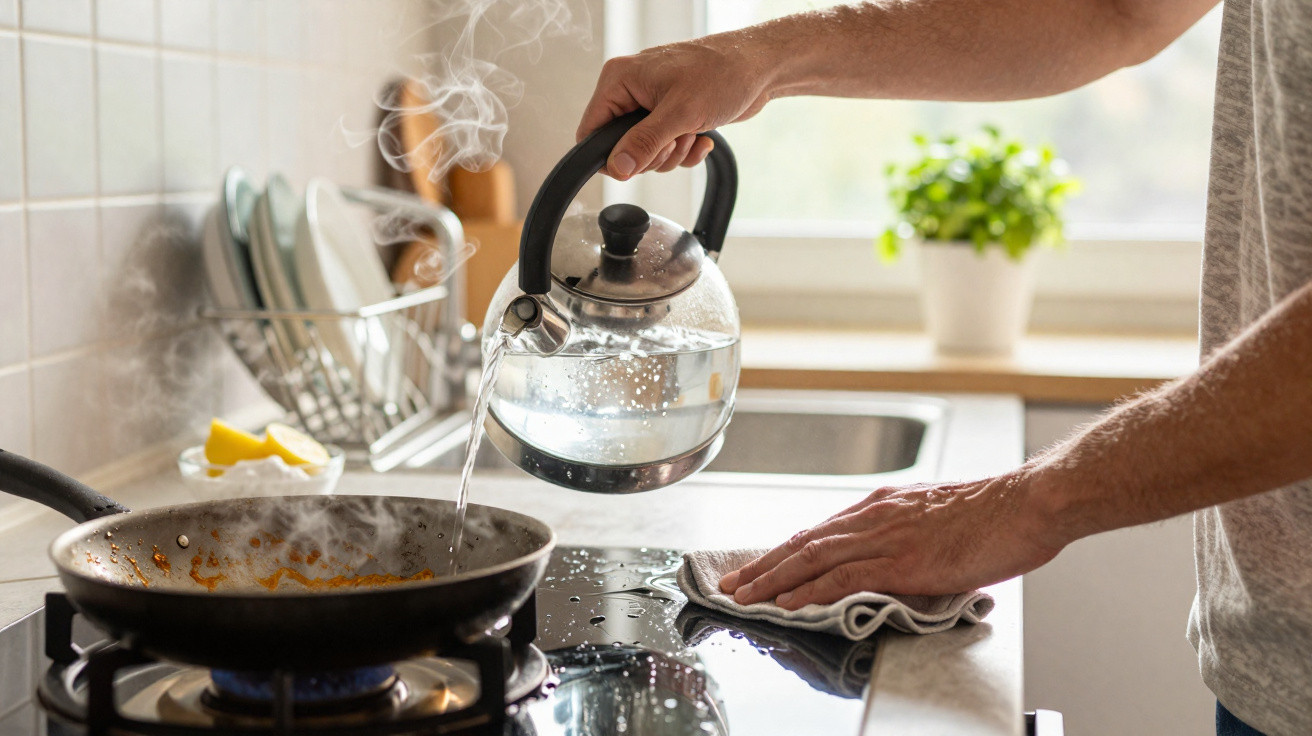
The smell of fried bacon still lingered long after the pan had been dumped in the sink. On the worktop, an invisible sheen caught the light. You only noticed it when you ran your hand across: greasy, slick, faintly sticky. It’s the same scene that plays out in countless kitchens every evening. You wipe, you spray, you mutter under your breath. And still that slight gloss remains, reflecting the cooker hood light like a reminder of the last meal.
In one of those moments, an older neighbour asked me something that sounded almost quaint: “Why don’t you use properly hot water?” She said it like she was letting slip an old family secret. That’s when it hit me: somewhere along the way, the simple warm-water approach to tackling grease has quietly slipped off our radar. And that’s exactly where things get interesting.
Why warm water suddenly feels like a bit of kitchen magic
Anyone who has tried to wash a greasy pan with lukewarm water on a cold winter day knows the irritation. The grease doesn’t disappear - it just migrates. Onto the sponge, around the sink, across the worktop. We all recognise that point where you give up and reach for the harsher cleaner just to be “done with it”. Compared with that, warm water sounds almost too gentle to matter.
Yet temperature genuinely changes the rules. The cloth glides more easily, the greasy film breaks into fine streaks and then lifts away instead of smearing. What looks like a small hack is really just straightforward cause and effect.
Not long ago, I was in an Airbnb kitchen late at night in a city I didn’t know. There was no familiar cleaner, just a half-used washing-up sponge, a bit of washing-up liquid, and a tap that seemed to offer only “cold” and “very hot”. On the pale work surface were the sticky traces of endless pasta sauces. I had zero appetite for a major clean; I just wanted to go to bed.
So I let the tap run, turned it to hot until steam rose, put a drop of washing-up liquid onto a microfibre cloth, and wiped the surface once.
The grease retreated as if someone had peeled off an invisible layer.
No scrubbing. No drawn-out battle. In under five minutes the sticky nightmare was gone - and I promised myself I wouldn’t underestimate this boring little routine again.
The reason is surprisingly plain. Grease behaves differently in heat than it does in cold. It softens, becomes more fluid, and reacts faster with surfactants - the cleaning agents in washing-up liquid and many household cleaners. Cold water often makes grease firmer; it clumps and grips the surface more stubbornly. Warm to hot water disrupts that structure. The molecules move more freely, so they’re easier to break up, surround, and rinse away.
That’s where the cleaner does its job: it “wraps around” the grease particles and carries them down the drain. Let’s be honest - nobody thinks about molecules while wiping a worktop. But that’s exactly what determines whether the surface is truly clean after one pass, or whether it merely looks slightly less bad.
The simple method: how to use warm water properly against grease
This starts at the tap, not with the product. Turn the water up until it’s clearly warm to hot - as hot as you can comfortably tolerate on your hands. Take a microfibre cloth or a soft sponge, soak it thoroughly, then give it a quick wring so it’s still properly damp.
Add only a small amount of cleaner to the cloth - a small dab is enough. Now you’ll feel the difference: wipe the greasy area in calm, overlapping passes instead of frantic back-and-forth rubbing. You’re effectively working with a hot “layer” that loosens the grease. Often one pass to lift and a second, lighter pass to finish is all you need.
Most people don’t fail because the method is flawed; they trip over the small details. The water isn’t hot enough. The sponge is worn out and spreads grease rather than absorbing it. Or there’s far too much product, leaving a smeary film that looks like fresh dirt under the light.
We also tend to reach straight for the most aggressive bottle under the sink rather than first turning up the water temperature. The result is dry hands, surfaces that get dulled or damaged, and that chemical smell people associate with “clean” - even though it doesn’t make anyone happier. Using hot water as your first step gives you more control. Over time it can save money too, because you use less product and your worktops stay looking better for longer.
A cleaning professional I spoke to about day-to-day life in commercial kitchens put it bluntly:
“If people knew what they could remove with properly hot water and a good cloth, nine out of ten specialist cleaners in the supermarket would suddenly be unnecessary.”
If you want to make the warm-water method a habit, these simple pointers help:
- First set the water hot enough that you can see steam, then turn it down slightly.
- Use a microfibre cloth - not yesterday’s old tea towel.
- Use a small amount of product; it’s better to add a little more than to overdo it once.
- Wipe in straight, overlapping passes instead of pushing everything around in circles.
- Finish with a quick wipe using clean, warm water to remove any residue.
Why this simple routine changes more than you’d expect
If you clean with deliberately warm water for a few days, something odd happens: surfaces don’t just look cleaner - they stay that way for longer. Grease films often aren’t truly removed; they’re diluted and nudged into invisible corners. Warm water breaks them down more thoroughly, so the surface returns closer to how it was before.
That may sound mundane, but in daily life it feels like a quiet reset. You walk into the kitchen and you don’t see the marks from two days ago - you see a worktop that’s back at “zero”. And, strangely, it does something emotionally too: the room feels lighter, less cluttered, less like a lingering to-do list.
At the same time, there’s an almost old-fashioned idea baked into this approach: understand first, then act. Instead of immediately grabbing the chemical hammer, you take a second to recognise how grease, water and heat work together.
Many of us heard some version of this from parents or grandparents: “Use hot water, love, and it’ll come off.” Behind that simple kitchen saying is more practicality than it gets credit for. Warm water is available, inexpensive, and predictable. It also makes you slightly more present: you wait for it to heat up, you judge when it would be too hot, you wipe with intention rather than absent-mindedly.
And maybe that’s the hidden value of this unglamorous method. It returns a small sense of control to an area that’s usually rushed. After a long day, hardly anyone tidies the kitchen in serene calm. It’s typically a sprint - one eye on the phone, the other already on tomorrow’s calendar.
Using warm water against grease on worktops creates a tiny pause. A quiet moment where you leave something visibly clean behind. Not perfect, not Instagram-ready - just genuinely clean to the touch. And surprisingly often, that’s enough.
| Key point | Detail | Benefit for the reader |
|---|---|---|
| Water temperature | Clearly warm to hot, just below what your hands would find painful | Grease dissolves more effectively, less effort needed while wiping |
| Choosing the right tool | Microfibre cloth or soft sponge instead of old rags | Grease is absorbed rather than spread; surfaces stay clean for longer |
| Cleaning routine | Short, overlapping passes, minimal cleaner, quick follow-up with clean water | Streak-free surfaces, lower product use, an everyday habit that actually sticks |
FAQ:
- Does warm water work on grease without any cleaner? To a degree, yes - especially on light greasy films. But adding a drop of washing-up liquid or an all-purpose cleaner helps dissolve and lift the grease far more thoroughly.
- How hot should the water be for worktops? Hot enough that it feels clearly warm, but still tolerable on your hands for a short time. For very sensitive materials such as natural stone, go a little cooler and check the manufacturer’s guidance first.
- Can warm water spread grease instead of removing it? Yes, if the cloth is saturated or you wipe without a surfactant. A fresh, well-wrung microfibre cloth plus a small amount of cleaner prevents exactly that.
- Is warm water enough for old, dried-on grease? Often you need one extra step: let it soak briefly so the warm water can work, then wipe after a few minutes. For stubborn spots, treat the area twice.
- Does the warm-water method save on cleaning products? In most cases, yes. Higher temperature makes the cleaner work more efficiently, so you need less product and fewer repeat wipes to get the surface properly clean.





Comments
No comments yet. Be the first to comment!
Leave a Comment