
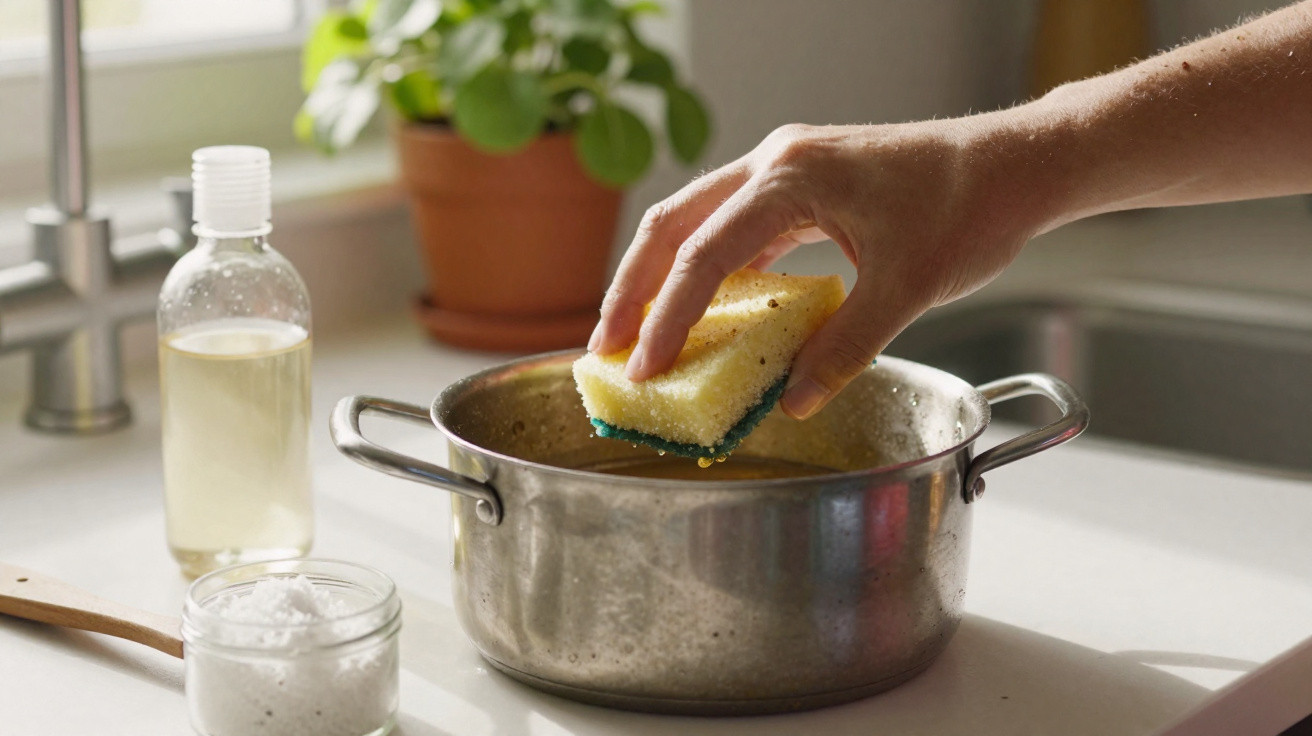
The smell gets you first: that sharp, bitter, smoky edge wafting out of the kitchen, followed by the quiet pause of someone praying nobody clocks what’s happened. You lift the lid and see it - a pan that was gleaming not long ago, now wearing a black, crusted layer that looks practically fused to the metal. It’s the sort of disaster that makes you want to hide it at the back of a cupboard and pretend it never existed.
You run the tap on hot, prod at the mess with a sponge, and the burnt bits don’t budge. It somehow feels personal.
Then somebody says, almost as an afterthought, “Why don’t you just use salt and vinegar?” and the whole situation shifts.
The day a ruined pan wasn’t ruined at all
In any shared kitchen, there’s usually one piece of cookware that carries a backstory. In a small flat I visited not long ago, it was a steel saucepan with a thick, black ring on the base - like a permanent eclipse. The owner gave a half-apologetic, half-stubborn shrug and admitted, “Pasta night. Got distracted by my phone.”
Everyone recognises that moment when a meal flips from fine to charcoal in five distracted minutes. You scrape, you scrub, your shoulders tighten, and you start mentally pricing up replacements.
And then some no-nonsense, grandmother-tier know-how walks in and rewrites the script.
A friend came over, reached up for a big box of salt from a high cupboard, and pulled a bottle of white vinegar from under the sink. No branded products, no rubber gloves, no lecture. Just two basics you can pick up in any local shop.
She tipped a thick layer of salt into the cold, burnt pan - not a polite pinch, but a proper drift - then poured in enough vinegar to soak it all. A clean, sharp tang rose immediately. “Let it sit,” she said, as if this were obvious.
About twenty minutes later, the black layer had slackened, lifting at the edges as though it was finally giving up.
What looks like magic is really straightforward kitchen chemistry. Salt does the gritty work: those tiny crystals act like a mild scourer under your fingertips. Vinegar does the dissolving: as an acid, it helps break down stubborn, carbonised food stuck to the metal.
Used together, they work on a burnt layer from two angles. The vinegar seeps into the crust and loosens its grip, while the salt helps shift the softened residue without shredding the surface of the pan. There’s no secret formula - just a reaction that quietly does the ugly work.
Once you’ve seen how uncomplicated it is, you start wondering why you spent years battling scorched pans and giving up too quickly.
How to rescue a burnt pan with salt and vinegar
This is the simple routine that took that “ruined forever” pan and made it usable again. Start by letting the pan cool right down. Cold liquid on hot metal can cause warping, and you don’t want to add that to the problem.
Next, cover the burnt area with a thick, even blanket of salt - think generous snowfall, not a light dusting. Pour in white vinegar until the salt is thoroughly soaked and there’s a shallow pool across the bottom.
Leave it undisturbed for 15 to 30 minutes. When you return, take a non-scratch sponge and rub gently in small circles. The blackened layer begins to come away in soft clumps, like mud loosening after rain. Rinse, repeat once if necessary, and the metal starts looking bright again.
A few common mistakes can make this easy trick feel like a waste of time. The first is rushing it: scrubbing after two minutes and declaring, “This doesn’t work.” Vinegar needs time to work into the burnt layer, particularly if the burn has been there a while.
The second is going in with steel wool or a harsh scouring pad. It can feel satisfying, but it may scratch the pan, ruin non-stick coatings, and shorten the life of your cookware. You’re trying to remove burnt food, not take revenge on the pan.
Finally, there’s the urge to throw every cleaning product you own into the mix. Mixing random cleaners is not clever, it’s risky, especially if strong chemicals end up combined. Salt and vinegar on their own are plenty.
“People think they’ve ‘killed’ a pan after one bad burn,” laughs Julie, a cooking teacher who runs low-budget kitchen workshops. “Most of the time, the pan is fine. It’s our patience that’s gone, not the metal.”
- Use plain white vinegar, not balsamic or apple cider vinegar.
- Let the pan cool before adding vinegar and salt.
- If your pan is non-stick, test gently first.
- Do another soak-and-scrub round rather than one intense, frantic scrub.
- Finish with a quick wash in hot, soapy water to remove any lingering smell.
More than a cleaning hack, a tiny mental shift
Once you’ve watched a blackened pan return with nothing more than salt, vinegar and five minutes of effort, something small changes in your head. Burnt food stops feeling like a catastrophe and starts feeling like a solvable hiccup - a glitch rather than a failure.
There’s a quiet reassurance in knowing that two everyday ingredients can undo what looked beyond saving. You become less nervous about cooking on a higher heat, leaving onions to caramelise a touch longer, or trying sauces that might catch on the bottom. And let’s be honest: nobody pulls off perfect timing every single day. Even so, simply knowing you could fix it makes the kitchen feel less like a performance and more like a place to play.
Some people swap festive recipes; others trade tips like this. It’s the sort of advice you send in a late-night message to a mate who’s just texted, “I think I destroyed my favorite pan.” And that may be the best part - not only rescuing your own cookware, but giving someone else their confidence back with a teaspoon of salt and a splash of vinegar.
| Key point | Detail | Value for the reader |
|---|---|---|
| Simple ingredients | Uses only standard household salt and white vinegar | A low-cost, easy-to-find answer for any kitchen |
| Gentle method | Abrasive salt plus acidic vinegar help loosen burnt-on food | Helps protect pans while shifting stubborn marks |
| Repeatable process | Soak, scrub lightly, then rinse - possibly twice | A dependable routine for the next kitchen mishap |
FAQ:
- Can I use this trick on non-stick pans? Yes, but be careful with the scrubbing part. Use fine salt, avoid aggressive pads, and test a small area first. If the coating looks damaged, stop immediately.
- Does the type of vinegar matter? White distilled vinegar works best. Colored vinegars can stain or leave sticky residues and are also more expensive for something that goes straight down the drain.
- What if the burnt layer doesn’t come off the first time? Empty the pan, rinse, and repeat the salt and vinegar soak. Some older, heavily burnt layers need two or three gentle rounds rather than one brutal scrub.
- Will my pan smell like vinegar afterwards? A quick wash with hot water and dish soap usually removes the smell. If it lingers, boil plain water in the pan for a few minutes and rinse again.
- Can I prevent pans from burning like this again? You can reduce the risk: don’t walk away on high heat, add a splash of water or stock if food starts sticking, and soak the pan soon after cooking. Still, if something burns, you already know what to do next time.


Comments
No comments yet. Be the first to comment!
Leave a Comment