
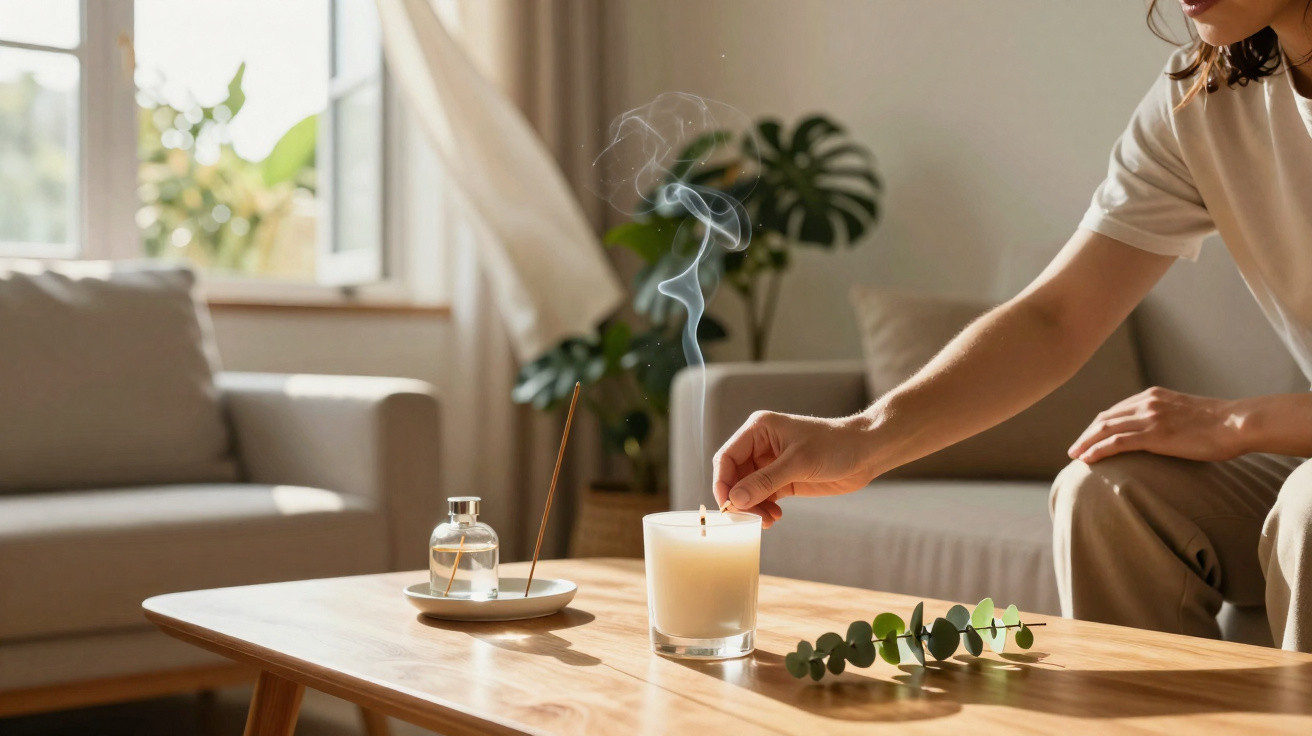
Many people associate scented candles, incense sticks and essential oils with cleanliness, calm and a “healthy home”. Yet the air you actually breathe can tell a different story: invisible pollutants, fine particles and irritating gases may build up indoors surprisingly quickly. If you light a candle every evening or keep fragrance oil constantly diffusing, you are not only keeping up a comforting habit - you are also changing your indoor air far more than most people realise.
Why our brains mistake fragrance for “clean”
A living room that smells of vanilla, cotton or “Fresh Linen” instantly feels looked-after. From childhood onwards, our brains learn to link pleasant scents with tidiness, hygiene and security. Advertising has reinforced that message for decades: one spray, one candle, a little smoke - and the home suddenly “is” fresh.
That is where the misconception starts. A powerful scent masks unwanted odours, but it does not remove them. The bin might seem odour-free, and traffic fumes may be less noticeable - but the compounds causing those smells are still present. On top of that, more substances are introduced: combustion by-products from candles, incense sticks or lit fragrance papers, plus chemical fragrance molecules released from sprays and oils.
"A room that smells strongly of a scented candle can, objectively, be more polluted than a well-ventilated home with no noticeable smell."
What’s really inside scented candles, incense sticks and similar products
Behind the cosy look of flame and smoke are often fairly down-to-earth ingredients:
- Scented candles: commonly made from paraffin (a petroleum product), with synthetic fragrances and colourants.
- Incense sticks and fragrance cones: blends of woods, resins, fragrance oils and binders that release smoke and particles while smouldering.
- Fragrance papers: soaked in resins and solvents so they burn evenly.
- Essential oils: highly concentrated plant extracts that may seem “pure” but can be strongly irritating at higher doses.
These items are frequently labelled “natural”, “plant-based” or “organic”. That mainly describes where the raw materials come from - not what they emit when burned or heated. Even a “natural” resin gives off particles and gases as it glows.
When wellness becomes an irritant: what burning produces
As soon as something burns or smoulders, combustion products are created. The smaller the room and the poorer the ventilation, the faster pollutant levels rise.
Typical substances that can be released by scented candles, incense sticks and fragrance papers include:
- Fine and ultrafine particulate matter - tiny particles that can penetrate deep into the lungs.
- Volatile organic compounds (VOC) - including substances such as formaldehyde, benzene or toluene.
- Allergenic fragrance molecules - for example limonene, linalool and citral, which may trigger reactions in sensitive people.
Measurements have shown that, in a standard-sized living room, a single scented candle burning for two hours can push the concentration of certain pollutants above recommended indoor guideline values. If you also light an incense stick or run a diffuser with fragrance oil at the same time, the load increases further.
"Several ‘feel-good rituals’ at once can worsen air quality almost as much as a busy road outside the window - except you don’t notice it by smell."
Who is most likely to react
Not everyone feels the effects immediately. Some people develop headaches straight away; others notice nothing for years and then wonder about vague, persistent symptoms.
People at higher risk include:
- Children - their lungs are still developing, and they breathe more air relative to their body size than adults.
- People with asthma or allergies - their airways tend to respond more quickly to irritants and particles.
- Older people - often with a weakened immune system or existing heart–lung conditions.
- Pets - especially birds and small mammals, which can be extremely sensitive to smoke and fragrance compounds.
Common signs of exposure may include: stinging eyes, a dry throat, a mild urge to cough, pressure in the head, tiredness, or a “heavy” head after an evening made cosy with lots of candles.
Essential oils: natural, but not automatically gentle on the lungs
Essential oils are often presented as a “healthier alternative” to scented candles. They can be useful - for instance when used in moderation, diffused cold, and in well-ventilated rooms. Problems tend to arise when:
- lower-quality oils are used, sometimes with diluents.
- they are vaporised continuously and at high concentrations.
- babies, pregnant people or pets are in the room.
Many oils contain substances that may cause allergies, headaches or breathing difficulties in people and animals. For cats, for example, certain essential oils are considered toxic because their liver can barely break these compounds down.
"‘Natural’ doesn’t automatically mean ‘gentle’ - plant power is concentrated chemistry."
How to reduce exposure without losing the atmosphere
If you do not want your home to turn into a sterile, scent-free space, a few straightforward habits can make a big difference.
1. Ventilate before you fragrance
Regular, short burst-ventilation is the single most effective step for cleaner indoor air. Opening windows wide on opposite sides of the home for 5 to 10 minutes, two to three times a day, is often enough to dilute pollutants noticeably.
A brief cross-breeze after extinguishing candles or incense sticks also helps, clearing fine particulate matter and irritating gases from the room more quickly.
2. Light less often, for less time, with more intention
Instead of using multiple candles and incense sticks every evening, a lighter touch reduces the load:
- Use candles deliberately for specific moments, rather than letting them burn for hours on end.
- Stick to one source at a time - either a candle or an incense stick, not everything together.
- Plan conscious breaks so the indoor air can recover.
3. Choose better products
If you would rather not give up fragrance entirely, you can at least shop more carefully. Useful criteria include:
- Candles made with a plant-based wax (for example soy, rapeseed or beeswax), ideally without colourants.
- Cotton or wooden wicks instead of wicks containing metals.
- For incense sticks, options with clearly declared, natural ingredients and no artificial fragrances.
- Essential oils in organic quality, used sparingly and preferably diffused cold.
When you see descriptions such as “fragrance blend”, “perfume” or “aroma”, it is worth reading closely: these often indicate synthetic fragrance cocktails whose composition is hard for non-specialists to judge.
Natural alternatives: fragrance without smoke and chemical cocktails
There are a few simple ways to make a room feel pleasant without pushing fine particulate matter upwards:
- Fresh air and textile care: ventilate regularly and wash curtains and cushions - this tackles odours at their source.
- Citrus peel: place dried peel from organic oranges or lemons in a bowl around the room.
- Scent sachets: put small bags filled with lavender flowers, dried roses or herbs in wardrobes and on shelves.
- Cold aroma stone: use a porous stone with one or two drops of a high-quality oil - without any heating.
"The less you burn, the lower the pollutant load - simple, and highly effective."
A closer look: what exactly are VOC and fine particulate matter?
Many articles mention “volatile organic compounds” (VOC) and fine particulate matter. These terms are not mysterious - they refer to very real chemistry.
VOC are gases released from paints, varnishes, cleaners, fragrances and furniture - and also from candles and incense sticks. Some irritate mucous membranes; others are suspected of increasing the risk of serious illness over the long term.
Fine particulate matter refers to airborne particles so small they can reach the lungs and even the bloodstream. When candles or incense burn, they produce a mix of soot, ash and condensed organic compounds. These particles can remain suspended in the air for a long time and are taken in with every breath.
What a realistic, healthier fragrance routine can look like
No one has to throw away every candle or bin every diffuser. A more achievable aim is to treat fragrance as an occasional extra, not a permanent state. One workable everyday routine might look like this:
- Air the home briefly in the morning and evening.
- Light a single candle only on a few evenings each week - for a maximum of two hours.
- Keep incense sticks as an infrequent ritual, perhaps once a week, then ventilate well afterwards.
- During the day, rely on natural scent sources: fresh fruit, flowers, herbs in the kitchen.
After a few weeks of being more mindful, many people notice that headaches ease, the air feels “clearer”, and far less fragrance is needed to feel comfortable. Often, a faint hint of lavender in a wardrobe or a small bowl of citrus peel on the dining table is enough.
That way, fragrance at home stays a pleasure - without your lungs quietly footing the bill each time.





Comments
No comments yet. Be the first to comment!
Leave a Comment