
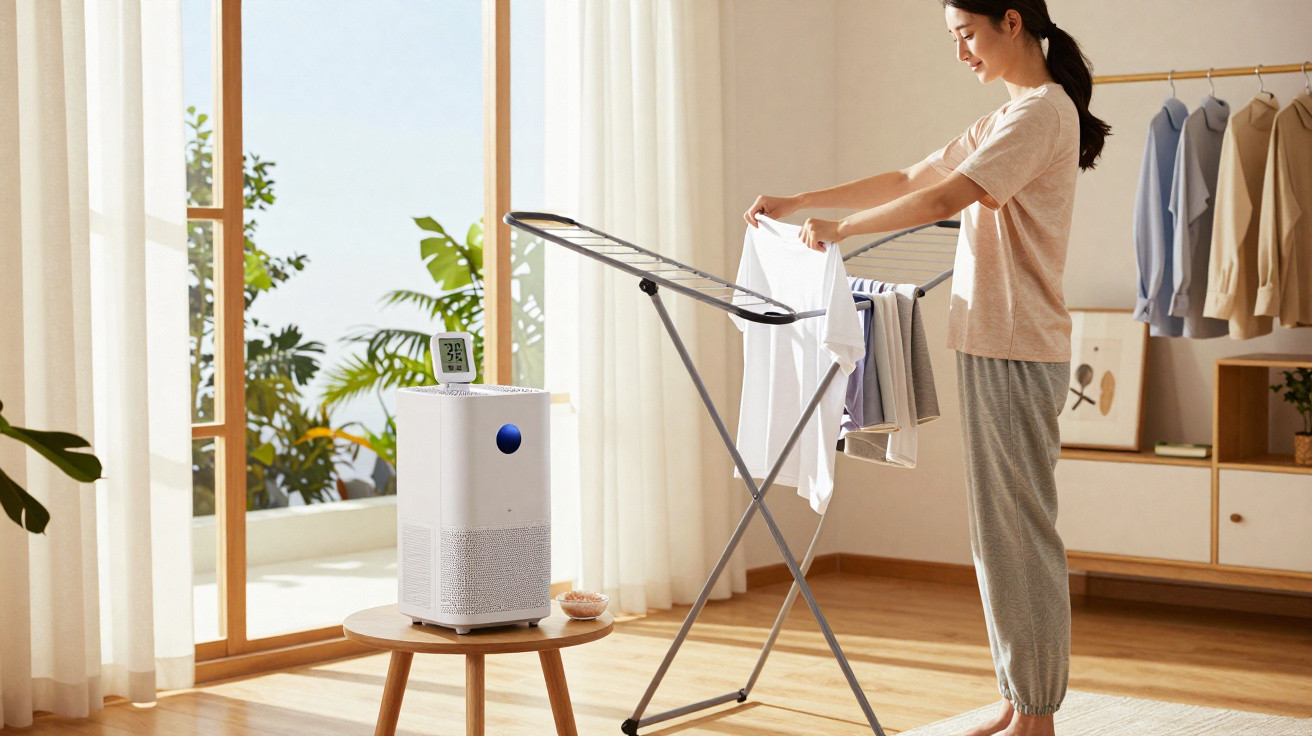
Drying clothes indoors becomes harder when the air already holds a lot of water vapour. In that situation, evaporation is less effective, garments stay damp for longer, and the room may develop condensation on cold surfaces.
How does air humidity affect clothes drying?
Relative humidity compares how much water vapour is in the air with the maximum it can hold at a given temperature. When that percentage is close to saturation, the air has less capacity to take in the water released by clothes during drying.
Temperature affects this balance as well, because the air’s vapour-holding limit changes with the conditions. On rainy days, humidity can rise as rainwater evaporates, which makes the exchange of water between fabric and the environment less favourable.
Key ideas that help explain what is happening include:
- Humidity: the amount of water vapour present in the air.
- Relative humidity: a comparison between the vapour already in the air and the maximum it can hold at that temperature.
- Rain: some of the water can evaporate and raise the humidity in the surrounding environment.
- Temperature: changes the maximum amount of vapour the air can hold.
- Saturation: when vapour reaches the limit allowed under those conditions.
Can a dehumidifier make drying more efficient?
Because humidity describes water vapour in the air, dehumidifiers are used to remove excess moisture. In practice, the appliance can steadily reduce the amount of vapour in a room and create conditions that are more favourable for evaporation.
However, the source does not provide tests involving indoor clothes horses, running time, or an exact reduction in drying time. It also does not define the correct distance between the appliance and the laundry, so any promise of rapid gains or a percentage efficiency improvement would be unreliable.
Do coarse salt, silica gel and charcoal work like an appliance?
Containers of coarse salt, silica gel, or activated charcoal are often suggested as home alternatives, but they are not covered in the cited source. The material does not compare their ability to remove humidity, nor does it confirm that they speed up clothes drying in closed rooms.
Removing moisture requires enough capacity.
Room size affects the outcome.
A purpose-built appliance continuously removes some of the excess vapour in the room.
The source does not show that small DIY containers produce a comparable effect near the clothes horse.
The same gap applies to advice on reactivating, replacing, or disposing of these materials. Without specific figures, it is not possible to say when they would be saturated, how much they would absorb, or whether they would make a noticeable difference near the clothes horse, particularly in rooms with a larger volume.
Some points often included in the discussion cannot be confirmed by the reference:
- How much salt is needed for each room size;
- How much silica gel can absorb near the clothes;
- The effect of activated charcoal on drying time;
- The correct frequency for reactivating the materials;
- Whether DIY containers are equivalent to electric dehumidifiers.
Why does air circulation still matter?
Ventilation can help by replacing some humid air with air under different conditions, reducing the chance of vapour building up around the clothes. Even so, the source does not provide a circulation protocol for utility rooms, nor does it set a minimum window opening.
Leaving space between items on the clothes horse and avoiding overlap fit the idea of exposing more fabric to the air, but these steps are not set out in detail in the consulted page. The confirmed point is that humidity means water vapour present in the atmosphere.
To read the technique without overstating it, keep these points in mind:
- A dehumidifier removes excess humidity from the air;
- The source does not specify an exact drying time;
- Rain can raise humidity through evaporation;
- Temperature changes the vapour limit the air can hold;
- Home alternatives need specific evidence.
How can you use the technique without unrealistic expectations?
If you are looking for other ways to dry clothes indoors, it helps to separate practical tips from what the source actually confirms. Using a dehumidifier is directly linked to removing excess humidity, but the outcome still depends on the conditions.
Seen this way, the technique is best understood as managing the indoor environment rather than an instant fix. Lowering air vapour levels tends to support evaporation, but salt, silica, charcoal, and any specific timeframes need their own proof before being presented as guaranteed drying methods.



Comments
No comments yet. Be the first to comment!
Leave a Comment