
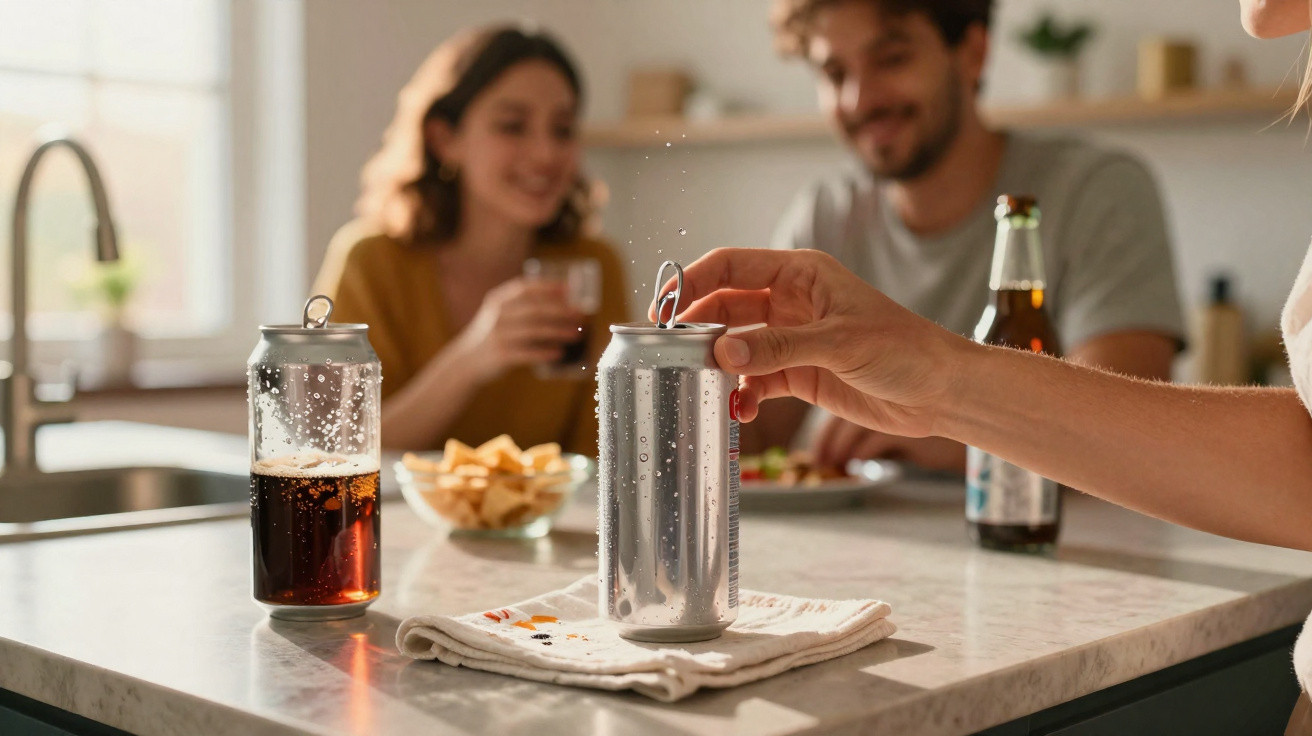
Fizzy spray everywhere, stained clothes, irritated guests: “exploding” lemonade cans can drive anyone mad when you open them - and a surprisingly simple move can change that.
Whether it’s a film night, a party, or just a quiet moment on the sofa, opening a shaken can can turn into a sticky shower. It can feel almost like a magic trick: you only lift the ring pull and, suddenly, the drink erupts like a fountain. But the annoyance has a straightforward explanation in physics. A former NASA engineer has demonstrated that a few firm taps on the can will stop the mess in most cases.
Why fizzy drinks suddenly “explode” when you open them
Standard soft drinks such as cola, orangeade and energy drinks contain carbon dioxide (CO₂) dissolved in the liquid under pressure. Under normal conditions, some of that gas collects in the small pocket of air at the top of the can or bottle. In a sense, it “parks” there until we open the seal.
Once a can has been shaken hard or jostled vigorously, the situation changes. The CO₂ no longer stays neatly at the top; instead, it moves through the liquid along the inside wall. Countless tiny gas bubbles form on microscopic rough patches in the metal and on small particles in the drink. Those bubbles are exactly what later produces the notorious geyser effect.
When you open the can, the pressure inside drops abruptly. The many tiny bubbles expand in an instant, rush upwards and drag the liquid with them - the soft drink shoots out of the can.
In physics, this process is called “nucleation”: gas bubbles form preferentially at surfaces and at tiny impurities in the liquid. The more of these ready-made bubbles there are, the more violently the drink fizzes when the can is opened.
The trick: four firm taps can save your clothes
US YouTuber and former NASA engineer Mark Rober examined the effect in a carefully produced video and presented a strikingly simple fix. You can reduce nucleation dramatically with a few well-placed taps.
Here’s how to do it:
- Pick up the can if it has been shaken or knocked about.
- Tap the side of the can four times, firmly, spacing the taps around the can.
- Open it as normal - ideally upright, and not directly above your keyboard.
Tapping makes the metal wall vibrate slightly. That vibration dislodges many of the bubbles clinging to the inside surface. They then rise into the headspace at the top of the can, which is where the gas should be in the first place.
As the bubbles travel upwards, the CO₂ redistributes itself “properly” - so when you open the can, mostly gas escapes rather than half the contents.
If you simply leave a shaken can alone for a few minutes, you can get a similar result because the bubbles gradually rise on their own. The tapping trick speeds the same process up and saves patience - especially when thirsty guests do not want to wait.
How the trick behaves with different drinks
With lemonade and cola, it works surprisingly well
Tests with typical soft drinks indicate that, in the vast majority of cases, tapping first prevents the big mess. A bit of hissing is normal, and a few bubbles usually still escape at the top. Compared with opening an untapped can, though, the difference is obvious: what could have been a sugary fountain becomes a fairly uneventful opening.
It’s particularly handy when cans have been shaken during everyday transport - for example, after a shop run in the car, in a rucksack on a bike, or when someone has rattled the can for a laugh. Remember the four-tap trick in those moments and you can usually open it calmly.
With beer, the trick often fails - the chemistry is more complicated
Interestingly, a 2019 study from the University of Copenhagen concluded that this technique is much less dependable with beer. The researchers looked at whether tapping really helps after beer cans have been heavily shaken.
Several factors work against it with beer:
- Some bubbles lodge so deeply in tiny micro-scratches in the aluminium that vibration won’t dislodge them.
- Beer contains proteins and hop-derived compounds that act as natural “foam builders”.
- As a result, a stable foam forms and pushes the liquid upwards more strongly.
A useful rule of thumb: with lemonade, tapping usually prevents trouble - with beer, keep a cloth handy.
That doesn’t mean the trick never works for beer, but the success rate is clearly lower. If a beer can has been shaken hard, it is better to leave it to rest for a few minutes, then lift the ring pull very cautiously.
How much shaking is too much?
In day-to-day life, these pressure traps often happen without you noticing. Common scenarios include:
- A crate of drinks is lifted out of the car a bit too roughly.
- A can falls out of the fridge but doesn’t burst.
- Children play with a can before putting it back down.
- A rucksack is dropped on the floor even though a can is inside.
The more intense and prolonged the movement, the more bubbles form on the inside walls. For maximum peace of mind, combine both approaches: tap first, then wait 1–2 minutes. In that time, many bubbles migrate upwards, and the pressure in the lower part of the can drops noticeably.
Hands-on physics: what happens during nucleation
For anyone who wants a closer look at the mechanism: nucleation describes the formation of bubbles or crystals at specific points known as nuclei. In fizzy drinks, these nuclei include:
| Location of nucleation | Example |
|---|---|
| Inside wall of the can | Micro-scratches in the metal |
| Impurities in the drink | Dust particles, tiny suspended solids |
| Surface of the liquid | Contact with the air space at the top |
While the internal pressure is high, a lot of CO₂ is effectively held “in” the drink. When the pressure drops suddenly, part of it turns into gas bubbles extremely quickly. If there are many nuclei - for instance, at rough areas of the can - huge numbers of bubbles shoot up at the same time. That mass launch is what creates the spraying spectacle when you open the can.
Tapping, in effect, removes many of those launch points because the bubbles detach early and collect at the top. The outcome is fewer bubbles rising all at once, so there is not enough upward force to drag large amounts of liquid with them.
Practical tips for everyday life, parties and the office
If you apply the effect deliberately, you can avoid a lot of awkward moments. A few useful pointers:
- Don’t open freshly transported cans immediately; set them down briefly first.
- Give four strong taps around the can - don’t just tap timidly.
- When opening, point the opening away from your body and away from sensitive electronics.
- With beer, allow extra time and open much more carefully.
In the office, the trick can literally save a keyboard. If you come back from the kitchen and notice the can is very cold and damp - a sign it may have been moved about - don’t open it directly over your desk. Tap first, then, to be safe, open it over the sink or at least slightly to one side of your laptop.
Risks, limits, and what the trick can’t do
Of course, tapping does not solve every situation. If a can has fallen from a significant height, rolled around in a car for minutes, or been shaken for ages as a joke, a lot of CO₂ will still be dispersed through the drink. In that case, tapping can reduce the severity, but a small overflow is still possible.
Temperature matters too. Warm drinks fizz more than well-chilled ones because the gas dissolves and escapes more readily. A lukewarm cola that has been shaken therefore poses a higher risk than the same drink straight from the fridge.
If you’re often out with children, or you carry drinks at festivals, picnics or at the stadium, it can help to make this trick a small safety ritual. In places where you don’t have spare clothes or cleaning wipes to hand, the habit really pays off.
What’s most striking about the whole story is this: a simple everyday mishap is rooted in clean physics, and a minimal extra step - four quick taps on the can - is often enough to defuse the problem almost completely. Try it once on purpose and you’ll likely never want to open a fizzy drink any other way.


Comments
No comments yet. Be the first to comment!
Leave a Comment