
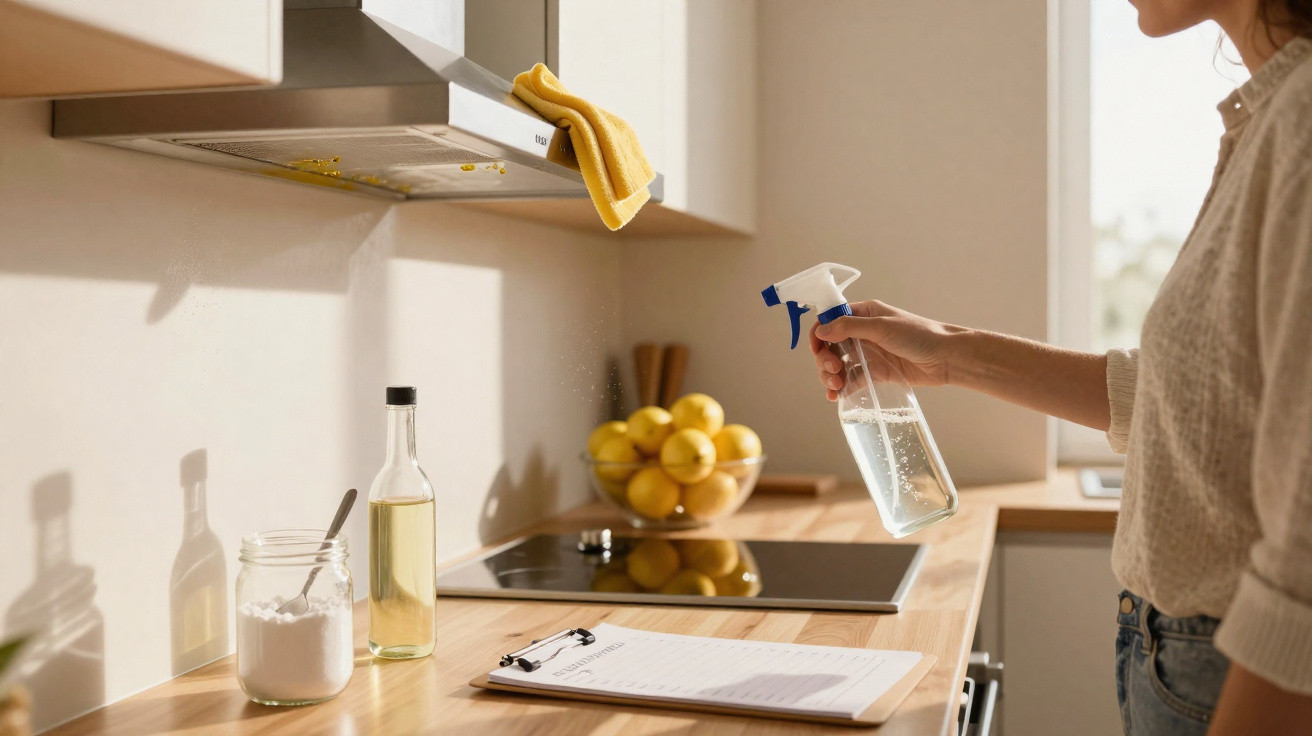
The smell hit first: a hard-to-pin-down blend of stale frying oil, dust, and that faint question of “How long has that been there?”. It was an ordinary Tuesday evening, and I was standing at the hob with a brightly coloured spray from the chemist, one that promised “Power against grease” on the label. Ten minutes later-after scrubbing, coughing from the mist, and sacrificing half a sponge-the truth was obvious. The greasy tide mark above the tiles was still there, only now it came with a citrus perfume. Right then a friend messaged me: “Try my mixture-you’ll laugh.” I did laugh. Mostly, though, I was amazed.
Why our kitchens are secret grease traps
Anyone who cooks regularly recognises the slow tipping point when a kitchen starts to feel… different. At first, everything looks polished; then little signs creep in: a thin film on the extractor hood, an oven handle that feels tacky, that one patch behind the cooker you deliberately stop looking at too closely. We tell ourselves it’s just how kitchens are-and it is. Airborne grease settles like an invisible mist on every surface. For weeks you barely notice it, until the sun comes in at an angle and mercilessly reveals every sheen.
A reader once told me about her first flat. The kitchen was tiny, storage was scarce, but she was proud of her gas hob. Three months in, the pride had evaporated: a brownish ring had formed around the control knobs, and it reminded her of an old takeaway. “I tried everything,” she wrote, “three different sprays, a so-called professional gel, even an expensive ‘eco grease-dissolving miracle’.” What she got for her trouble was a heavy chemical smell, irritated hands, and a till receipt that hurt more than the grime. In the end, what fixed it was something that was already sitting in the kitchen cupboard.
Grease is stubborn because, with dust, heat and time, it effectively cures into a kind of varnish. Many sprays only tackle the surface: they soften a bit, smear it around, and mask it with fragrance. The physics is simple. Grease shifts best when you use opposites that break up its structure-acid, salt, surfactants. A lot of household mixes work on exactly that principle, just without the flashy bottle or the marketing claims. And suddenly the kitchen cupboard feels more interesting than the cleaning aisle in the supermarket.
The natural mixture that’s surprisingly strong on grease
The well-known mix that so many people swear by is basically three things: vinegar, bicarbonate of soda, and warm water. Nothing else. What matters is the order. Half-fill a glass or spray bottle with warm water, add 2–3 tablespoons of clear household vinegar, and give it a quick stir. Only then do you add 1 heaped tablespoon of bicarbonate of soda. It foams, it quietly fizzes, and the whole thing comes alive. It looks like a school experiment-except the result is genuinely useful.
A lot of people make the same mistake: they dump loads of bicarbonate of soda straight on to a greasy patch, rub it in, end up with white crumbs everywhere, and a surface that somehow feels dull. Or they rely on neat vinegar, which is brilliant on limescale but quickly reaches its limit with built-up grease. This combination uses both: the degreasing effect of the acid and the lightly abrasive, emulsifying action of the bicarbonate. And compared with harsh sprays, the smell settles down to neutral fairly quickly. Let’s be honest: nobody enjoys spraying chemicals into a small kitchen every other day.
“I sprayed the mixture on my extractor hood, left it for five minutes, then wiped it off with an old cotton cloth. The yellowish film was gone. No scrubbing. I was almost offended by how long I’d been scrubbing before,” Lisa told me-she has two children, very little time, and a refreshingly blunt way of putting things.
If you want to try it out, this quick checklist helps:
- 1 part clear vinegar, 1 part warm water, 1 heaped tbsp bicarbonate of soda per glass - don’t mix it the other way round
- Spray or apply, leave for 3–5 minutes, don’t wipe immediately
- Wipe away with a soft cloth; for heavy build-up, repeat
- Test on an inconspicuous spot first, especially on delicate surfaces
- Use on days when you can open a window so any odour clears faster
How this mixture changes the way you see housework
Once you’ve watched an old, greasy patch disappear in minutes, your relationship with routine kitchen jobs shifts. Cleaning suddenly feels less like punishment and more like a small experiment. You start tackling the places you normally avoid: behind the cooker, next to the bin, along the top edge of cupboard doors. The mixture becomes a kind of key-not only for greasy surfaces, but for the thought: “Maybe I can actually get on top of this without sacrificing half of Saturday.”
At the same time, there’s a trap. Because it works so well, some people use it everywhere-even where it doesn’t belong. On natural-stone worktops, for instance, vinegar can cause fine damage; wood can swell if it gets too wet; high-gloss fronts can sometimes be touchy. Taking a moment to check the material saves both nerves and cabinet doors. This mixture is a tool, not a magic wand. And even if it beats many sprays, it doesn’t replace common sense. Kitchen grease will always be part of life, especially if we enjoy frying, baking, and experimenting.
“The cleanest kitchen is often the one where nobody cooks,” an older neighbour once said, holding a mug of coffee while she stood in my half-finished chaos corner. “I’d rather have a bit of grease and the life that comes with it.”
A few thoughts worth keeping:
- Grease isn’t a personal failing; it’s a by-product of everyday cooking and enjoyment
- The smartest fixes are often cheap, simple, and packaged without fuss
- Frequent mini-cleanups beat rare, marathon deep-cleans for both results and mood
- Natural mixtures can be kinder on your lungs-and your budget
- A little mess isn’t a crisis - it’s proof people live and cook here
What’s left once the grease film is gone
When the tiles go back to a matte finish instead of that slippery shine, and the hob no longer feels sticky, more changes than just appearance. A clear worktop makes you want to try something new, dig out an old recipe, invite friends round on a whim. Your eyes stop snagging on grey edges and move more freely around the room. It’s easy to underestimate how much energy small “dirt islands” quietly drain day to day. The vinegar-and-bicarbonate-of-soda mixture doesn’t only lift grease-it frees up a bit of headspace too.
Maybe that’s the real appeal: realising you don’t need every brightly branded product shouting “Ultra”, “Max” or “Power” from the shelf. A glass, a spoon, and a little know-how is often enough. That kind of practicality feels quietly liberating-and it spreads. Once someone sees how quickly the greasy film above the cooker can vanish, they tell other people, send photos, message friends. Kitchens turn into small, silent test labs, where “recipes” are created not only on plates, but during the tidy-up. In the end, one simple idea remains: you can’t de-grease life. But you can make it easier, with a mixture that delivers more than it promises.
| Key point | Detail | Benefit for the reader |
|---|---|---|
| Natural grease-cutting mixture | Combination of vinegar, warm water and bicarbonate of soda, mixed in the right order | A simple, low-cost alternative to chemical sprays with strong cleaning performance |
| Targeted use instead of blind application | Check the material first, respect the dwell time, avoid sensitive surfaces | Protects finishes, prevents damage, and saves time when cleaning |
| A routine that fits real life | Small, regular uses against grease rather than occasional big blitzes | Less frustration, a nicer cooking experience, and a visibly better-kept kitchen |
FAQ:
- Question 1 Can I use any vinegar for the mixture? Best is clear household vinegar, or vinegar essence diluted with water. Balsamic or flavoured varieties are more likely to leave marks and odour.
- Question 2 Is the mixture suitable for all surfaces? No. On natural stone (marble, granite), unfinished wood, or very sensitive high-gloss fronts, either test first in an inconspicuous area or avoid it.
- Question 3 How long can I store the mixture? It’s most effective when fresh, straight after the foaming reaction. It’s still usable for a day or two in a tightly sealed container, but it gradually loses strength.
- Question 4 Does the mixture help in the oven too? Yes-light to medium grease layers lift well. For baked-on patches, a second round or extra soaking time may be needed.
- Question 5 Will the kitchen smell strongly of vinegar? The smell is noticeable at first, but it clears quickly with an open window. If you like, add a few drops of essential oil to your cleaning water.



Comments
No comments yet. Be the first to comment!
Leave a Comment