
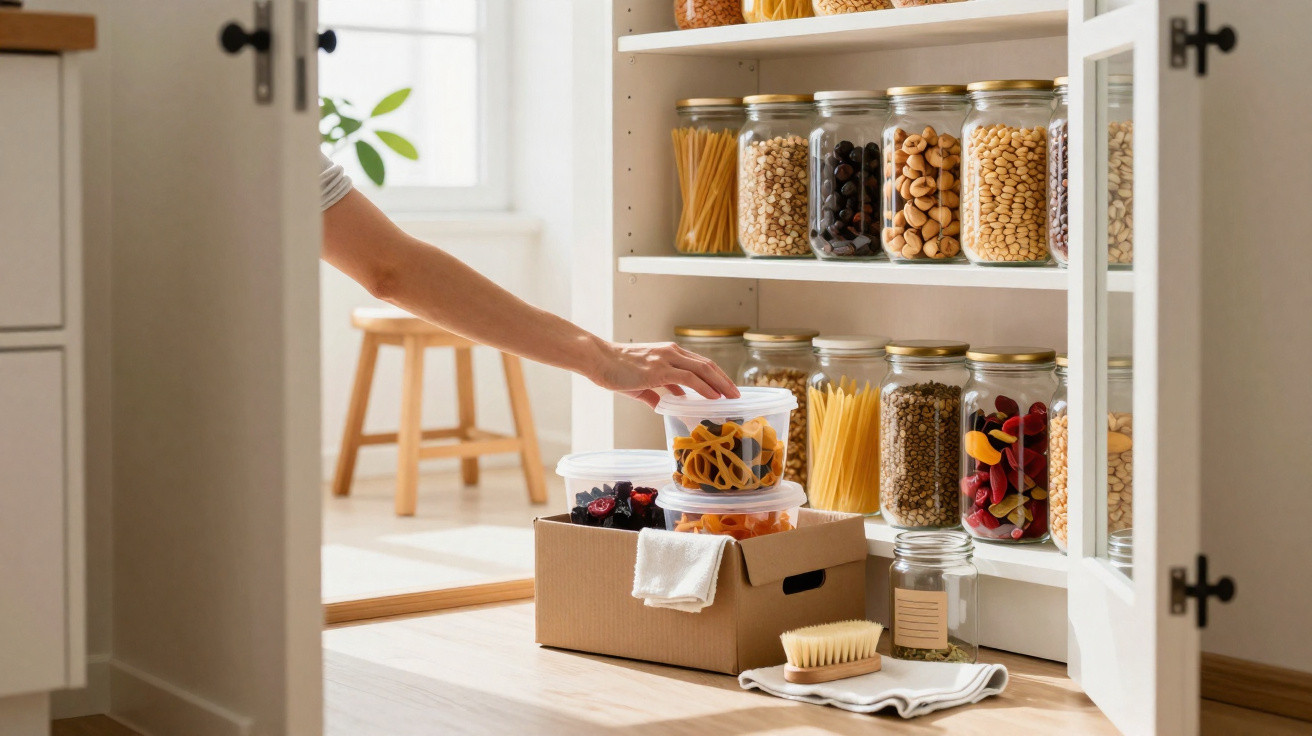
The first time you open a pantry lined with glass jars, it’s oddly like walking into a silent library.
Every ingredient is on show, lined up neatly. When you slide out a shelf, nothing clatters. There’s no crumpled plastic, no unidentifiable tubs with grubby lids. Instead, you get neat rows of clear cylinders catching the light and telling you exactly what you’ve got. Usually, that moment comes after the opposite: flour erupting from a split bag, stale cereal lost behind a half-torn packet, and three bags of rice bought because the first two disappeared into the mess.
You shut the glass door and notice something else: your food suddenly feels organised, and your brain unclenches. Writing a shopping list becomes simpler. Meal ideas arrive just by looking. Somewhere between the soft clink of a lid and the quiet weight of a jar settling into place, the pantry stops feeling like a dark cave and starts acting like a calm control centre.
That’s also the point where plastic bins begin to feel like a noisy relic.
Why glass jars change the whole feeling of a pantry
Open a pantry packed with plastic bins and what do you mostly see? Lids. Solid, cloudy, sometimes slightly yellowed with age. You stack them, then lose track of what’s in the ones at the bottom. Food ends up shoved into corners, squeezed into whichever gap is left. You’re organising by how much fits, not by what you can see. It’s fine on day one, straight after the big clean-up. By week three, the “system” starts coming apart.
Glass jars reverse the whole approach. You organise through visibility. Even when one jar sits behind another, your eyes still pick up shapes, colours and fill levels. The glass bounces light around, making shelves feel cleaner, deeper and almost like a shop display. That visual order turns down the mental static: you stop searching and start choosing.
And, oddly, the pantry begins to draw you in.
A professional organiser in Portland told me about a client who insisted she had “no space” and was “terrible at cooking”. Her pantry was crammed with mismatched plastic tubs, most of them unlabelled, plus at least seven open bags of pasta. When they replaced the bins with plain glass jars-same shelves, same food-the change was instant. The client stood there quietly, then whispered, “I didn’t know I had all this.”
Within a month, her grocery spending fell. She stopped buying duplicates because she could literally see the difference between “nearly empty” and “completely gone”. The children started choosing nuts and dried fruit instead of mystery snack bags, simply because the jars made them visible at their height. There was nothing fancy and no designer pantry-just rows of glass. One afternoon of decanting shifted how the whole family used the kitchen.
We often assume we need a bigger house or more cupboards. Quite often, what we really need is more transparency.
The reason is straightforward: the brain loves patterns and hates friction. Plastic bins create more friction than we like to admit. You have to unstack, lift, open a lid, and rummage. It sounds minor, but it’s enough to make you shove a new bag in at the front “for now” and walk away-exactly how clutter starts.
Glass jars remove steps. You can see the level immediately. With one glance, you know whether it’s worth opening the jar. Shelves become visual dashboards rather than storage dumps. Your memory improves too, because your brain builds a map of colours and shapes-brown lentils in tall jars, white rice in medium ones, bright snacks in smaller jars.
The payoff isn’t only prettier shelves-it’s fewer decisions every time you cook. Less searching, less guessing, less waste. Organisation stops being a once-in-a-while project and becomes the default.
How to actually switch from plastic to glass without going crazy
The easiest way to move to glass jars isn’t an “everything in one weekend” overhaul. Begin with a single shelf. Choose the area that irritates you most-often baking supplies or the breakfast corner. Take everything out. Bin or combine old packets, then pick 5 to 10 glass jars in the same style and height for the staples you use every week: flour, sugar, oats, pasta, rice.
Fill those first. Set them at the front, with labels facing you if you use labels. Push bulky or rarely used items-like seasonal sprinkles or specialist flours-to the back in whatever packaging they already have. The difference shows up straight away: one tidy row of glass becomes the visual anchor for the entire pantry. You get a win without turning your kitchen into a war zone.
Do the same thing once a week, shelf by shelf, and the pantry quietly improves in the background of everyday life.
There’s a truth most people don’t say out loud: new systems often collapse because they’re too “perfect”. Every jar labelled in identical cursive. Every lid aligned. It looks incredible on day one-and feels completely impossible on a Tuesday night after work. Let’s be honest: nobody truly keeps that up every day. If your pantry refresh depends on your best self turning up daily, it won’t stick.
Glass jars work best when they allow for real life. Choose wide mouths that are easy to pour into without a funnel. Stick to a couple of standard sizes rather than ten different ones. Use plain, readable labels-or even a wax pencil you can update in seconds. Leave breathing room on shelves so jars slide in and out rather than being wedged in like Tetris.
Organisation that lasts always makes space for tired-you, rushed-you and “I’ll sort it later”-you.
One home cook I met put it perfectly, in a way I still remember:
“When I switched to glass jars, I stopped feeling like my pantry was judging me. It started helping me.”
That’s the quiet superpower of glass: it works with your habits instead of battling them. The clarity forces honesty-if you never use that obscure grain you bought two years ago, you’ll see it every time. And the uniform shapes create natural boundaries: if the jars are already full, you probably don’t need three more types of crackers this week.
- Group jars by how often you use them, not by category. Everyday foods belong at eye level.
- Keep a small “quarantine jar” for near-empty leftovers (like the last handful of pasta shapes) and throw it into soups.
- Pick lids you can open one-handed; if they’re a struggle, you’ll quietly drift back to bags.
- Save one shelf for children’s snacks in clear jars so they can help themselves safely.
- Let one jar stay deliberately “imperfect” or mixed-it keeps the system human rather than rigid.
The deeper shift: from storage to visibility culture
After you’ve lived with glass jars for a while, an unexpected change kicks in: you stop thinking “where can I hide this?” and start asking “how can I keep seeing this?” That one shift influences what you buy, what you cook and what you waste. Food you can always see gets eaten. Food that’s tucked away becomes clutter and, eventually, rubbish. It’s not aesthetics first-it’s being honest about what’s already in your home.
Plastic bins, by their nature, are excellent at concealment. They’re ideal for toy rooms, seasonal decorations or anything you hardly ever need. In a pantry, that hiding ability works against you. Glass jars turn the idea on its head. They reward you the moment you put something away-the shelf looks clearer, cleaner and more complete. The satisfaction is small but real, like the tiny click of a puzzle piece fitting into place.
Over time, that little hit of order shapes behaviour. You shop with more intention. You cook from what’s on the shelves, not only from cravings. And the pantry stops being a source of guilt and becomes a quiet kind of pride-something you wouldn’t mind guests seeing.
| Key point | Detail | Why it matters to you |
|---|---|---|
| Total visibility | Ingredients are instantly recognisable in transparent containers | Fewer duplicates, less waste, faster decisions when cooking |
| Calming visual order | Uniform shapes, visible colours, easy-to-read fill levels | A calmer pantry, a greater sense of space, more motivation to keep things tidy |
| A system that lasts | Jars are reusable, easy to clean, and suitable for different foods | Organisation that holds up over time, a worthwhile investment, and a better day-to-day relationship with your kitchen |
FAQ:
- Are glass jars really safer for food than plastic bins? In most cases, yes. Glass is non-porous, doesn’t hold on to smells or stains, and doesn’t leach chemicals into food. It’s particularly reassuring for long-term storage of dry goods such as flour, grains and nuts.
- Won’t glass jars break too easily in a busy kitchen? Good-quality jars are tougher than you might expect. Opt for thicker glass with sturdy lids and avoid stacking too high. Most breakages happen when shelves are overcrowded; a little breathing space reduces the risk.
- Do I have to decant absolutely everything into glass? No. Begin with the staples you use weekly: rice, pasta, oats, coffee, sugar and nuts. Keep specialist items in their original packaging until you’re sure they deserve a permanent jar.
- Isn’t switching from plastic to glass expensive? It can be if you buy it all in one go. Many people build a collection gradually by washing and reusing supermarket jars (pasta sauce, pickles), then adding a few matching jars over time.
- How do I label glass jars in a way that’s flexible? Use removable labels, painter’s tape and a marker, or write directly on the glass with a wax pencil. That way you can change contents without feeling like you’ve ruined a “perfect” setup.
Comments
No comments yet. Be the first to comment!
Leave a Comment