
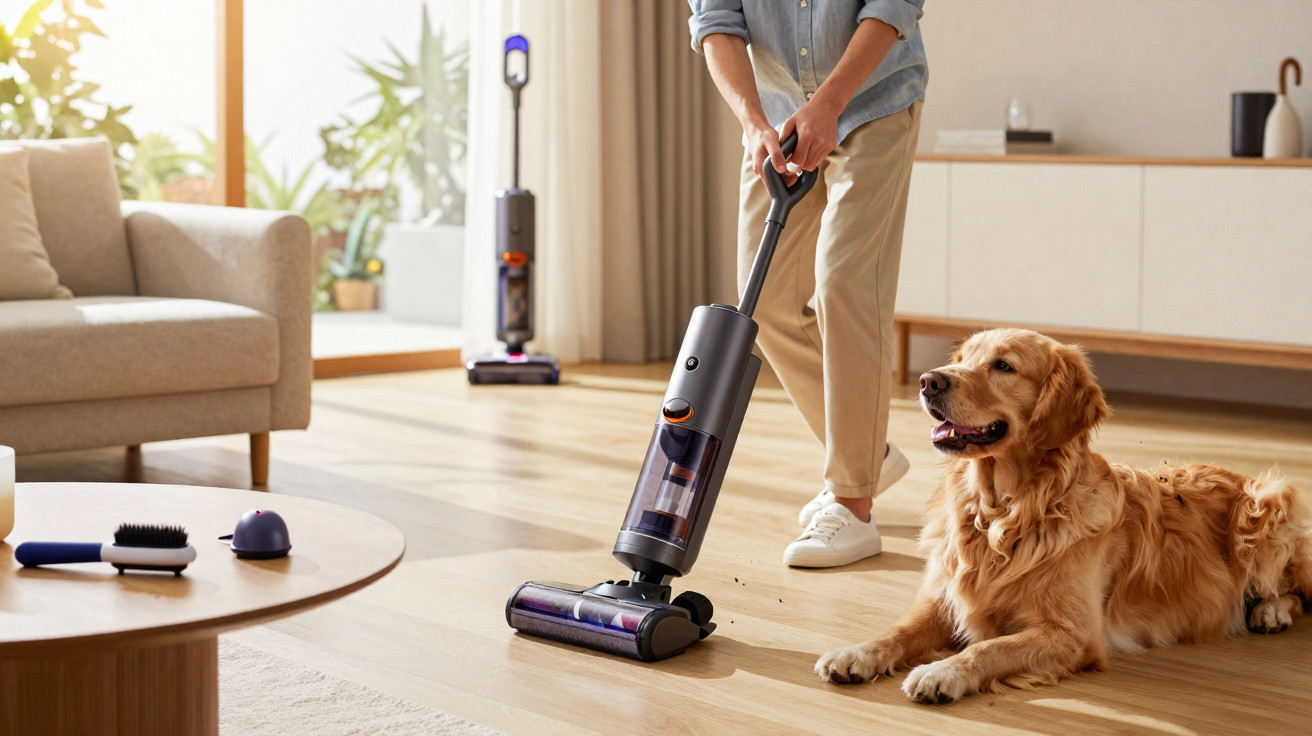
Xiaomi, best known for keenly priced smartphones, has been steadily assembling a credible range of home appliances. With the Vacuum Cleaner G30 Max, the brand steps squarely into Dyson’s space, prioritising high suction, long runtime and a generous bundle of attachments over big-budget promotion.
A cordless cleaner built to challenge Dyson
The Vacuum Cleaner G30 Max succeeds Xiaomi’s earlier G20 Max and significantly ups the headline cleaning power. Xiaomi quotes 280 air watts for the new model - a measure that reflects both airflow and suction pressure together. Compared with the G20 Max at 180 air watts, that is a sizeable increase, particularly for thicker carpets and more ingrained dirt.
Those numbers are not just competitive on a spec sheet. On Dyson’s side, the V12 Origin is roughly 120 air watts, while the V15 Detect Absolute comes in at about 240 air watts. Only Dyson’s newest V16 Piston Animal, launched in September, goes beyond Xiaomi’s figure, at 315 air watts.
The G30 Max positions itself in the same performance band as higher-end Dyson models, while aiming to keep a mid-range price.
If you are trying to cut through the jargon, it helps to separate air watts from motor wattage. A higher motor watt figure does not automatically translate into stronger cleaning. Air watts are intended to show how much usable power reaches the floor through suction and airflow, which is what tends to matter day to day.
Three cleaning modes and an intelligent dust sensor
Xiaomi splits the G30 Max’s operation into three cleaning modes. Turbo mode drives the unit at maximum output for demanding areas such as rugs, car mats and entryways. The trade-off is faster battery drain, but it is designed for short, focused tasks where you want each pass to count.
For longer, quieter cleans, eco mode dials the power back considerably. Because hard floors generally need less suction, eco mode is positioned as a way to reduce noise and energy use while still controlling visible dust.
The standout update versus earlier Xiaomi cordless models is the new automatic mode. Here, an integrated dust sensor gauges how dirty the surface is and adjusts suction on the fly. Features like this are still relatively uncommon in mid-range cordless vacuums, and they are meant to reduce the need to constantly swap power settings yourself.
The dust sensor lets the G30 Max save battery when surfaces are light to clean, and ramp up only where dirt actually accumulates.
In practice, that could mean running at lower power along a hallway, then briefly boosting suction over crumbs in the kitchen or where a pet tends to shed on a rug. This kind of adaptive behaviour can be valuable in both small flats and larger houses, as it avoids wasting battery capacity where it is not needed.
Battery life, filtration and dust bin: what changes in daily use
Inside, the G30 Max uses a 4,000 mAh battery. Xiaomi says runtime is up by 51% versus the older G11, with up to 70 minutes in eco mode when using the main motorised brush. Against the G20 Max’s 45 minutes, that extra half-hour could be the difference between finishing a flat in one session and having to stop mid-clean.
Real-world runtime will be shorter when you lean on automatic or turbo, but the claim still suggests enough endurance for a typical two- or three-bedroom home - particularly if the vacuum varies power levels sensibly.
Filtration has also been improved. The G30 Max uses a five-stage filtration system, and Xiaomi states 99.98% efficiency for fine particles. The implication is that it is designed to trap not only larger debris, but also smaller material such as pollen and some allergens, rather than circulating it back into the room.
A five-stage filtration chain helps retain very fine dust, an issue that often concerns allergy sufferers and pet owners.
Capacity increases too: the dust bin is 800 ml, up from 600 ml on the G20 Max. That should mean fewer emptying trips for homes where hair and debris build up quickly, such as with pets or children. The main floor brush also adds a practical touch - a white LED light to highlight dust and hair on hard floors. Once you get used to a lit brush head, it becomes easier to spot what can be missed in darker corners.
A full accessory kit, with special attention to pet owners
Xiaomi includes a broad set of accessories intended to cover large floor areas as well as awkward edges and furniture. In the box you get:
- Main electric floor brush with integrated LED light
- Small electric brush for mattresses, stairs and upholstery
- Dedicated nozzle for sofas and cushions
- Wide 2-in-1 brush for shelves and furniture
- Narrow 2-in-1 brush for tight spaces and car interiors
- Pet grooming brush for collecting hair directly on the animal
- Wall-mounted charging dock and accessory holder
The pet grooming brush is the most distinctive addition. It attaches to the vacuum, letting owners brush a cat or dog while suction lifts loose hair before it spreads around the house. Naturally, this only works if the animal is comfortable with the noise and the sensation of a brush connected to a vacuum tube.
If you do not have pets, the small electric brush is likely to become the second most-used attachment. It is suited to mattresses, car seats, stair treads and fabric headboards, where crumbs and dust mites tend to collect. The two 2-in-1 tools are aimed at regular trouble spots such as skirting boards, window frames, keyboards and other tight areas.
How it compares with Dyson on price and position
Xiaomi has not yet confirmed a release date or final European launch price for the G30 Max. Even so, looking at the previous generation makes the intended positioning fairly clear. The G20 Max currently sells for 299.99 € in Europe. By comparison, the Dyson V15 Detect Absolute launched at around 799 €, and the newer V16 Piston Animal at 849 €.
| Model | Approx. suction (air watts) | Launch price (Europe) |
|---|---|---|
| Xiaomi G20 Max | 180 | 299.99 € |
| Xiaomi G30 Max | 280 | To be confirmed |
| Dyson V15 Detect Absolute | 240 | 799 € |
| Dyson V16 Piston Animal | 315 | 849 € |
Should Xiaomi keep pricing near the G20 Max, the G30 Max would land at roughly a third of the cost of Dyson’s top models, while offering suction figures similar to the V15 and not far behind the V16. Even with a modest rise, Xiaomi would still be positioned to undercut Dyson by a wide margin.
Aggressive pricing combined with high air-watt figures puts strong pressure on Dyson in the mid- to high-end cordless segment.
For many buyers, the bigger unknown will be build quality, longevity and after-sales service. Dyson has a long-established reputation on these points. Xiaomi, while well versed in consumer electronics, still needs to demonstrate that its cordless vacuums remain reliable after years of routine use - especially in busy households with pets and children.
What “airflow” and “autonomy” actually mean at home
Airflow and suction: more than a spec sheet term
Vacuum cleaner advertising often blends several technical measures together. Airflow - measured in litres per second or cubic metres per hour - describes how much air the machine moves. Suction pressure, typically given in kilopascals, reflects how strongly it pulls air in. Air watts combine airflow and suction pressure to offer a more practical indicator of real cleaning power.
In everyday use, stronger airflow helps gather lighter mess such as dust, hair and crumbs across a broader area. Higher suction pressure is more helpful for pulling heavier particles out of carpet pile. When a model like the G30 Max pushes air watts higher, it is generally better placed to handle both scenarios - assuming the floor head design also delivers that power effectively.
Battery autonomy: why the headline number can mislead
In cordless vacuum terms, “autonomy” means runtime on a single charge, but the headline figure is usually measured in the lowest power mode. A claim of 70 minutes typically assumes eco mode on hard flooring with a non-motorised tool.
In reality, people mix modes. A more plausible pattern for the G30 Max could be 40 to 50 minutes blending automatic and eco for standard cleaning, with much shorter turbo bursts for carpets and spot work. This is exactly where Xiaomi’s dust sensor is meant to help: it aims to extend autonomy by adjusting power dynamically, rather than leaving you to guess the best setting room by room.
How the G30 Max fits into a changing home-appliance market
Xiaomi’s approach with the G30 Max also reflects how the cordless vacuum market is evolving. Not long ago, Dyson largely had the high-performance end to itself, while many rivals concentrated on cheaper, less powerful machines. Increasingly, brands with strong electronics know-how - particularly Chinese manufacturers - are bringing sensors, more efficient motors and larger batteries into this category.
For shoppers, that creates more choice but also more comparison work. Tools like dust detection, multi-stage filtration and pet grooming attachments are designed to meet specific needs. Before buying, households can weigh factors such as allergies, how many pets they have, floor types, storage space and how much noise they can tolerate. With the G30 Max, Xiaomi is aiming at people who want Dyson-level suction without paying Dyson prices, and who are willing to back a brand still building its home-care credentials.
A wider shift is happening too: smart gadgets and traditional appliances are converging. The same company that sells connected phones and wearables is now offering a vacuum that varies power based on detected dust levels. A logical next stage would be closer smart-home integration, usage data, or reminders to clean filters and brushes to help maintain performance.
For now, the G30 Max is an assertively positioned cordless vacuum still waiting on an official launch date and final pricing. Its combination of high air watts, long claimed autonomy and a well-stocked accessory kit puts obvious pressure on established names - and gives buyers another reason to reconsider which brand handles the weekly clean.


Comments
No comments yet. Be the first to comment!
Leave a Comment