
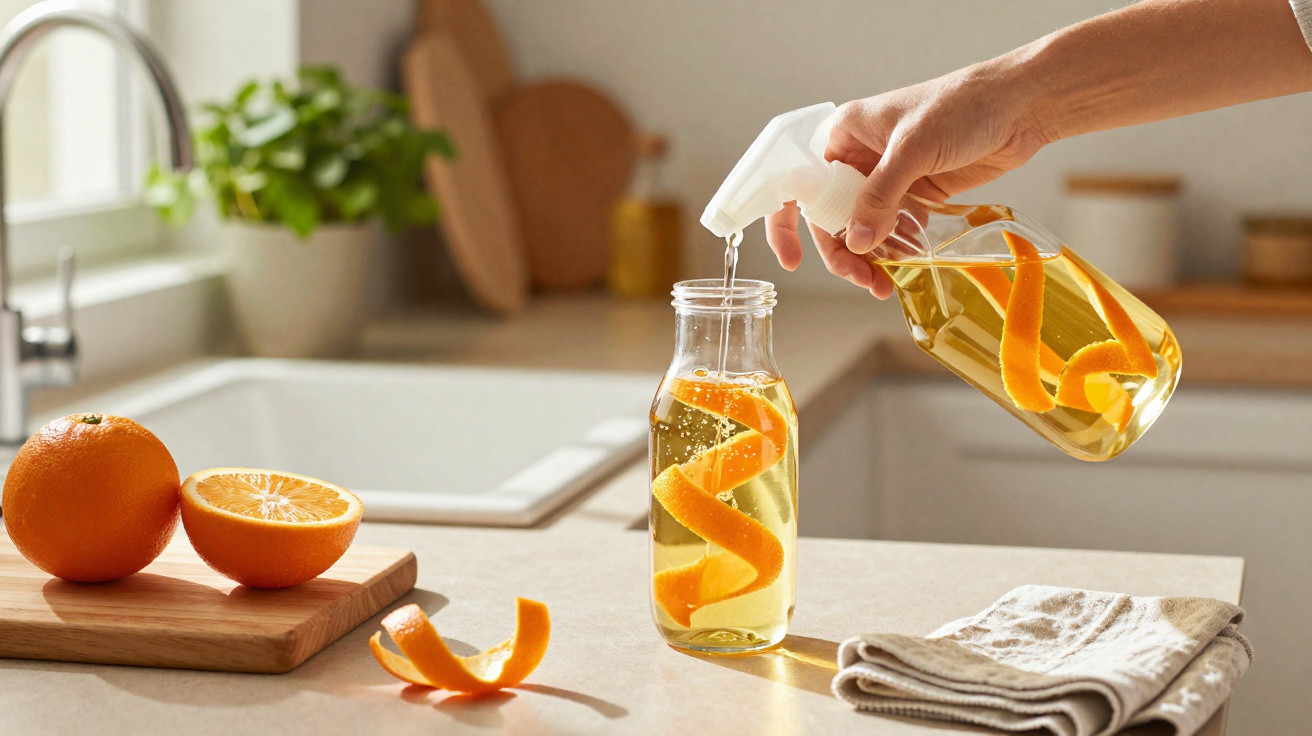
Among the homemade cleaning recipes that have become popular in recent years, the orange peel and vinegar mixture has emerged as one of the most talked-about options. It is straightforward to make, makes good use of organic leftovers, relies on easy-to-find ingredients, and is intended to produce a natural cleaner with decent yield, a distinctive citrus scent, and a lower cost than many ready-made products.
What is the orange peel and vinegar mixture, and why does it work?
The orange peel and vinegar mixture is a natural multi-purpose cleaner made by steeping orange peels in vinegar for several days. Vinegar’s acidity can help lift light grease, soap residue, and certain surface marks, without relying on complicated formulations.
Orange peel, in turn, releases citrus essential oils, which make the smell more pleasant and can strengthen degreasing in some situations. While it does not replace dedicated disinfectants in higher-risk areas, it can be useful for everyday household upkeep-especially for light dirt and unwanted odours.
Watch a video in which organisation and cleaning specialist Flávia Ferrari explains exactly how to make this degreasing multi-purpose cleaner using vinegar and orange peels:
How to prepare the orange peel and vinegar mixture at home
The method is simple, but cleanliness of the container, the ingredient ratio, and the infusion time all have a direct impact on the final result. Using white distilled vinegar is often preferred, as it tends to have a more neutral smell while still providing good acidity.
A commonly used step-by-step method is laid out like this:
- Wash the oranges thoroughly and keep only peels with no mould or spoiled sections.
- Put the peels into a clean glass jar with a lid and cover them completely with vinegar.
- Store in a dry, dark place for around 10 to 20 days, giving it a gentle shake from time to time.
- Strain after the infusion, pour into a spray bottle and, if you wish, dilute with water.
What is this mixture used for in cleaning, and how to get the best from it?
In day-to-day household routines, this solution is mainly used on washable surfaces, focusing on removing dust, light grease, and unpleasant smells. It is particularly helpful for maintenance cleans between deeper, more intensive sessions that use other products.
Commonly reported uses at home include non-porous worktops, tiles, shower screens, the outside surfaces of appliances, and neutralising odours in bins and drains. It is typically applied with a spray bottle and a microfibre cloth, while avoiding materials that react poorly to acidity, such as marble, unfinished wood, and waxed floors.
What benefits does the mixture offer, and how can you use it safely?
As well as cutting down on some shop-bought cleaners, this combination allows you to reuse peels that would otherwise be thrown away and to bring several functions together in a single bottle. Many people also appreciate the gentler citrus scent compared with strong synthetic fragrances.
To use it safely, test it first on a small, hidden area before applying it widely, keep the bottle tightly closed and out of reach of children and pets, and never mix it with bleach or other strong agents. Used in this way, the orange peel and vinegar mixture can be a practical, budget-friendly and surprisingly versatile helper for small everyday cleaning jobs.


Comments
No comments yet. Be the first to comment!
Leave a Comment