
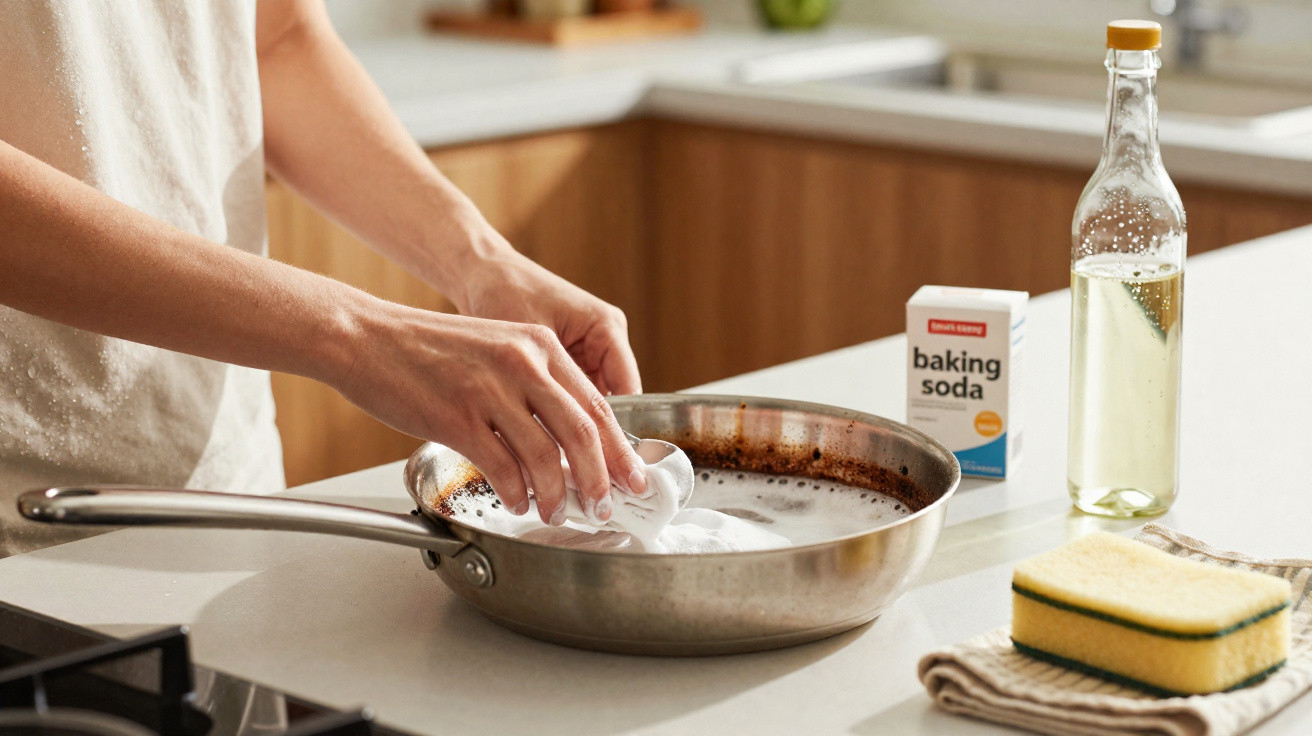
Cleaning a burnt pan is often a frustrating job in many kitchens, especially when food has stuck firmly to the bottom. Rather than reaching for harsh scourers or expensive products, there is a straightforward method that relies on just two everyday items, helping to lift the dark, baked-on layer without demanding excessive scrubbing across different types of pan.
What is the secret to cleaning a burnt pan with two ingredients?
The most popular low-effort combination for cleaning a burnt pan is bicarbonate of soda and vinegar. Found in most households, these two create a mixture that helps loosen stuck-on residue and dark marks without being overly aggressive on the surface.
Bicarbonate of soda works as a mildly abrasive cleaner, while vinegar adds acidic action that helps soften burnt-on grime. In many situations, the fizzy reaction starts lifting parts of the crust straight away, making the wash afterwards quicker and gentler.
How to apply the method step by step to a burnt pan
The process for cleaning a burnt pan with two ingredients is simple and can be adjusted depending on how severe the burning is. Following an easy sequence helps maximise the effect of the mixture and reduces the effort needed when you scrub.
- Remove loose residue: lift off any free bits of food with a spoon, avoiding scraping with sharp objects.
- Add a bicarbonate layer: cover the burnt base with a thin, even layer of bicarbonate of soda.
- Pour in vinegar: add white vinegar until the bicarbonate is well dampened, creating a fizzing paste.
- Leave it to work: let the mixture sit for 15 to 30 minutes for light burning, and up to about 1 hour for tougher cases.
- Optional simmer: for pans that can safely be heated directly, top up with a little water and warm on a low heat for a few minutes.
- Scrub gently: after the resting time, use a soft sponge to lift the crust, then rinse.
Allowing the mixture time to sit is a key part of the method, as it prevents over-scrubbing and lowers the risk of scratching the material. If small burnt patches remain, it is better to repeat the steps than to keep increasing the pressure.
How to adapt cleaning a burnt pan to the material
Not every burnt pan responds in the same way to the bicarbonate of soda and vinegar mixture. The material affects how you should apply it, how long to leave it in contact, and which sponge is best-particularly for more delicate coatings.
A few basic precautions help protect each type of pan during cleaning:
- Stainless steel: handles the mixture well and can be simmered on a low heat; you can scrub a little more, but avoid steel wool.
- Non-stick: avoid leaving vinegar on for long periods and use only a soft sponge.
- Aluminium: widely cleaned using this method, but too much force can mark the metal; repeating the process is the better option.
- Ceramic or enamel base: needs shorter contact time and light movements to avoid dulling the shine.
What helps stop the pan burning again?
Beyond the two-ingredient method, a few everyday kitchen habits significantly reduce the chance of heavy burning. Keeping the heat under control, stirring thicker dishes, and not letting liquids boil away completely in the pan can all make a noticeable difference.
It also helps not to heat an empty pan on a high flame for too long, and to wash up soon after use while residue is still damp. When burning does happen, bicarbonate of soda and vinegar are simple allies for restoring a burnt pan with less effort and less wear on the coating.


Comments
No comments yet. Be the first to comment!
Leave a Comment