
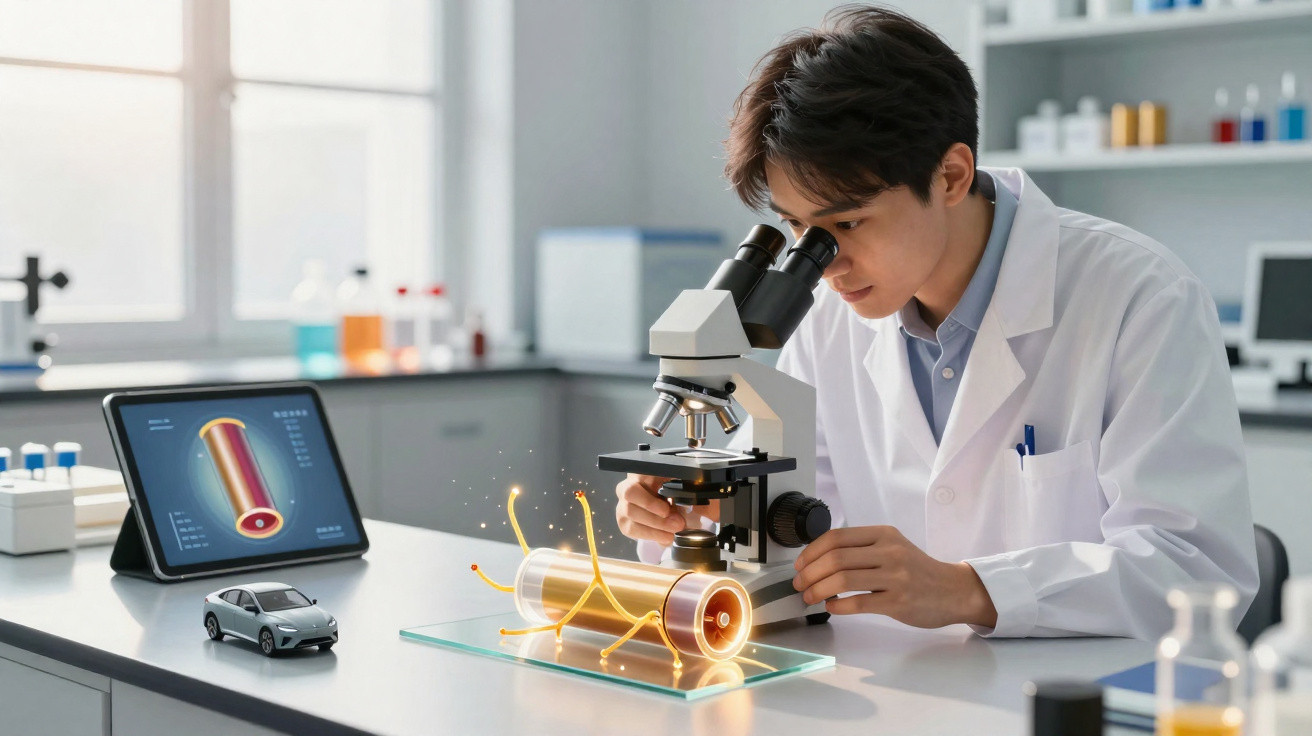
For years, a simple assumption was treated as almost certain: the delicate structures that form inside lithium batteries behave like soft metal. A nanoscale experiment now shows that this picture was wrong - and, in doing so, offers a clear explanation for why batteries age faster, lose capacity, and in the worst cases can even catch fire.
What really goes wrong inside lithium batteries
Whether it is a smartphone, a laptop, or an electric car, almost all rely on lithium-ion batteries. From the outside they look unremarkable, but inside, complex physics and chemistry are at work. During charging and discharging, tiny metallic structures build up on the anode: so-called dendrites.
These formations are extremely thin - far finer than a human hair. With every charge cycle they continue growing towards the separator, the membrane that electrically keeps anode and cathode apart. If they pierce it, an internal short circuit occurs.
“Dendrites are the invisible troublemakers of modern batteries - smaller than dust, with consequences all the way up to battery fires.”
When a short circuit happens, electrons take the direct route through the inside of the cell instead of flowing through the external circuit as intended. That leads to:
- intense local heating inside the battery
- rapid loss of capacity
- in extreme cases, thermal runaway and a fire risk
As a result, millions of batteries worldwide quietly lose performance year after year or fail earlier than expected. Until now, research largely assumed these dendrites behaved like soft, easily deformable lithium. A new study is now challenging that assumption.
Researchers capture lithium dendrites snapping like dry spaghetti
A team from the New Jersey Institute of Technology and Rice University has, for the first time, examined dendrites directly under an electron microscope at the nanoscale. To rule out interference, the experiment was carried out in a high vacuum, with no oxygen or moisture present.
Even seasoned battery researchers found the outcome unexpected: the fine needles do not bend - they fracture. The structures behave more like glass or dry spaghetti than like a soft metal.
“The dendrites don’t yield - they just snap. That changes the whole understanding of battery damage.”
Measurements show just how extreme the effect is. While bulk lithium has a mechanical strength of about 0.6 megapascals, the dendrites reach values around 150 megapascals. That makes them roughly 250 times stronger than the material they are made from.
The key lies in an ultra-thin shell. A layer of oxide forms immediately on the dendrites’ surface. It is only a few nanometres thick - yet it has an outsized impact. It turns a soft metal into a hard, brittle structure. As a result, dendrites act like tiny harpoons: they can punch through the separator without bending.
Why this slows the dream of the super-battery
For years, one technology has been seen as a major hope: lithium-metal batteries. Instead of a graphite anode, they would use pure lithium. The potential benefit is enormous: broadly speaking, energy density could be tripled.
For electric cars, that would mean that rather than 300 kilometres of range, 800 to 900 kilometres on a single charge could be feasible. Carmakers, suppliers, and start-ups around the world are chasing that prospect with multi-billion budgets.
But this promising approach has, so far, been held back by the dendrite problem. Pure lithium is even more prone to forming these needle-like structures. With the newly measured high strength, it becomes clear why many earlier solutions have come up short.
There is another issue as well: when dendrites break under stress, small pieces of lithium remain inside the cell. The research team refers to this as “dead” lithium. These fragments are electrically isolated, no longer take part in charging, and occupy space inside the cell.
“Every broken dendrite tip leaves behind dead lithium - and usable capacity shrinks a little further with each cycle.”
For users, the practical impact is straightforward: the battery never reaches its theoretical service life. After noticeably fewer charge cycles, range drops in a way you can feel, or the device needs to be plugged in more often.
Why solid electrolytes on their own are not enough
In battery development, the long-standing belief has been that solid electrolytes could solve the dendrite issue because they are more stable than liquid ones. The new study suggests that is only partly true. Extremely stiff dendrites can also penetrate solid electrolytes if the material is not tough or flexible enough.
That leaves the industry facing a change in strategy. Simply putting “harder” materials into the cell is not sufficient. What is needed are concepts that influence how dendrites form and grow at the atomic level.
Three concrete approaches to taming dendrites
The research groups involved are now working on three material strategies that follow directly from the new findings:
- Lithium alloys: By mixing in other metals, the aim is to modify pure lithium so that the rigid oxide layer forms less easily or ends up less brittle. The goal is a material that produces fewer sharp needles, or that tends towards blunter, safer structures.
- Intelligent separators: New membranes between anode and cathode should be not only hard, but also elastic enough to spread mechanical stress. Think of it like an airbag at microscopic scale, catching or deflecting dendrite punctures.
- Special electrolyte additives: Additives in the electrolyte are intended to influence the dendrites’ crystal structure as they form. The aim is for them to grow not as brittle needles, but as broader, less hazardous deposits.
If these three routes can be combined successfully, lithium-metal batteries could become far more reliable. Carmakers would then be a decisive step closer to vehicles with ranges comparable to conventional combustion engines - without constant range anxiety.
What this means for electric cars and power grids
For e-mobility, more robust high-energy batteries would be attractive in two ways. First, cars could travel much further with the same battery size. Second, battery packs could be made smaller, saving weight and reducing costs.
The effect could be even bigger in the energy sector. Solar installations and wind farms need enormous storage to buffer electricity from sunny or windy hours. The more energy a single battery can hold, the smaller and cheaper those storage farms can be.
A longer lifespan also reduces demand for raw materials. Fewer battery replacements mean less lithium mining, lower cobalt and nickel consumption, and a smaller environmental burden.
How one wrong assumption can cost decades
Above all, this work highlights one point: a plausible assumption that is never directly tested can hold back an entire industry. The idea that dendrites were soft and flexible shaped material choices, safety concepts, and modelling over decades.
With modern nanoscale imaging, such foundational assumptions can be examined far more rigorously. Direct observation replaces guesswork. In fields such as aviation, energy storage, or semiconductor technology, that can determine whether entire technologies succeed or fail.
A few terms, briefly explained
- Dendrites: Fine, tree- or needle-like metal structures that form on the anode during charging.
- Separator: A thin, porous film inside the cell designed to prevent short circuits between anode and cathode.
- Energy density: A measure of how much energy can be stored in a given mass or volume.
- Dead lithium: Metal remnants in a battery that are electrically cut off from the rest of the material and no longer participate in the reaction.
What users can do today
Even though this research has not yet made it into mass-produced batteries, more mindful day-to-day use still helps. Extreme fast charging, very high or very low temperatures, and keeping a battery permanently at 100% put more strain on the internal components and encourage unfavourable structures.
Anyone who runs their electric car, smartphone, or laptop more often within a mid-range state of charge and avoids major heat spikes can slow cell ageing - at least within the limits of today’s technology. The new insights into the true nature of dendrites increase the chances that future batteries will tolerate such everyday “care mistakes” far better.






Comments
No comments yet. Be the first to comment!
Leave a Comment