
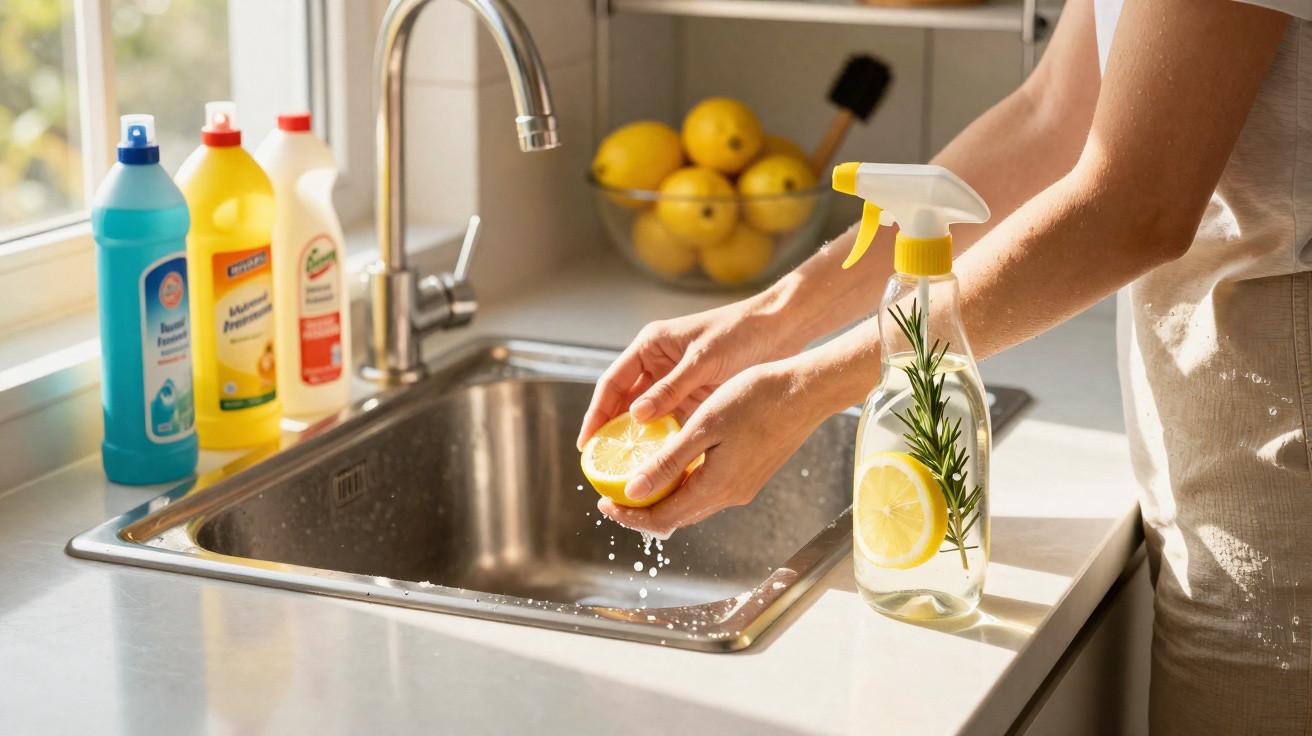
Off to one side sat a half-empty glass cleaner, a greasy hob and a sink marked with water spots. It was one of those evenings when the kitchen looked more like “long day” than “Pinterest”. Out of sheer convenience, I cut a lemon to squeeze into my water. A splash of juice landed on the stainless-steel sink - and instantly left a lighter streak. I rubbed the surface once with the lemon half. The mark vanished. No foam, no chemical haze, no plastic spray trigger. Just that small yellow fruit that can do far more than brighten a cup of tea. And in that moment, a quiet, slightly cheeky question popped into my head.
Why a lemon of all things?
If you only ever see a lemon as decoration in a jug of water, you’re missing its undercover role as a cleaning pro. Inside that unassuming peel is a stubborn mix of acid, essential oils and odour-fighting power. In many homes, colourful bottles pile up: one for limescale, one for grease, one for bad smells. And right in the middle of it all, there’s often a single lemon, sitting there as if it’s waiting to be called up. We all know that moment in front of the cleaning cupboard when you pause and think: which of the eight sprays was meant for the taps again?
More and more kitchens are swapping that clutter for a small still life instead: bicarbonate of soda, vinegar - and a lemon, cut open and ready to go. An Allensbach survey a few years ago found that almost a third of Germans felt “overwhelmed” by the range of household cleaners on offer. In chats with friends, the same pattern kept coming up: people buy specialist products, use them twice, then forget about them. One friend told me she had to throw away five different cleaning bottles when she moved house - all half full, all out of date. The lemon, though, is the one thing she buys fresh every week.
There’s a straightforward truth in that: many everyday cleaning problems are simpler than supermarket shelves would have us believe. Citric acid tackles limescale, breaks down greasy residues and neutralises classic kitchen stink sources like onion, garlic or fish. Of course, it isn’t a disinfectant in the medical sense. But in normal day-to-day life, its punch is often enough to stand in for three familiar cupboard staples: a limescale remover, a grease-cutting kitchen cleaner and an air freshener. And it comes with something no plastic spray bottle can offer: the quiet satisfaction of managing with fewer chemicals.
How a lemon replaces three cleaning products
The simplest method is this: cut a lemon in half and use one half like a natural sponge.
For removing limescale in the bathroom, rub the cut side over taps, the shower head and the mixer. Leave it for a short moment, rinse with clean water and buff dry. The acid shifts the white marks without you breathing in harsh fumes. For stubborn patches, sprinkle a little salt onto the cut surface - it adds a gentle abrasive effect, like a fine exfoliant for metal.
In the kitchen, a lemon can take the place of your grease-busting cleaner. The trick: squeeze a few drops of lemon juice straight onto a greasy hob, let it sit briefly and wipe with a damp cloth. It’s particularly effective on dried-on splashes from frying. If you like, mix lemon juice in a small bowl with a little warm water and a tiny drop of washing-up liquid. You can use that to wipe cupboard fronts, clean handles and even refresh the microwave - heat a bowl of water with lemon slices for a few minutes, wait a moment, then wipe it out. The inside smells clean again.
The third job is as a natural odour brake. Slice the lemon and place one or two pieces in the fridge or in a small dish next to the sink. If a chopping board smells unpleasant, rub it firmly with the cut side, leave it for a moment, then rinse. In the bin, an already-squeezed lemon half is enough: place it on a piece of kitchen paper and set it on top of the rubbish. Many people who try it once say the whole room feels different - less stale, more fresh, without that artificial floral scent. Let’s be honest: nobody truly sprays air freshener every day just because the kitchen smells of onions.
What to watch out for so the lemon really shines
A simple “lemon-based basic kit” often comes down to a small routine. Don’t keep one or two lemons only in the fruit bowl - leave them in sight near the sink. As soon as you start cooking, cut one open and use the leftovers on purpose. First, flick a bit of juice onto the tap; then rub the peel briefly over the hob; finish with the chopping board. That way, the lemon becomes more than an ingredient - it turns into a small cleaning ritual. If you want, pour a mix of water and lemon juice into a glass spray bottle and use it as a light everyday surface cleaner.
There are a few traps almost everyone falls into at the start. Some people get enthusiastic and rub lemon on absolutely everything - including delicate natural-stone worktops or unsealed marble. In those cases, the acid can do more harm than good. A quick test in an inconspicuous area is the safest approach. Others leave lemon on for too long: yes, the limescale loosens, but dull patches can be left behind. And then there’s the time factor. Anyone expecting a lemon to “quickly” rescue an oven often ends up disappointed. For years of baked-on layers, you need more than a piece of fruit and good intentions.
At the same time, people who clean with lemon regularly often describe a sort of mental relief. Fewer bottles, fewer labels, fewer warning symbols. More clarity, and more of that fresh-kitchen smell instead of “chemical lab”. One reader wrote to me:
“Since I started using a lemon like a small tool, cleaning feels less like a chore and more like a quick reset for my kitchen.”
It helps to keep the fruit’s three-in-one role in mind:
- As a limescale remover for taps, sinks and shower heads
- As a grease-breaker for hobs, microwaves and kitchen fronts
- As an odour neutraliser for fridges, bins and chopping boards
What changes when a lemon tidies up the cleaning cupboard
If you take an honest look through your cleaning cupboard, you won’t find a miracle of organisation - you’ll find a miniature museum. Bottles with old logos, specialist products for problems you’ve long forgotten, half-used sprays you can’t even remember buying. Once you start using a lemon deliberately, a quiet shift in perspective often follows: the question of what you actually need gets louder - and what you’re just carrying along out of habit. A lemon almost forces you to pay attention again: how do the taps respond? what does the kitchen smell like afterwards? how many products could you remove?
There’s also an unexpectedly social side to this small change. When people come round, we often feel self-conscious: the kitchen isn’t perfect, there are water marks somewhere, the bin is half full. But if someone asks, “What smells so fresh?”, and you answer, “Just a bit of lemon in the sink,” it leads to a different kind of conversation. Suddenly it’s about simple tricks, everyday life and that quiet wish for home to feel a little easier. Perhaps that’s the lemon’s hidden charm: it’s so ordinary that nobody feels lectured.
A lemon won’t turn your home into a glossy magazine set. It won’t work miracles if years of “I’ll do it later” have built up. But it can be a small counterweight to feeling overwhelmed by shelves full of colourful promises. A yellow dot in your line of sight that says: start small. Use what you already have. Make something useful out of a leftover. Once you’ve seen how a single lemon can replace three bottles, you often rethink not only your cleaning cupboard, but other routines too. Your next lemon might tell you more about your home than you expect.
| Key point | Detail | Benefit for the reader |
|---|---|---|
| Lemon as a limescale cleaner | Citric acid dissolves limescale on taps, sinks and shower heads, applied using the cut surface | Saves buying a dedicated bathroom cleaner and reduces day-to-day chemical use |
| Lemon as a grease remover | Used directly on the hob or in a water-and-lemon mix for surfaces | Replaces a grease-cutting kitchen cleaner and makes use of food leftovers you already have |
| Lemon as an odour killer | Slices in the fridge, in the bin, or rubbed into chopping boards | Fresher air without artificial scents, less need for air fresheners |
FAQ:
- Can a lemon really replace all chemical cleaners? No - it mainly replaces light limescale, grease and odour products, but not strong disinfectants or specialist cleaners.
- Which surfaces should I not use lemon on? Sensitive natural stones such as marble, limestone and unsealed concrete can react badly to acid and may become dull.
- How long should lemon juice be left to work? On metal and ceramic, usually only a few minutes - it’s better to apply briefly more often than leave it on once for too long.
- Can I keep leftover lemon for several days? In the fridge in a container for one to two days; after that it shrivels and loses effectiveness.
- Is cleaning with lemon cheaper than conventional cleaners? In many households, yes, because a regularly bought lemon can partly replace several specialist products and is less likely to sit unused in the cupboard.


Comments
No comments yet. Be the first to comment!
Leave a Comment