
The vacuum bellows, the cable catches around a chair leg, and there’s that faint whiff of warmed-up dust.
After three minutes your wrist is aching, your back is complaining, and that crumb under the table is still there - wedged stubbornly against the skirting board. You switch it off and the sudden quiet fills the room. It doesn’t feel crisp or clean. A moment ago it was just loud. Now it’s simply… not very fresh.
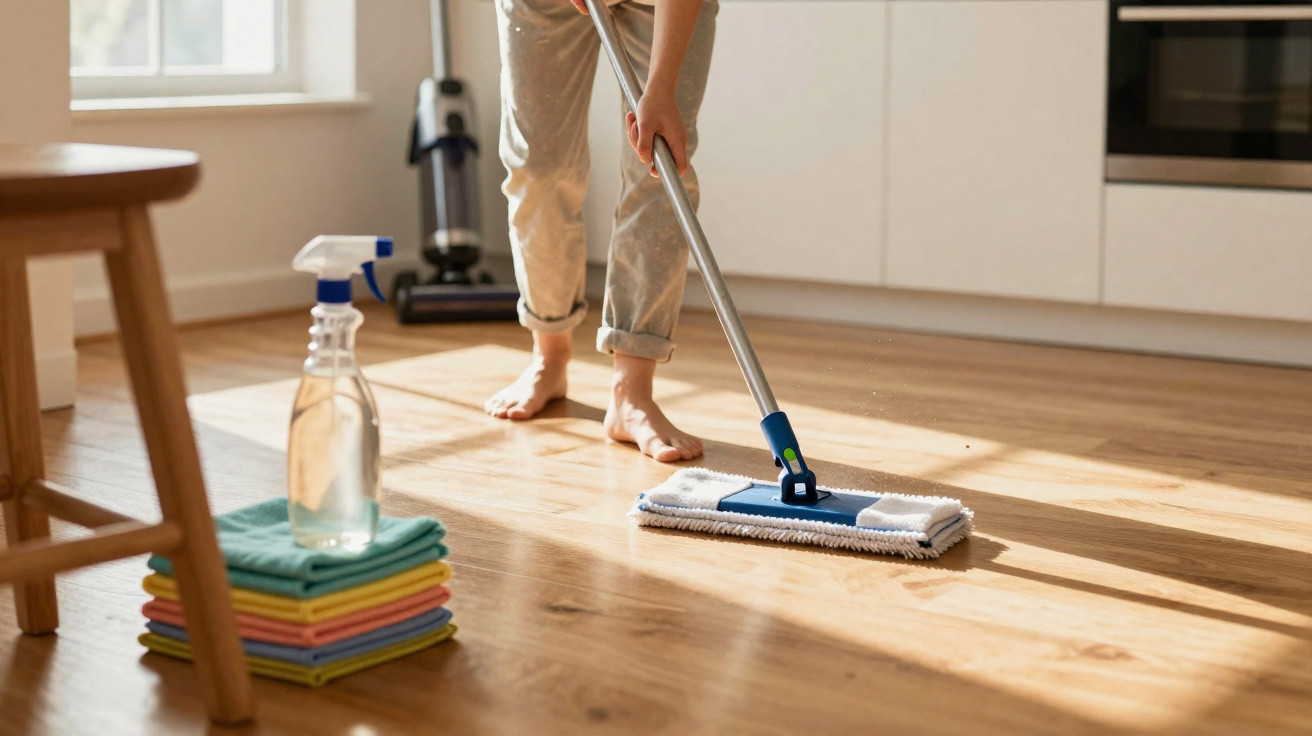
Almost on autopilot, you reach for something old-school: a flat mop with a damp microfibre pad. Two swift passes. The floor looks changed - calmer, somehow. The dust the vacuum seemed to shuffle about is now stuck to the cloth as if it never wanted to let go. You glance down at the pad and feel a little horrified by what was actually sitting on your floor.
That’s when the odd realisation lands: in some rooms, vacuuming may not be the smartest choice at all.
Why vacuuming isn’t the hero in every room
In a compact bathroom, you can vacuum and still catch dust drifting in the light afterwards. Fine hairs cling along the skirting. There’s a strange ribbon of fluff behind the loo. The vacuum has been “everywhere”, yet the edges and corners still look untidy. On tile or vinyl, the wheels chatter over grout lines and the floor head thuds into the sink pedestal like a trolley with a wonky wheel.
Hard flooring is ruthless about half-done cleaning. It throws back light, shows footprints, and makes water marks obvious. Vacuums are designed for speed and volume: excellent on carpets and in large open rooms. But once you’re in cramped, awkward spaces - bathrooms, entrances, kitchens, utility rooms - the size and shape start working against you. The machine feels ungainly, and the dirt always seems a step ahead.
A London cleaning company reviewed its repeat visits for “doesn’t really feel clean” complaints. Month after month, kitchens and bathrooms topped the list - even when teams used powerful commercial vacuums. The feedback was remarkably consistent: edges, corners, behind doors, around toilets, under radiators. Places a vacuum can technically reach, but rarely reaches well.
One cleaner summed it up: “The vacuum gives people confidence. The mop gives them proof.” When she swapped to a sweep-then-mop routine in small hard-floor rooms, the complaints dropped almost overnight. No new tech - just a different tool. The stubborn grime line along the bath edge? Removed. The dull grey film in front of the basin? Lifted onto the cloth rather than pushed aside by moving air.
Vacuums clean by shifting air. In deep fibres, that’s ideal: crumbs and dust sit within the pile, and suction pulls them up. On smooth surfaces, the airflow can flick lighter particles sideways, driving dust into grout lines, tiny cracks, and under skirting boards. Hair winds around wheels and brushes. Fine powder rides the air stream and settles elsewhere.
That’s why a simpler approach can win in certain rooms: remove dirt by contact, not by chasing it with suction. It’s like the difference between writing with a pen and trying to tidy confetti with a leaf blower. A flat microfibre mop - or a good broom plus a damp cloth - doesn’t blast dust around. It gathers it, traps it, and takes it out of the room. Quietly. No cable, no motor, no drama - just dirt, gone.
The cleaning method that secretly beats your vacuum
The routine is almost comically straightforward: sweep (or dry-dust) first, then damp-mop with microfibre. No fancy gadgetry - just a two-step process that hard floors seem to “want”. In a small bathroom, begin with a quick pass using a soft-bristled broom or a dry microfibre mop head. Go steadily rather than frantically; you’re aiming for dust to cling, not lift and float.
Next, take a microfibre pad that’s lightly damp (moist, not dripping) and move the mop in overlapping strokes. Start at the far corner and work back towards the door, as if you’re painting the floor. The pad acts like a magnet for skin flakes, hair, fine dust, and even faint residue from products. On tile, the cloth presses into grout lines where vacuum heads barely make contact. On vinyl or laminate, it grips the grey film that can leave floors looking dull even “right after” vacuuming.
This is where the method really earns its keep: rooms that collect sticky, invisible traces of daily life. In the kitchen, sweeping picks up the obvious crumbs, while the damp microfibre pad lifts oily mist, sugary spills, and dried splatters around the hob and sink. In the entrance, it pulls up gritty particles from shoes that a vacuum may suck up and then nudge sideways. In a utility room, it captures lint that drifts off clothing and settles on the floor.
Let’s be honest: nobody truly does this every day. Even so, you notice the benefits quickly with just once or twice a week. People who switch to this “low-noise cleaning” often say the room smells cleaner, despite using no strongly fragranced product. That’s what happens when you remove the grimy film instead of merely stirring it.
The science is, frankly, straightforward. Microfibre is made from ultra-fine split fibres, creating extra surface area and tiny hooks that physically grab particles. Used slightly damp, it can remove more than 90% of bacteria from smooth surfaces, according to several independent cleaning studies. A vacuum may boast HEPA filtration and strong suction, but on hard floors in cramped rooms it’s still largely air moving around hard obstacles.
In a busy bathroom, airflow gets disrupted by pipes, baskets, scales, and chair or cabinet legs. Some dust is pulled in, some is pushed aside, and some is lifted and redistributed. That’s why a bright strip of sunlight after vacuuming can feel so unforgiving. A flat mop, guided slowly by hand, avoids that problem. It traces edges, slips behind the bin, and wraps its pad around the base of the toilet where no vacuum head ever truly fits.
How to make the “better than vacuuming” method actually work
Begin by choosing tools that suit the job. A flat microfibre mop with removable, machine-washable pads hits the sweet spot. A swivel head helps it lie almost flat under furniture and reach behind toilets. Keep at least two pads for each room you clean often, so you’re not spreading yesterday’s grime back over the floor.
For small spaces, stick to a simple pattern: collect, then wipe. First, collect loose debris with a broom or dry mop. Second, wipe with a damp pad using a bucket of warm water and a small dash of gentle cleaner. Swap the pad as soon as it starts to look grey. Two quick passes with a clean pad beat endless scrubbing with a dirty one - and your nose will often notice the improvement before your eyes do.
Many people trip up by using far too much water. The result is streaking, stickiness, or - worst of all - slight edge warping on vulnerable flooring. The pad should feel lightly moist, not heavy. If you step down and hear a squelch, you’ve gone too far. Long, unhurried strokes outperform frantic scrubbing every time. You’re gliding, not battling.
On an exhausting day, it’s easy to ignore corners, clean only what’s obvious, and call it finished. That’s normal. Practically speaking, though, the skipped areas are often where odours start: behind the loo, along the shower base, under the shoe rack. When those spots become part of your route rather than an afterthought, the entire room feels different. In a rough week, even five focused minutes in a bathroom with a microfibre pad can feel like hitting reset.
“The game-changer wasn’t a new product,” a professional cleaner told me. “It was slowing down enough to actually touch where the dirt lives.”
- Best rooms for this method: bathrooms, kitchens, entrances, utility rooms.
- Best floors: tile, vinyl, sealed wood, laminate and polished concrete.
- Avoid over-wetting: especially on wood or laminate; aim for a light mist, not puddles.
- Wash pads hot: 60°C if your care label allows, and avoid fabric softener so they stay grippy.
- Keep one pad solely for the toilet and the immediate area around it, and wash it separately from the rest.
What this small shift changes in your everyday life
There’s a quiet sort of relief in cleaning without the growl of a motor. In a small flat or a lively family house, it changes the whole tone of the task. You can chat to someone in the next room. A podcast can stay at a normal volume. You can hear yourself think. It feels less like wrestling a machine and more like looking after your space.
More than that, this approach gives you back a sense of control in rooms that slip into chaos easily. That tiny bathroom that starts to smell “a bit off” after a few days? The mop-and-microfibre routine targets the film you usually miss. The tacky patch in front of the kitchen sink that never quite disappears with vacuuming alone? Two slow passes with a damp pad, and it’s dealt with.
Everyone knows the moment you catch the floor in daylight and think, “When did it get this bad?”. It’s rarely about big crumbs. It’s the fine daily layer that clings. Vacuuming remains a strong ally - especially for carpets, rugs, and large open areas. But in the tight, real-life rooms where dust, moisture and habits collide, the humble sweep-and-microfibre combination often does the cleaner job. And once you’ve seen what ends up trapped in that pad, it’s difficult to forget.
| Key point | Detail | Benefit for the reader |
|---|---|---|
| Microfibre + damp mopping beats vacuuming on hard floors | It traps dust, hair and residue by contact rather than blowing them about with airflow | Rooms look and smell cleaner with less effort and less noise |
| Best in small, awkward rooms | Bathrooms, kitchens, entrances and utility rooms with edges, pipes and tight corners | Tackles the exact areas that often stay dirty even after vacuuming |
| Light moisture and clean pads are crucial | Use slightly damp pads, change them often, wash hot without fabric softener | Helps prevent streaks, sticky floors and hidden bacteria build-up |
FAQ:
- Is sweeping and mopping really better than vacuuming on hard floors? On smooth floors in small rooms, often yes. Sweeping or dry mopping gathers loose debris, then a damp microfibre pad captures fine dust, hair and residue that a vacuum tends to scatter or miss along edges.
- Do I still need a vacuum if I switch to this method? Yes. Vacuums are still best for carpets, rugs and large open areas. The sweep-and-mop routine is a useful complement, particularly in bathrooms, kitchens and entrances.
- How often should I mop with microfibre in a bathroom or kitchen? In a busy home, once or twice a week is a sensible rhythm. High-traffic spots - such as in front of the sink or shower - may benefit from a quick targeted pass more frequently.
- Can I just use a traditional string mop instead of microfibre? String mops hold a lot of water and often push dirty water into grout and corners. Microfibre uses less water and traps dirt in the fibres, which usually means a cleaner result and faster drying.
- What kind of cleaner should I use with a microfibre mop? Choose a mild, low-foam floor cleaner diluted in warm water - or simply warm water for light maintenance. Very harsh or overly soapy products can leave residue that attracts dust and makes floors look dull.

Comments
No comments yet. Be the first to comment!
Leave a Comment