
The bottle slipped again. The moment you hauled it out from the back of the cupboard, the neck spun in your grip like a bar of soap under the shower. A fine sheen of oil coated the glass, hoovering up crumbs and dust and turning your “extra virgin” into “extra gross”. You wiped your hand on a tea towel - and now the tea towel felt tacky. Then you touched the cupboard door. Then the fridge handle. With every reach, the mess spread like a widening crime scene.
You tried rinsing the bottle under hot water - no change. You went in with washing-up liquid - still sticky. You even toyed with the idea of decanting the oil into a fresh bottle, but you knew exactly how that story ends. After a while, it’s tempting to assume grimy, sticky oil bottles are simply the price of being an adult who cooks.
They aren’t. There’s one straightforward trick that hardly anyone uses.
The real reason your oil bottle always feels dirty
Take a close look at any cooking oil bottle and you’ll usually spot the giveaway: an almost invisible “halo” around the neck and cap. After each pour, tiny drips creep downwards and spread into a greasy ring. Then everyday life does the rest - you boil pasta, children charge through the kitchen, someone gives the bottle a bit too enthusiastic a shake. Dust, flour, breadcrumbs, ground coffee: they all stick to that oily band as if it were glue.
What makes it so frustrating is that the grime doesn’t stay on the bottle. Your fingers hit that ring every time you pick it up, and those same fingers then go straight to the salt, the fridge, the cupboard handles. Before long, it isn’t one sticky bottle - it’s a whole “oil ecosystem” across the kitchen.
A home cook in Lyon told me she only noticed the scale of the problem when she took everything off her counter to repaint the wall. “I thought my counter was just old,” she said, “but under the spice rack, it was like a thin layer of glue.” She traced it back to a single leaky olive oil bottle sitting next to the stove. Once she wiped the wall, she could actually see a faint spray pattern around where she usually drizzled oil into the pan.
That’s the part people miss: these bottles don’t merely get sticky - they distribute the stickiness. A 2019 household hygiene survey in Europe found kitchen handles were among the top three most contaminated spots in the home, right after sponges and taps. Oils don’t carry bacteria like raw meat, but they do trap dirt, crumbs and dust, which is why cleaning can feel never-ending.
Hot water and ordinary soap often lose this battle for a basic reason: oil is made to repel water. Washing-up liquid can break it down to a degree, but once the oil has combined with airborne dust and dried into a thin film, you’re dealing with something closer to a greasy varnish. Each new micro-drip reactivates that film and nudges it a little further.
So the bottle never seems properly clean because you’re only removing the newest layer, not tackling what’s underneath. It also explains why a bottle feels fine straight out of the dishwasher, then turns annoyingly tacky again within a week. The same routine - pour, drip, wipe on a sleeve - recreates the mess from zero.
The unexpected trick that actually breaks the greasy cycle
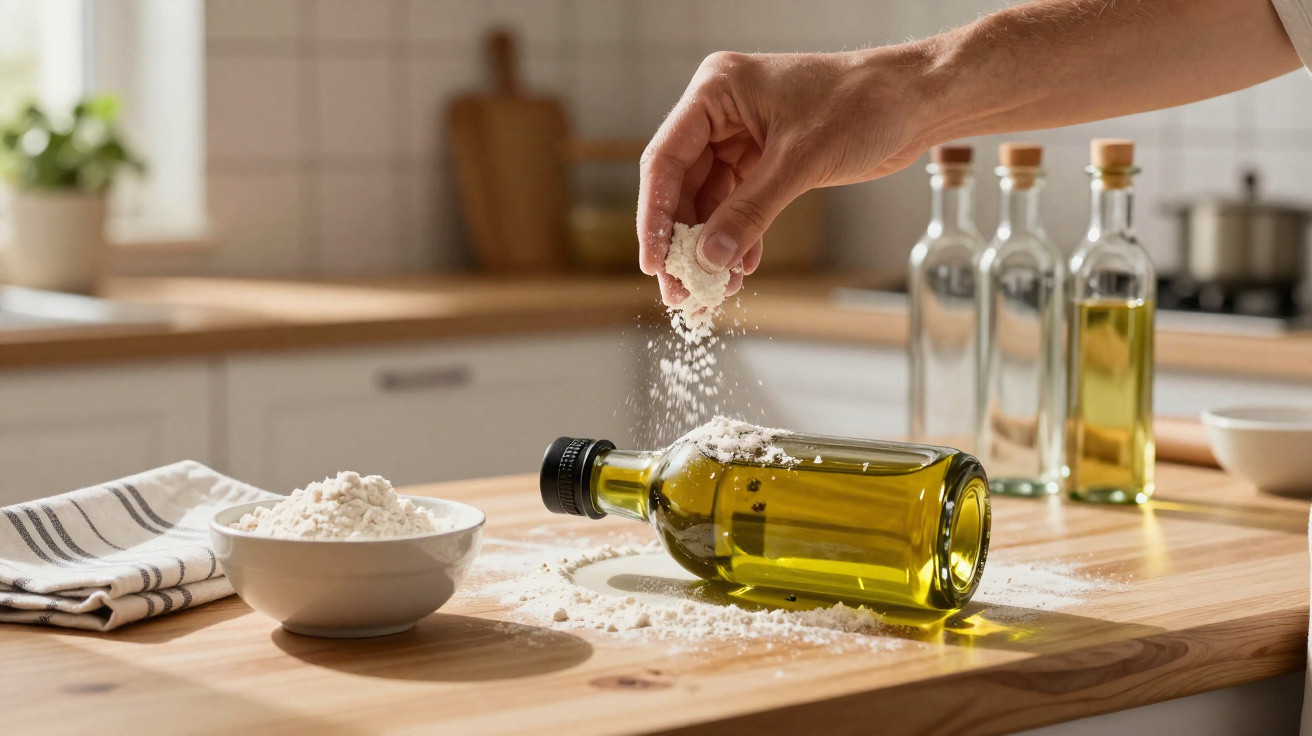
Here’s the slightly odd move that changes everything: before you wash a sticky oil bottle, clean it with flour. Not bicarbonate of soda. Not vinegar. Just plain white flour. Put a sheet of kitchen paper or newspaper on the worktop. Tip a tablespoon of flour into your palm, then gently “massage” the outside of the bottle, focusing on the neck and the base.
The flour grabs the oil as if it were magnetic. As you rub, it clumps into small greyish crumbs that lock in the grease and grime. Wipe those crumbs off with a dry cloth or fresh kitchen paper. Only after that do you rinse with hot water and a little washing-up liquid. All of a sudden, the glass feels squeaky-clean again - and you realise just how tacky it had become.
Most of us don’t think to use a dry ingredient on a greasy problem, which is exactly why it works. Water tends to smear oil around; flour turns it into something you can lift away. The same approach helps with the oily ring under the bottle, or the greasy circle it leaves on a wooden shelf: dust flour over the mark, wait a few seconds, then rub in slow circles and sweep away the clumps.
A few cautions help. Don’t shake flour straight into a sink full of water, or it can turn into a pasty mess. Put the oily flour crumbs in the bin instead. And don’t be heavy-handed on delicate natural stone with deep pores - use a light touch and try a test patch first. Realistically, nobody is doing this every single day.
What’s great about this trick is that it relies on something almost every kitchen already has, rather than a specialist “degreaser” that ends up forgotten at the back of a cupboard. You’re simply reversing the order: dry first, wet second.
“Once I tried flour on my oil bottle, I stopped dreading touching it,” says Clara, a food stylist who spends half her life pouring olive oil on set. “We use it on props, on bottles, even on the tray where everyone drips a bit. Two minutes and it’s like new. It’s almost too simple to take seriously, but it works.”
- Use flour on dry grease – Sprinkle it on, rub gently, then wipe or sweep it away.
- Then wash as usual – A quick go with hot water and washing-up liquid finishes it off.
- Keep it near the hob – A small jar of flour within reach makes it automatic.
- Prevent new drips – Give the bottle neck a quick wipe after pouring, or fit a spout.
- Extend to other spots – Try it on greasy jars, bottle bottoms, or that sticky tray by the hob.
From annoying detail to quiet kitchen upgrade
After you clean a properly sticky bottle with flour, your attention shifts. Suddenly you spot all the other oily irritations you’ve been putting up with: the soy sauce bottle, the sesame oil, the chilli oil with the clogged cap. In five minutes, you can run the same routine across the lot, and the shelf looks more like a cookbook photo than a forensics bench. The bottles sit securely in your hand instead of sliding about.
That small change affects how you cook, too. You’re less hesitant to throw a quick meal together on a weeknight because your hands and handles won’t end up feeling as though they’ve been dipped in syrup. You reach for the oil with confidence, pour what you need, wipe the neck once if you like, and carry on. Minimal effort, minimal stress, maximum comfort.
There’s a particular satisfaction in these quiet household improvements. No visitor is going to walk in and say, “Wow, your oil bottles are so clean.” But they’ll sense the kitchen feels calmer and easier to use - less sticky in every way. You notice it yourself when you pull the fridge door or open the drawer with the wooden spoons and nothing clings to your skin.
Everyone knows that moment when a tiny, daft detail in the kitchen makes the whole day feel 10% heavier. Sorting out the humble oil bottle won’t transform your life, but it does remove that constant background irritation. You move from tolerating the sticky annoyance to feeling in control of the space where you cook, one unexpectedly effective trick at a time.
| Key point | Detail | Value for the reader |
|---|---|---|
| Dry first, then wash | Use flour to absorb grease before water and soap | Faster, cleaner bottles with less scrubbing |
| Stop the spread | Focus on the bottle neck, base and drip zones | Fewer sticky handles, shelves and worktops |
| Make it a habit | Keep a small flour jar near the hob for quick touch-ups | Kitchen stays pleasant without big cleaning sessions |
FAQ:
- Can I use any type of flour for this trick? Yes. Plain white flour works best, but wholemeal, cornflour or even old baking flour you don’t cook with anymore will still absorb oil effectively.
- Will flour scratch glass or metal bottles? No. Flour is very soft and acts more like talc than a scrub. Just avoid mixing it with something abrasive like coarse salt if you’re worried about delicate finishes.
- Is this method safe for wooden shelves or cutting boards? Used gently, yes. Rub lightly, sweep away the oily flour, then wipe with a damp cloth and a touch of washing-up liquid. On very porous or untreated wood, test a small area first.
- How often should I clean my cooking oil bottle? Once every couple of weeks is usually enough. If you cook a lot, a quick flour rub once a week keeps the bottle from ever reaching that “gluey” stage.
- Can I do this if my bottle is already wet with water? It works best on dry or slightly greasy surfaces. If the bottle is wet, towel-dry it first, then use flour, then wash it properly with hot water and washing-up liquid.

Comments
No comments yet. Be the first to comment!
Leave a Comment