
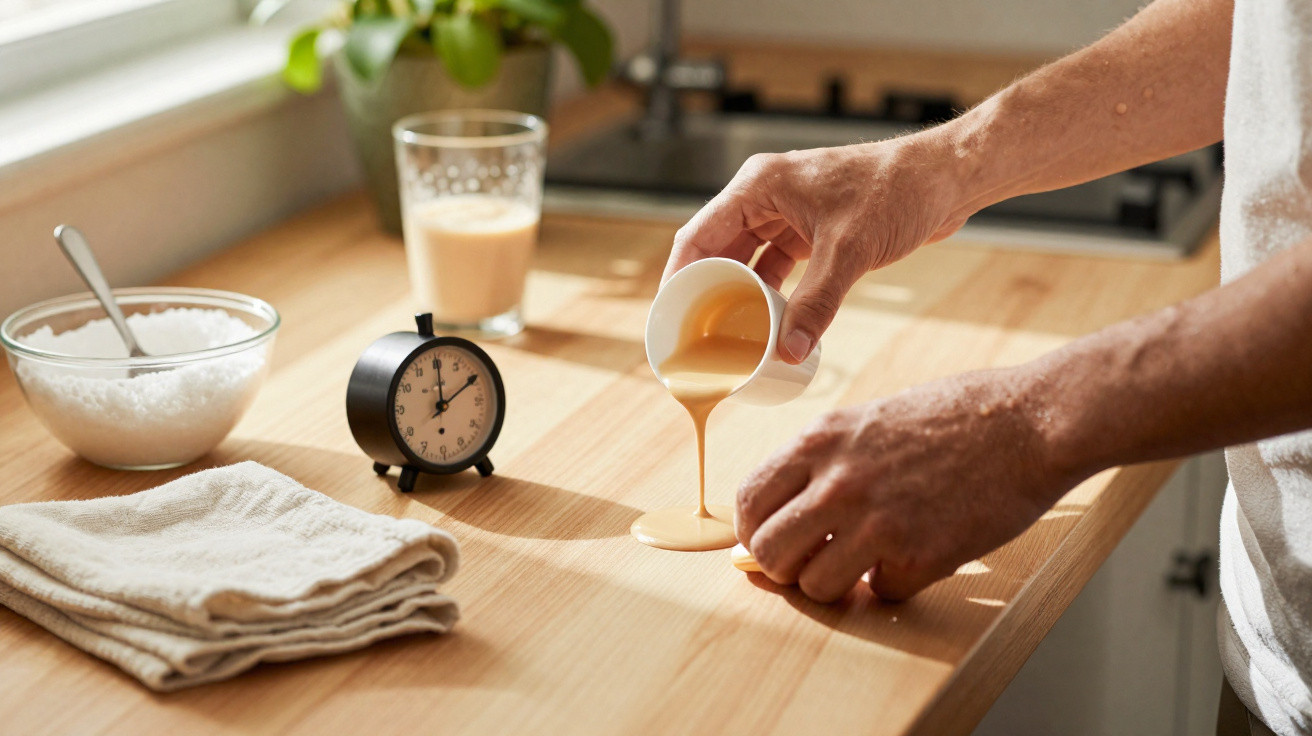
Orange juice fanned out across the kitchen worktop, then began its slow, silent creep down the cupboard doors. Your hand moved ahead of your thoughts, snatching the nearest tea towel and scrubbing as if your credibility as a competent adult depended on it.
It’s only human. Most of us have been conditioned to make mess vanish the moment it appears - a reflex learnt from slightly flustered parents and the fear of losing a tenancy deposit. Something spills, you wipe it up. End of.
Except, not always. On some materials, wiping straight away simply forces the liquid further in. On others, the friction turns a minor mark into a stain that never quite leaves. And in certain situations, the cleverest move is to wait a couple of seconds. That tiny gap between spill and wipe is where the real difference is made.
When wiping too fast makes things worse
Last winter, I watched a friend go into full panic mode after knocking red wine onto a pale fabric sofa. Fast hands, tight jaw, paper towel after paper towel thrown at it. In under half a minute, the stain had ballooned - the original splash surrounded by a spreading, hazy pink halo.
The wine hadn’t been lifted away. It had been smeared and worked into the fibres like an accidental dye job.
That’s the usual outcome when we attack spills instantly with broad strokes and heavy pressure. Your eyes register chaos and your body responds with speed. We interpret “cleaning” as “shifting the mess elsewhere”, while the liquid quietly migrates sideways and downwards. It’s less about reaction time, more about direction and control.
On a wooden dining table, a rushed wipe can pull liquid straight into tiny breaks in the varnish. On a doormat or carpet, frantic scrubbing can rough up the fibres while the spill sinks into the underlay. It looks improved on the surface, but the real problem ends up deeper - and far harder to reach.
On a phone or laptop, that anxious swipe can herd droplets into speaker grilles or charging ports. One quick movement can be the line between a “little scare” and a “water damage estimate”.
A UK home maintenance survey once reported that nearly 40% of people said their first instinct after a spill was to “rub hard until it disappears”. Many of the same respondents also mentioned marks that “never really went away”. The impulse is common; the regret, too.
Take coffee on a pale rug. In the first moments, it doesn’t instantly soak every strand. For a few seconds, much of it sits in the top layer. If you press gently with something absorbent, you can draw it up. If you rub, you drive it down and outwards - like pushing pigment into canvas.
The same goes for cooking oil on a wooden floor. The sheen looks alarming, so we go at it with a cloth. That sideways wiping spreads a thin greasy film beyond the original spot, especially if the cloth is already damp or oily from other kitchen “incidents”.
The reasoning behind taking a breath or two is straightforward: liquids behave differently depending on the surface. Some bead and sit on top. Some seep slowly. Some bind quickly with particular materials. Rushing in without checking what you’re dealing with is like treating every unfamiliar sound in your car as a puncture.
Your first move is more important than your speed. Vertical pressure (blotting) draws liquid up; horizontal pressure (rubbing) pushes it around. On porous materials - stone, unsealed wood, fabric - that difference is enormous. With electronics, the safest first response is often not wiping at all, but tipping the device away from openings and giving it a gentle shake.
Temperature plays a part as well. Hot liquids such as tea or soup can open up fibres or soften finishes. Scrubbing while everything is still warm can set the stain further in. Letting it cool for a moment before you intervene can improve your chances, particularly with plastics and synthetic fabrics.
The “pause, then act” method that actually works
The most effective habit is almost dull in its simplicity: stop for three seconds before you touch anything. That tiny pause prevents panic from taking over. You watch what the spill is doing, clock the surface it’s on, and choose your first move instead of guessing.
Then use a three-part sequence: contain, lift, clean.
To contain is to prevent spread. If water goes over a table, it can be as basic as placing a dry cloth - or a ring of kitchen roll - around the edge of the puddle like a little dam. If wine hits a sofa, the first job is to stop it travelling downwards: if you can, slide a folded towel under the cushion so nothing drips deeper.
To lift is where you blot, always from the outside in. Light, vertical pressure; no scrubbing. Brief presses, then move to a fresh dry area of cloth each time. That’s when you actually remove liquid rather than smearing it. Only after that comes clean: a suitable product, used sparingly, to treat what remains.
Let’s be honest: hardly anyone does this perfectly every day. You get in late, tip pasta water, grab the nearest sponge and swipe. Even so, keeping the method in your head helps you do a less disastrous version of your usual scramble. You don’t need flawless technique - you just need to avoid the few habits that make it worse.
One classic mistake is relying on the same “does-everything” cloth. It’s already damp or greasy, it faintly smells of last night’s tomato sauce, but it’s within reach so you use it. That cloth won’t absorb much; it will mostly spread the spill. A few cheap, dry microfibre cloths kept folded in a drawer will outperform one heroic, overworked sponge every time.
Another common misstep is reaching for cleaning spray too soon - and using far too much. Drenching a fresh spill turns a straightforward blot into a sticky puddle. The chemicals mix with the liquid and travel further. Then you need more wiping, more rubbing, more time. What could have been a short moment becomes a full-length episode.
With carpets, the familiar “kneel and scrub” approach is particularly harsh. It frays the pile, crushes the texture and drives colour down. Even if the stain lightens, the damaged area reflects light differently. That’s how a five-second spill becomes a permanent-looking “shadow” you notice every time you pass.
“The first 60 seconds after a spill decide whether you’re dealing with a quick blot or a long-term stain,” says a professional cleaner I met, who swears by the rule: “Less force, more patience.”
To make this workable day to day, it helps to keep a small “spill kit” you’ll actually use. Nothing elaborate.
- 2–3 clean, dry microfibre cloths reserved purely for spills (not for greasy pans).
- A roll of kitchen roll for the first soak on bigger puddles.
- A small spray bottle filled with plain water for gentle rinsing on textiles.
- A mild, colour-safe stain remover or washing-up liquid, clearly labelled.
Tucked in a drawer or under the sink, this mini-kit helps you shift from panic to routine. You know what to grab, and you know the order: dry first, product later. That familiarity does a surprising amount of the work.
Rethinking “clean” when life is a bit messy
On a rough day, a spill can feel like the universe adding one more irritation. Coffee on the duvet cover, salad dressing down your favourite shirt five minutes before you leave, juice dripping from the fridge shelf - small, maddening, perfectly timed.
On a good day, it can be almost comic. The cat pads through the water you were about to mop, leaving neat little prints across the tiles. A friend knocks over a bottle of sauce and everyone reaches for napkins in unison. Around a shared table, a spill is strangely democratic.
More broadly, our urge to wipe instantly is tied up with control. A spotless surface suggests life is under control - nothing leaks, nothing escapes. But real homes are workshops, not show homes. Liquids run, stains happen, wood drinks things in, fabrics remember. The aim isn’t to delete every trace of disorder; it’s to understand how materials behave and work with them.
There’s a quiet satisfaction in dealing with a spill with less drama. You pause, you contain, you lift. You accept that a few marks will stay on your chopping board, and that’s fine. Others you’ll beat - simply by making the right first move at the right moment.
Everyone has a story where a tiny mishap becomes a tale you retell: red wine at the wedding rehearsal, a fizzy drink exploding in the car, a bottle of olive oil on brand-new parquet. What changes the outcome isn’t superhuman cleaning - it’s those seconds when you choose between frantic wiping and deliberate action.
Perhaps that’s the quiet nudge behind every little puddle on the table: slow down, see what’s actually in front of you, and respond rather than react. Spills aren’t only mess; they’re practice runs for handling the unexpected. And sometimes, the smartest thing you can do in the middle of the splash is nothing at all - for three small seconds.
| Key point | Details | Why it matters to readers |
|---|---|---|
| Blot, don’t rub, on fabrics and carpets | Use a clean, dry cloth or paper towel and press straight down on the spill, working from the outer edge toward the centre. Rotate to a fresh section of cloth as it becomes damp, and only add a small amount of water or stain remover once most of the liquid has been lifted. | This simple change keeps the stain from spreading, protects fibres from damage, and often means the difference between “barely visible” and “permanent halo” on sofas, rugs and clothes. |
| Protect porous surfaces before wiping | On untreated wood, stone or grout, your first move should be to stop downward seepage. Lay an absorbent cloth or paper towel over the spill, then gently press rather than swipe. For large puddles on tables, create a “dam” with towels around the edges before working on the centre. | Porous materials stain fast and deeply; containing the spill vertically instead of smearing it buys you time and keeps liquids from soaking into joints, cracks and under-layers you can’t easily reach. |
| Handle electronics by tilting, not scrubbing | If liquid hits a phone, laptop or remote, turn it off, unplug it and tilt so the spill runs away from ports and openings. Gently shake off excess, then dab with a soft, lint-free cloth. Avoid pushing liquid toward keys, speakers or charging points with horizontal wiping. | A single rushed swipe can drag moisture into the device and cause corrosion or short circuits. A calm tilt-and-dab response sharply reduces the risk of expensive repairs or total failure. |
FAQ
- Should I really wait before wiping a spill, even on a wooden table? A brief pause helps you see how far the liquid is spreading and where it’s heading. On a wooden table, use those few seconds to grab a dry cloth and place it gently on top of the spill instead of dragging the liquid along the grain or into tiny cracks in the finish.
- What’s the safest first step for a red wine spill on a sofa? Start by placing a folded towel or cloth under the cushion if possible, so nothing soaks deeper. Then blot the surface stain with a dry, light-coloured cloth, pressing straight down. Only once the bulk of the wine is absorbed should you reach for cold water or a specific stain remover.
- Can I use the same spray cleaner for every fresh spill? Not really. All-purpose sprays often contain surfactants and perfumes that spread liquids or leave residues on fabric and unfinished wood. For fresh spills, plain water and blotting usually work best at first, with targeted products added later if a mark remains.
- What if I’ve already rubbed a carpet stain and it looks worse? Stop rubbing and switch to blotting with a clean, damp cloth to lift what you can. Then let the area dry fully before reassessing. If the fibres look rough or matted, a professional cleaner or a carpet-specific product may be needed to restore the texture and lighten the mark.
- How fast should I react to spills on my laptop keyboard? Turn it off immediately, unplug it and flip it gently so the liquid drains away from the keys. Dab with a soft cloth rather than wiping, and leave it upside down on a towel for several hours. If a sticky drink was involved, a technician’s cleaning is usually safer than trying to scrub it yourself.
Comments
No comments yet. Be the first to comment!
Leave a Comment