
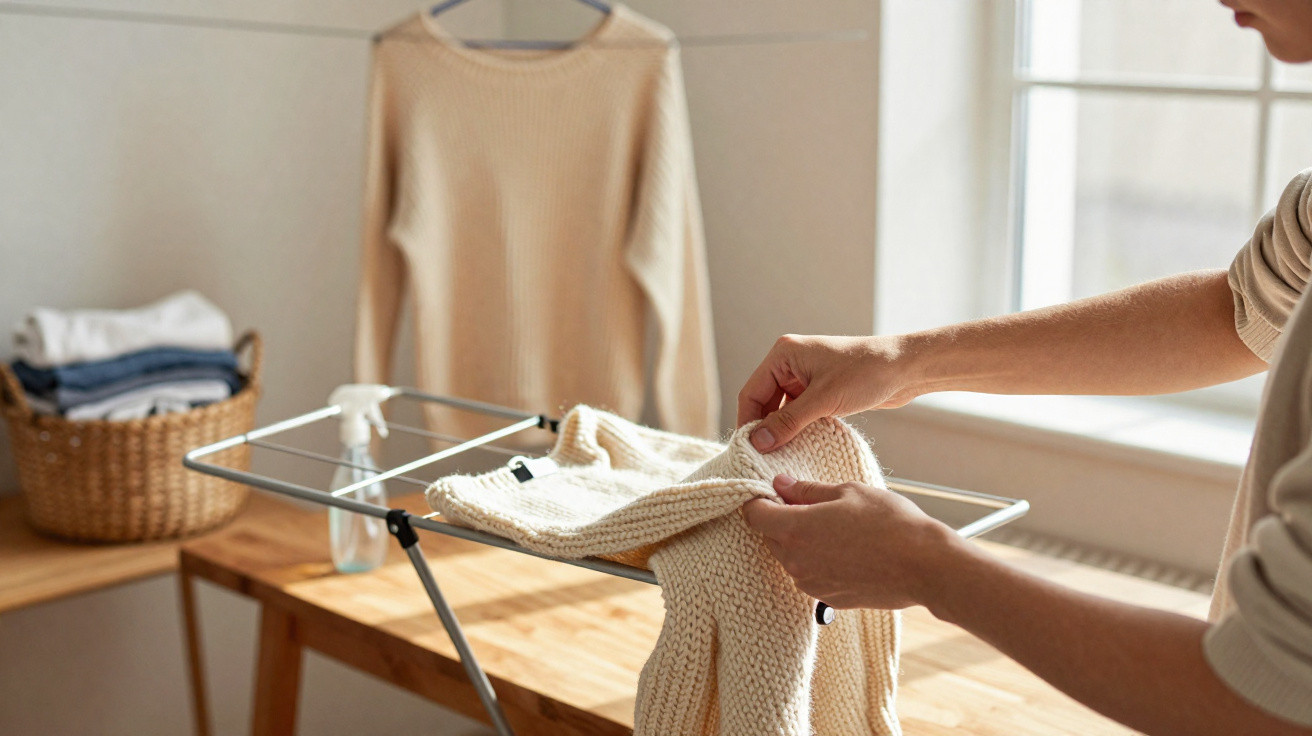
The sweater came out of the wash looking… worn out. You know the look: slumped shoulders, sleeves stretched in odd places, and a waistband that somehow seems broader than you remember. You hold it up, baffled, and mentally replay the last cycle like a crime scene. Same detergent. Same programme. Same water temperature. So why does your favourite knit suddenly look as if it’s aged ten years overnight?
You exhale, fold it anyway, and decide it’s “around-the-house” clothing now. Then, the following week, your T‑shirt follows suit. After that, your jeans. Gradually, piece by piece, your wardrobe starts to feel like it was made for somebody else’s body.
Something in your routine is quietly reshaping your clothes.
The sneaky drying habit that ruins the shape of your clothes
When clothes start losing their shape, most of us point the finger at the washing machine: the spin speed, the detergent, the wrong setting. But in many cases, the real damage happens afterwards. During drying. More specifically, it comes from hanging heavy, soaked garments by the shoulders, sleeves, neckline, or waistband-and letting gravity do what it always does.
Clothing fibres behave a bit like tiny elastic springs. Once they’re waterlogged, they become heavier and more delicate. A small pull makes them give. Hang them the wrong way and they gradually distort-quietly, and often so slowly you don’t notice at first.
It’s an easy scene to imagine. It’s 10 p.m., you’ve finished dinner, and you suddenly remember the wet washing still sitting in the machine. You hurry, tip everything into a basket, and start pegging items onto the drying rack as fast as you can. Sweaters get clipped at the shoulders. T‑shirts go up by the collar. Jeans, heavy and dripping, hang from their belt loops.
By morning, that beloved cotton T‑shirt has a stretched, downcast neckline. The cardigan looks longer, as if it’s been tugged towards the floor. Your jeans show strange pull lines at the knees and seat. You put it down to poor quality: fast fashion, a bad brand, bad luck. Yet the pattern is the same each time-wet fabric hanging vertically, dragged out of shape by its own weight.
Textile specialists see this constantly. When fabric is saturated, the fibres swell and become far more susceptible to tension. If you hang a sweater by the shoulders or peg a T‑shirt by the collar, the water’s weight pulls downward at exactly the moment the fibres are weakest. The garment then dries in a subtly altered position.
Do it once and you’ll barely notice. Do it 20 times and the clothing starts to “learn” that new shape. That’s how V‑necks deepen for no apparent reason, seams start twisting, and waistbands slowly widen. It isn’t only the wash cycle that ages your clothes-it’s the drying position you force them into.
The right way to dry clothes so they keep their shape
A straightforward principle can protect your wardrobe: take the weight off wet clothes by supporting them as horizontally as you can. Dry sweaters flat on a rack or on a clean towel, then gently coax them back into form with your hands. For T‑shirts and tops, fold them over a rail so the weight is shared between the front and back, rather than pulling from the neck.
For jeans and other heavy trousers, fold them in half lengthways and drape them over the rack with the legs together, keeping the waistband supported. Lighter pieces-underwear or small tops-can be hung from the hem or side seams, but never from delicate areas such as straps or necklines. This small change in how you hang laundry can genuinely add months, even years, to the life of your clothes.
Naturally, it’s easier to read this than to practise it on a Wednesday night after a long day. Most of us dry washing in survival mode: quickly, on autopilot, weaving around socks and school bags. That’s when habits take hold-pegging sweaters by the shoulders because it’s quicker, cramming everything onto one bar so it dries “faster”, leaving a heavy hoodie half folded and half dangling into thin air.
Let’s be realistic: nobody manages perfect laundry technique every day. Some evenings you’ll be careful; other times you’ll hang things however you can. The goal isn’t perfection-it’s cutting down the number of times you truly punish your clothes. A few better movements, repeated often enough, make a noticeable difference.
“Once I stopped hanging my knits by the shoulders, I realized my ‘old’ sweaters weren’t old at all,” laughs Léa, 32, who lives in a tiny apartment where the drying rack is practically part of the decor. “I just had to respect the weight of the fabric a bit more.”
- Lay knits flat on a rack or towel, gently reshaping them.
- Fold T‑shirts and sweatshirts over a bar, not by the neck.
- Support jeans and heavy pants at the middle, not from the belt loops.
- Use hangers only for quick air-drying, and ideally for light items.
- Never leave clothes bunched up; spread the weight and smooth the fabric.
Changing habits, saving clothes (and a bit of your patience)
Once you connect misshapen clothes to how they were dried, it’s hard to ignore. Every stretched sweater starts to look like a small mistake from last winter’s drying routine. Every distorted neckline seems to trace back to a rushed night and a heavy, wet T‑shirt clipped by the collar.
There’s an emotional price too: pulling on a warped piece you used to love never feels neutral. It’s a small, recurring irritation-one that could have been avoided with a different choice made two minutes earlier at the drying rack.
After that, you may start tweaking your set-up. Perhaps you reserve one rail on the rack for knits you dry flat. Perhaps you buy a larger rack so everything isn’t weighed down in the same place. Perhaps you decide delicate pieces never go in the tumble dryer, and never get hung from their shoulders. These tiny decisions become a quiet kind of self-care, expressed through how you treat your clothes.
You’re not just “doing laundry”; you’re protecting shapes that fit your body, your style, and your comfort. And the day you put on an older sweater that still fits like it did on day one, you’ll notice.
Other people notice as well: a shirt whose seams aren’t twisted, a cardigan that hasn’t mysteriously grown a size. You may even find yourself passing these drying tips on at brunch or in a group chat-slightly self-conscious because it sounds so basic, and slightly pleased because it actually works. Clothes cost money, but also energy and time spent choosing them.
When you treat the drying stage with the same care as the wash, the outcome changes. You can’t control the quality of every item in your wardrobe, but you can control the everyday drying habit that decides whether your clothes hold their shape… or slowly surrender it.
| Key point | Detail | Value for the reader |
|---|---|---|
| Support clothes horizontally | Lay knits flat, fold tops and jeans over bars instead of hanging by shoulders or waistband | Reduces stretching and keeps garments closer to their original shape |
| Wet fibres are vulnerable | Heavy, water-soaked fabric stretches more when hung vertically | Helps you understand why certain items deform and how to prevent it |
| Small routine changes | Better placement on the rack, avoiding collars and straps, skipping the tumble dryer for delicate pieces | Extends the life of your wardrobe without buying new products or gadgets |
FAQ:
- Why do my sweaters always end up longer after washing? They’re probably being hung by the shoulders or hem while still very wet, so the weight of the water pulls the knit downward. Laying them flat and reshaping them gently while drying helps them keep their original length.
- Can I use the tumble dryer without deforming my clothes? For sturdy cottons like towels or some T‑shirts, a dryer on low heat is usually fine. For knits, delicate fabrics, or clothes with elastane, a dryer can quickly break fibres and distort shapes, even with gentle programmes.
- Is hanging T‑shirts on hangers to dry a bad idea? It depends. For light T‑shirts and quick drying, it’s acceptable, especially if you use wide, rounded hangers. Thin or wire hangers can leave marks and stretch the shoulders over time.
- How should I dry jeans so they don’t lose their fit? Fold them in half and hang them over a bar so the weight is distributed between the legs. Avoid hanging them only by the waistband or belt loops, which can stretch those areas and distort the shape.
- Do I really need to reshape clothes while they’re wet? Gently yes. Smoothing seams, aligning hems and adjusting the shoulders while the fabric is still damp helps the garment “remember” its original cut. It only takes a few seconds per item and pays off in how clothes look on you.






Comments
No comments yet. Be the first to comment!
Leave a Comment