
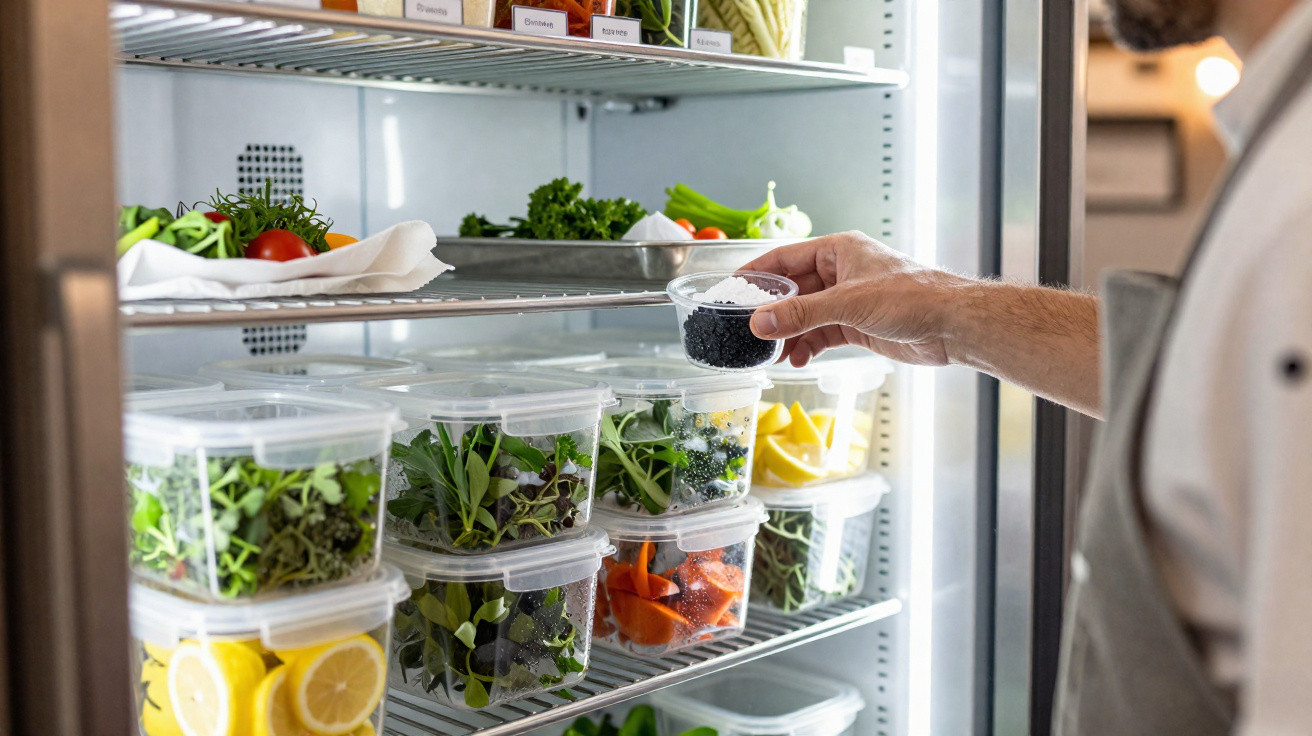
Outside in the dining room, it’s a festive haze of Christmas jumpers, office Secret Santas and Prosecco flutes chiming together. Inside the fridge room, though, there’s… nothing. No onion. No fish. No sour dairy lurking at the back. Just a light, crisp coldness, almost like newly fallen snow.
The head chef slips in, lifts a tray of marinated chicken, takes in the air and grins. “We’d never survive December without this trick,” she mutters, nudging the door back open with her heel as another ticket rattles out on the pass.
During the most punishing weeks of the year-when fridges are packed to the limit and everyone’s running on fumes-many restaurant kitchens quietly depend on a straightforward fridge‑odour trick to stop the whole place from, quite literally, stinking.
The hidden battle inside a restaurant fridge
Step into almost any restaurant on a Saturday night in December and you’ll sense the strain before you clock what’s happening. The pass is piled high with dockets, the bar is three deep, and the dishwashers rumble like engines in heavy weather.
What stays out of sight is the other fight: the one behind the stainless‑steel doors. In a rush, staff thump containers onto already crowded shelves, trays of raw meat end up a touch too close to puddings, and the fridge air turns heavy with mingled aromas and unseen damp.
If you ignore that mix, it becomes the kind of smell that clings to supposedly clean plates and lifts with the steam when hot food meets cold air. It’s flavour’s quiet saboteur.
In one busy London bistro, the sous‑chef has a name for the December fridge: “the beast”. On the Monday before Christmas it’s stuffed from top to bottom-turkey crowns, tubs of cranberry sauce, pre‑portioned salmon, three different cheeses, and garnishes lined up in labelled gastronorm trays.
She still recalls the year they dropped their regular fridge‑odour routine “just this once” because they were short on time. By the fourth day, the cold room had developed a slight but persistent sour edge. Not an outright rotten stench-just… off.
Nothing had actually spoiled. The temperatures were correct, use‑by dates were checked, and an inspector would have signed it off. Even so, the team began to pick up on it: panna cotta tasted faintly “fridgey”, as though it had borrowed notes from the garlic mash sitting above. A few plates came back with vague feedback-“it tastes weird”, “not as fresh as last time”.
Those comments sting more than a one‑star review. Smell and memory are tightly linked, and when fridge odours seep into food they blur that connection. Guests won’t say, “Your fridge is overloaded and the air isn’t clean,” but they will decide, “We’ll try somewhere else next year.”
Kitchens understand that, which is why they’ve built near‑ritual habits for keeping fridge odour under control when the pressure peaks. No flashy tech. No pricey gadgets. Just plain, repeatable routines that keep the air in that cold box neutral and dry.
Chefs sometimes describe it as “resetting the fridge atmosphere”, in the same way you might reset a cluttered head. It’s not about a dramatic, heroic deep clean; it’s about small, consistent steps that stop smells accumulating in the first place.
That’s the role of the fridge‑odour trick: inexpensive, effective, and easy to slot into the chaos of service without slowing anyone down.
The fridge‑odour trick restaurants actually use
The method most kitchens swear by is almost comically low‑tech: a combination of open absorbents plus dry, moving air. Think bowls of bicarbonate of soda, trays of activated charcoal, and sometimes even coffee grounds, all doing their quiet work while fans keep cold air circulating.
These little “odour sponges” are tucked onto shelves where they won’t be knocked-often in the back corners where stale air tends to settle. The principle is simple: give the smells something other than your food to latch onto.
When the fridge is heaving in peak season, those bowls and trays become the unseen team members protecting the flavour of every plate that heads out across the pass.
In a real kitchen, it often starts with what junior chefs call the “fridge reset” on the first morning of a major week-Christmas service, Mother’s Day, Valentine’s. The doors are left open for a minute to release trapped old air. Shelves get a quick wipe with hot water and vinegar or lemon-nothing strongly perfumed.
Next come the trays: shallow, open containers of food‑grade bicarbonate of soda placed on the bottom shelf and in the back corners. In some kitchens, small mesh pots of activated charcoal go in alongside-especially near punchy ingredients such as fish or blue cheese.
Once service begins, nobody makes a fuss about it. The trick simply runs in the background. When someone swings the door open, the first thing they notice is what isn’t there: no smell. Just cold. That’s the point.
The science is fairly simple. Bicarbonate of soda is alkaline, and it reacts with acidic molecules that often create unpleasant odours. Activated charcoal goes further: its porous structure traps volatile compounds in millions of tiny holes.
In a full fridge-where different ingredients “breathe” out their own gases and moisture-these absorbents act like bouncers, catching the troublemakers before they drift into everything else.
It’s not magic. Raw onions still smell like onions, and opened cheese still smells like cheese. But those smells don’t dominate the whole fridge.
And when cold air is allowed to move-thanks to sensibly placed fans and by not blocking vents with oversized tubs-the absorbents capture more odour molecules instead of letting them linger on plastic lids and cardboard cartons.
Bringing the restaurant trick into your own kitchen
You don’t need a walk‑in fridge or a brigade of line cooks to copy this at home. The key move is almost addictive in its simplicity: give odours something else to cling to before they reach your leftovers.
Begin with a shallow bowl or small tray of bicarbonate of soda on the bottom shelf. If your fridge is regularly crammed, add a second on the top shelf. During particularly pungent weeks-think Christmas cheeseboards or curry leftovers-put a small dish of activated charcoal or coffee grounds towards the back.
Replace them often, the same way restaurants do. In busy periods, many kitchens swap trays every three to five days. At home, changing them weekly or fortnightly is usually plenty.
The bit most people tend to overlook is airflow. Even the best odour absorber struggles if the fridge is so packed that air can’t circulate. Leave a little gap between containers, and don’t wedge a huge roasting tin directly in front of the internal fan.
That doesn’t mean you need Instagram‑perfect shelves. Let’s be honest: nobody truly keeps it that way every day. But a touch of breathing room-literally-helps bicarbonate and charcoal do their job rather than just sitting there looking worthy.
On a practical level, this is about more than removing smells. When a fridge is neutral‑smelling, it changes how you feel when you open the door after a long day: no stale dairy hit, no mystery funk that makes you shut it again and order a takeaway.
“We learned the hard way that bad fridge smell is like background noise,” says a Manchester head chef. “You stop noticing it, but your guests don’t. The odour trick isn’t glamorous, it’s just part of respecting the food.”
Restaurants learn through slip‑ups-and you probably will as well. The most common mistakes at home are easy to put right:
- Using scented cleaners that leave a fragrance stronger than the food.
- Forgetting to replace the bicarbonate of soda for months so it becomes basically decorative.
- Storing uncovered onions or cut lemons next to cakes or dairy.
- Blocking internal vents with large trays or takeaway boxes.
- Relying only on temperature and ignoring humidity and airflow.
Why this tiny habit matters more than you think
Once you start noticing fridge smell, it’s hard to stop. There’s that quiet half‑second when you open the door and your brain judges the air: fresh, or not fresh. That instant influences what you cook, what you throw away, and what you remember about a meal.
Most of us have had the pre‑guest panic: you open the fridge and wonder whether that odd whiff will hit everyone else too. Restaurants live in that moment every day during the high season. For them, odour control isn’t a nice extra-it’s part of the kitchen’s rhythm.
The trick is small, but the impact spreads. It prevents carefully prepped food from picking up unwanted flavours. It keeps desserts tasting of vanilla rather than “a bit like last night’s garlic prawns”. It gives staff confidence that what leaves the kitchen smells as clean as it looks.
At home, borrowing this simple ritual can quietly change how you eat during your own busiest stretches. Hosting, batch cooking, juggling leftovers from three different meals-everything feels easier when the fridge isn’t working against you.
You may find you waste less food because things don’t smell suspicious after two days. You might actually fancy eating what you stored, instead of binning it “just in case”.
And perhaps that’s the real lesson restaurants are sharing: not merely a bowl of bicarbonate of soda tucked in the corner, but a mindset-treat the air around your food as part of the recipe.
| Key point | Detail | Why it matters to you |
|---|---|---|
| Odour absorbers | Bicarbonate of soda, activated charcoal, coffee grounds placed in open containers | Easy to copy at home, costs pennies, and helps keep bad smells under control |
| Airflow in the fridge | Leave a little space around tubs; avoid blocking internal vents | Improves cooling and helps the absorbers work better, protecting how food tastes |
| Regular “resets” | Swap the bowls, do a quick wipe, and check especially strong‑smelling foods | Cuts waste, makes festive meals more enjoyable, and feels reassuring when you’re hosting |
FAQ:
- How often should I change the bicarbonate of soda in my fridge? In a normal week, every 1–2 months can be fine, but in busy periods-or if odours start-swap it every 1–2 weeks for a restaurant‑style reset.
- Is activated charcoal safe to use near food? Yes, provided it’s food‑grade and kept in an open container that won’t spill onto ingredients.
- Can I just rely on commercial fridge deodorisers? They can help, but many chefs favour simple, unscented options like bicarbonate of soda or charcoal to avoid adding any fragrance.
- Why does my food sometimes taste “like the fridge”? It usually means odours and moisture are circulating freely, and uncovered foods are absorbing smells from other items in a crowded, poorly ventilated space.
- Do I really need to clean the fridge if I’m using these tricks? Yes: absorbents tackle airborne smells, but spills, old packaging and forgotten leftovers still need regular wiping to stop them becoming the next source of odour.

Comments
No comments yet. Be the first to comment!
Leave a Comment