
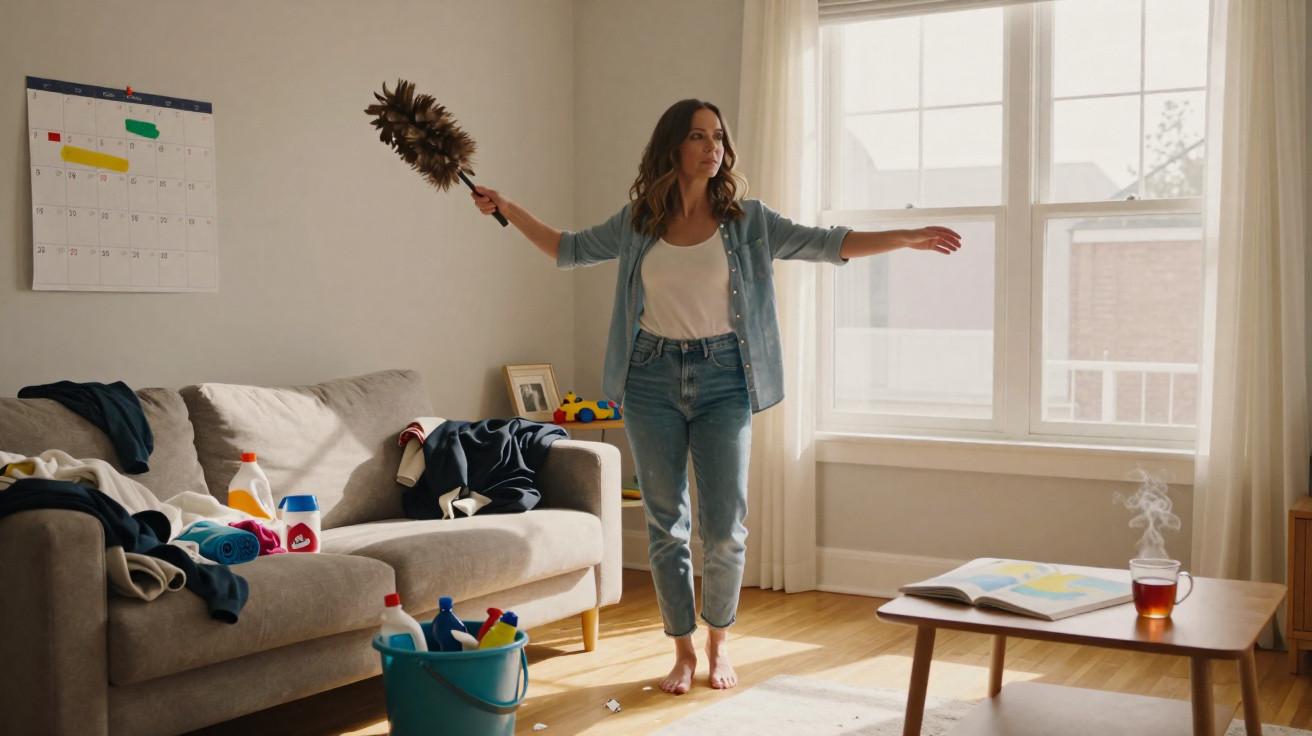
At 7:12 a.m., the crumbs on the kitchen worktop have already taken the lead. Claire rubs at the very same mark for the third time, only half paying attention as her son bargains over how many chocolate chips can possibly count as a “healthy” breakfast. The washing machine pings in the background, the dishwasher drones on, and somewhere beneath the sofa a stray sock is quietly collecting dust and humiliation. The place isn’t dirty - not remotely. But in her mind, each toy left on the floor registers as a personal failing, and every fingerprint on the stainless steel reads like a wordless accusation. By 9 a.m., she’s drained, and the day has barely begun.
She isn’t the only one.
The drive to keep a home perfectly clean is quietly devouring large parts of women’s lives.
And almost nobody wants to say it out loud.
When cleanliness becomes an invisible cage
Have a late-night scroll through Instagram and it’s everywhere.
Gleaming white kitchens, towels folded into faultless towers, sitting rooms that look as if nobody has ever eaten, played, or relaxed in them. In the comments, women ask: “How do you keep it so clean with kids?” The replies are predictable: routines, discipline, a bit of “motivation”. It seems harmless.
But away from the camera, there are women hoovering at 10 p.m. with sore backs, collecting Lego bricks as though they’re defusing explosives. The house photographs beautifully. Their faces do not.
Consider Maria: 36, two children, a full-time job, and a cleaning plan that would make most hotel managers nervous. Mondays are bathrooms. Tuesdays are floors. Wednesdays are bedding. Thursdays are for “deep cleaning”. Weekends are reserved for “catching up” on everything that slipped during the week. Every job lives in a colour-coded app.
One evening, her daughter asks whether they can play a board game. “After I finish the kitchen,” Maria says. By the time the worktops shine, it’s bedtime. The game remains unopened.
That night, Maria lies awake wondering what she is truly arranging: her home, or her guilt.
This strain doesn’t appear from thin air. Many girls grow up watching their mums apologise for a single glass left by the sink. When the doorbell goes, everyone suddenly rushes to hide the laundry like it’s incriminating evidence. Women get praised for being “so organised”, “so clean”, “such a good homemaker”.
Men rarely face the same scrutiny if their place is untidy for a day. Or a week.
The lesson arrives early and hits hard: your value lives in your living room. Dust-free shelves become a kind of virtue. A floor scattered with toys feels like proof you’ve failed. Over time, that quiet conditioning turns basic tidying into a never-ending performance.
From spotless to sane: learning what “clean enough” really means
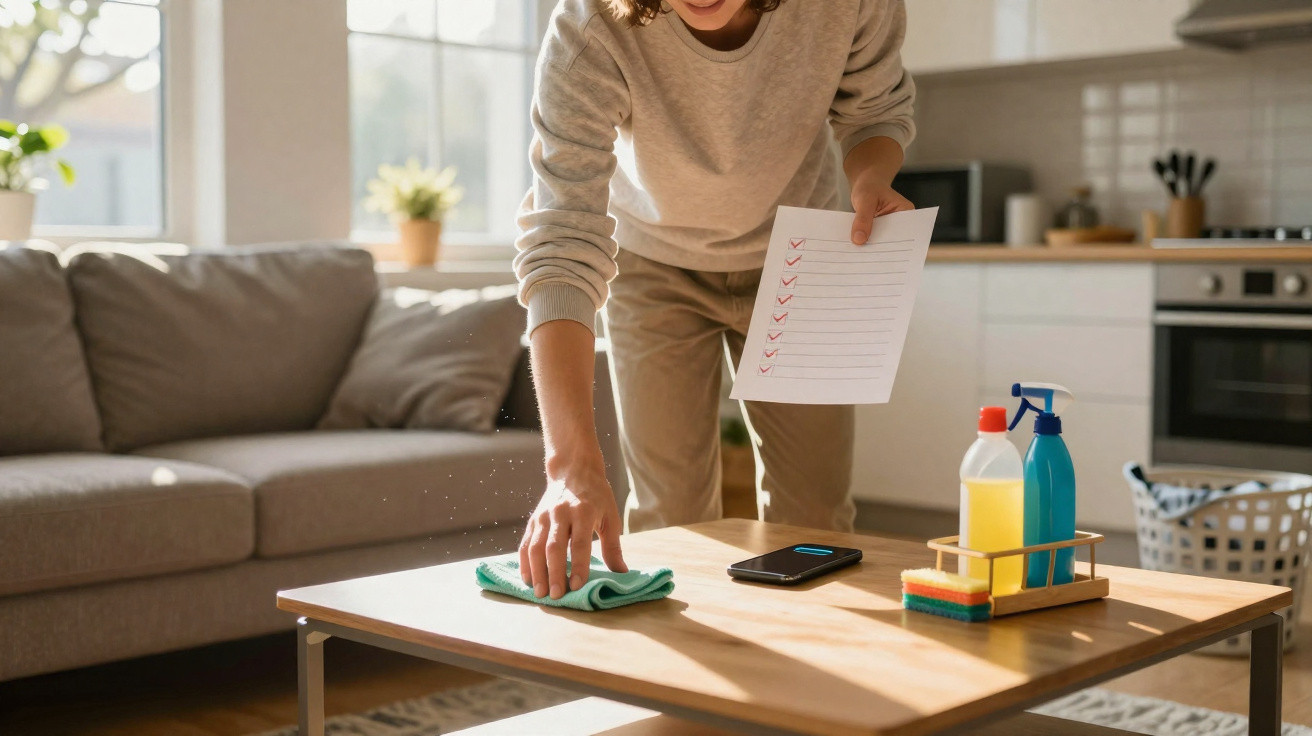
There’s a small, almost rebellious decision that can shift everything: define what “clean enough” means for you - not for your mum, not for Pinterest, and not for an influencer who may well have a cleaner off camera. Choose three daily non‑negotiables. Perhaps it’s an empty sink at night, one swept area, and a quick wipe of the bathroom. Done. Everything else can rotate when you genuinely have the capacity.
Some women even write a “good enough” manifesto on a sticky note and stick it on the fridge. It can sound daft. But reading “Floors can wait, sleep cannot” at 11 p.m. can be the difference between starting yet another load of washing and finally sitting down.
The easiest trap is letting cleaning become your identity. “I’m just the kind of person who needs everything spotless.” Are you, though? Or have you simply become accustomed to the anxiety you feel when something is out of place? Many women push themselves to the edge, while quietly resenting everyone else who walks through the house dropping socks like confetti.
That resentment isn’t a personality defect. It’s information. It often points to a workload that’s wildly uneven, or standards that were never properly discussed as a couple or as a family. You are not failing at cleanliness. You are drowning in an expectation you never consciously chose.
Sometimes, the bravest sentence a woman can say in her own home is: “This is not just my job anymore.”
- Start with a Sunday reset talk Not an argument - a proper conversation. What does each person actually care about? What can slip without anyone truly suffering?
- Use “good enough” language Try: “The living room needs to be at a 6 out of 10, not a 10,” so others understand you’re no longer chasing perfection.
- Assign specific, visible tasks “Help more” is meaningless. “You do the bin and the washing up every night” is clear. When ownership is clear, the responsibility stops being invisible.
- Lower the bar on hidden zones Drawers, cupboards, children’s rooms - they don’t have to look magazine-ready. Shut the door and give your brain a break.
- Protect one no-cleaning zone of time Maybe it’s after 9 p.m.; maybe it’s Sunday afternoon. No laundry, no hoovering, no “I’ll just quickly…”. That time belongs to you, not the mop.
What women could reclaim if they stopped chasing spotless
Picture an evening without the constant scanning. Your eyes stop flicking from crumb to sock to cup while someone is talking to you. You walk in, put your bag down, register the mess and… sit anyway. Your child shows you a drawing and you actually take it in. Your partner starts telling you something and you remember the story, rather than the marks on the table.
The house feels “lived in”, not out of control. You can breathe again. A little dust isn’t an emergency - it’s evidence that a real life is happening here, not a showroom.
| Key point | Detail | Value for the reader |
|---|---|---|
| Question the standard | Pay attention to where your cleaning rules truly come from | Less guilt, more conscious choices |
| Redefine “clean enough” | Three daily tasks plus rotating chores | More energy and time for what you care about |
| Share the load | Clear roles, simple systems, spoken expectations | Less resentment, more fairness at home |
FAQ:
- Question 1 What’s a realistic level of cleanliness for a busy family?
- Answer 1 Aim for “safe, hygienic, and functional”, not photo-ready. If you can cook, find what you need, use the bathroom without stress, and nobody’s getting ill because of hygiene problems, you’re already at a solid baseline.
- Question 2 How do I stop feeling guilty when I don’t clean?
- Answer 2 Catch the automatic thought (“I’m lazy,” “I’m falling behind”) and swap it for something factual: “I’m resting so I can function tomorrow.” Guilt weakens when you respond to it out loud.
- Question 3 What if my partner doesn’t see the mess or doesn’t care?
- Answer 3 Explain the impact, not only what’s on the floor: “When everything falls on me, I feel like the house owns me.” Then propose specific tasks they fully own, from start to finish.
- Question 4 Is hiring help a failure?
- Answer 4 Not at all. Paying for cleaning - even once a month - is simply another way of managing unpaid labour. If you wouldn’t feel ashamed about ordering a takeaway, you don’t need to feel ashamed about a cleaner.
- Question 5 How do I start if I’ve been a perfectionist for years?
- Answer 5 Choose one area where you’ll deliberately lower your standards for a week - the children’s room or the hallway, for example. Let it be a bit messy on purpose. Notice what actually happens. Most of the disaster is in your head, not on the floor.

Comments
No comments yet. Be the first to comment!
Leave a Comment