
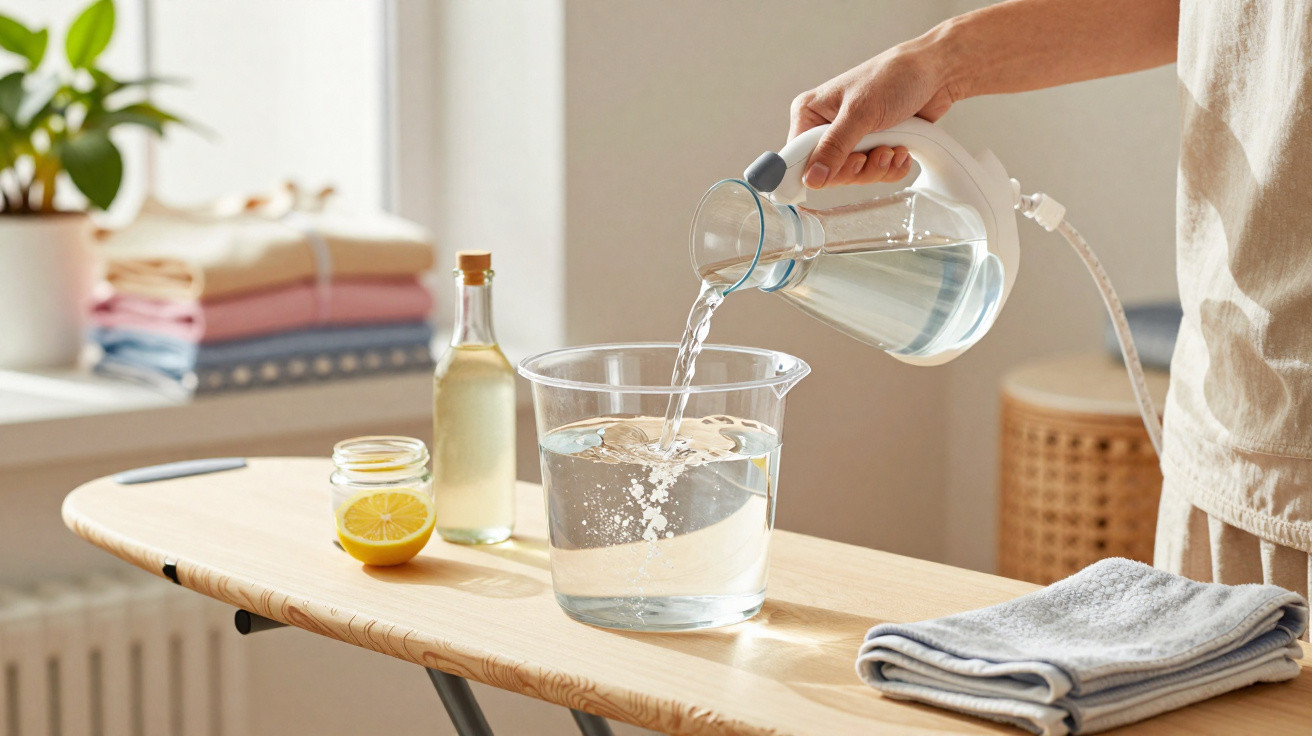
Many people only notice the issue when a freshly ironed shirt is suddenly ruined by ugly stains that seem to come from nowhere. Instead of clean steam, you get droplets, crumbs and odd noises. The quick conclusion often follows: "Broken - buy a new one." In reality, the real failure is usually signposted much earlier - and if you understand the common mistakes when filling and cleaning the water tank, you can often keep an iron going for years.
When a steam iron spits dirty water
A steam iron that releases brown or yellowish droplets can instantly feel like a write-off. On light-coloured clothing in particular, it looks dramatic. The typical warning signs tend to creep up gradually:
- The steam output weakens, so smoothing takes longer.
- Small white or brownish particles appear from the steam holes.
- Water jets out instead of steam, often in splashes.
- The iron gurgles, clicks or makes unfamiliar noises.
In most homes, the same culprit sits behind all of this: limescale from tap water. The harder your water, the faster the tank and internal channels clog up. Each time the iron heats, minerals settle in the steam chamber, around the heating element and inside the fine passages. Those pathways narrow more and more until there’s barely any room left for steam.
When limescale blocks the channels, there isn’t enough time for the water to turn into steam - it comes back out as liquid and lands as a stain on the fabric.
The knock-on effect is that the pump has to work harder, the heater runs for longer, electricity use rises and the appliance ages faster. So the visible stains are not just an irritating cosmetic problem - they’re a clear warning signal.
The typical mistakes when dealing with water in a steam iron
Here’s the good news: a lot of damage can be avoided if you drop a few unhelpful habits. The bad news is that almost everyone repeats at least one of these mistakes.
Mistake 1: Only ever using tap water and never cleaning
In hard-water areas, every tank refill brings a decent dose of limescale into the iron. If you never descale the tank, you effectively build up a limescale wall inside the channels over months. Every heat-up then adds a little more damage.
Many people assume it’s enough to empty the water after ironing. But by then the dissolved minerals have already stuck to the inner surfaces - and at the next session they bake on even more. The process stays out of sight until the steam suddenly disappears.
Mistake 2: Ignoring the warning signs
Once an iron starts spitting, alarm bells should ring immediately. In real life, it often goes the other way: stains get wiped off and people simply carry on. That’s exactly when the limescale properly hardens, forming solid plugs that can be difficult to shift later.
Mistake 3: Using cleaners that are too strong
In a panic, plenty of people reach for harsh solutions - and end up finishing the iron off. The most problematic options include:
- highly concentrated vinegar poured into the tank without diluting with water
- descalers intended for coffee machines or dishwashers
- aggressive cleaners that attack rubber seals
Strong vinegar can damage seals and hoses, leading to leaks. Chemical descalers can leave residues behind, which may loosen during the next heat-up and end up back on your laundry.
Mistake 4: Overlooking built-in features
Many modern irons include anti-limescale rods, self-cleaning programmes or clear guidance on which type of water to use. These features often go unused. Even the simple tip to mix very hard tap water with some distilled water is frequently missed. As a result, the condition worsens gradually - even though the technology could help protect the iron.
Gentle descaling: how to get the water tank clean again
If you act early enough, a “spitting” steam iron can often be rescued with mild descaling. What matters is using the right mixture.
Option 1: Diluted household vinegar
A standard clear household vinegar cleaner is suitable. The mix should not be too strong:
- Fill the tank to 50% with water.
- Top up to 50% with vinegar cleaner.
Leave the iron switched off and, ideally, place it in the sink. Let the mixture sit cold for about 30 minutes. That gives the limescale time to loosen without putting too much strain on the seals.
Option 2: An odour-neutral citric acid solution
If you dislike the smell of vinegar, use citric acid powder from a chemist or supermarket. All you need is:
- 1 tablespoon of citric acid to 250 millilitres of water
- Dissolve thoroughly and pour into the tank.
Again, keep the iron switched off and leave it to stand for around 30 minutes.
Important steps after descaling
After the soak, empty the tank completely and rinse several times with clean water. Then:
- Fill the tank with fresh water.
- Heat the iron up.
- Trigger the steam function repeatedly over the sink until the steam is clear and steady.
If you repeat this routine every one to two months, you’ll slow limescale build-up noticeably. In areas with extremely hard water, a shorter interval can make sense.
Regular, mild descaling extends service life, saves electricity and helps prevent sudden stains on clothing.
Prevention: keeping the water tank clean for longer
A few simple habits can reduce limescale stress significantly. It can pay off financially too: a good steam iron can easily cost into three figures, while basic care is far cheaper.
- Check your water quality: Many water suppliers publish hardness levels online. The higher the figure, the more risky it is to use only tap water.
- Use mixed water: With hard water, use a blend of tap water and distilled water, for example 50:50.
- Don’t leave the tank full all the time: Empty it briefly after ironing so limescale has less contact time.
- Use anti-limescale features: Run self-cleaning and clean any limescale collection rods regularly, following the manual.
- Don’t add fragrances or additives to the water: Perfumed products can gum up channels and create further deposits.
Why limescale puts such a heavy load on a steam iron
From a technical perspective, limescale changes how the entire appliance operates. In the steam chamber, water has to be heated very quickly. When limescale coats the heating element, it acts like an insulating layer. The heater needs more energy to produce the same amount of steam.
Over time, this can lead to several issues at once:
- The iron takes longer to heat up.
- Temperatures fluctuate, so creases are harder to remove.
- Internal parts wear faster and seals become brittle.
- The fire risk increases slightly, because parts can overheat if they are constantly trying to “heat through” the limescale layer.
It’s also a problem from a climate point of view. Using more electricity to get the same result means unnecessary extra energy consumption in day-to-day life.
Practical examples: when descaling is still worth it - and when it isn’t
Whether a rescue attempt makes sense depends on the condition. If only small particles come out occasionally and the steam is just a bit weaker, one or two descaling rounds are usually enough. Afterwards, steam output often stabilises noticeably.
It becomes more difficult if:
- almost no steam comes out at all
- strong water jets continue despite cleaning
- rust marks are already visible inside (e.g. around the tank area)
- the outside is already badly damaged or the iron is very old
In these situations, the pump or heating system may already be too badly affected. Then replacement is usually the only option - but with consistent care next time, so the new iron lasts longer.
More useful tips for ironing
If you want to protect your clothes from stains, use old towels or tea towels as a first test whenever you suspect a problem. If the water runs clear and the cloth stays clean, the risk to your favourite blouse is much lower.
A quick fix for the rushed: if the iron spits when you start up, iron briefly on maximum steam onto an old cloth until the output becomes steady. Only then move on to delicate items. And if you rarely iron, don’t leave a steam iron unused for years with leftover water in a cupboard - that’s ideal conditions for limescale deposits and even mild odours.
Professional dry cleaners also rely deliberately on well-maintained steam systems. When heavy limescale build-up is present, quality visibly suffers. The same effect shows up at home: a clean water tank, properly descaled channels and suitable water not only prevent marks on clothing, but also make ironing faster and far less stressful overall.



Comments
No comments yet. Be the first to comment!
Leave a Comment