
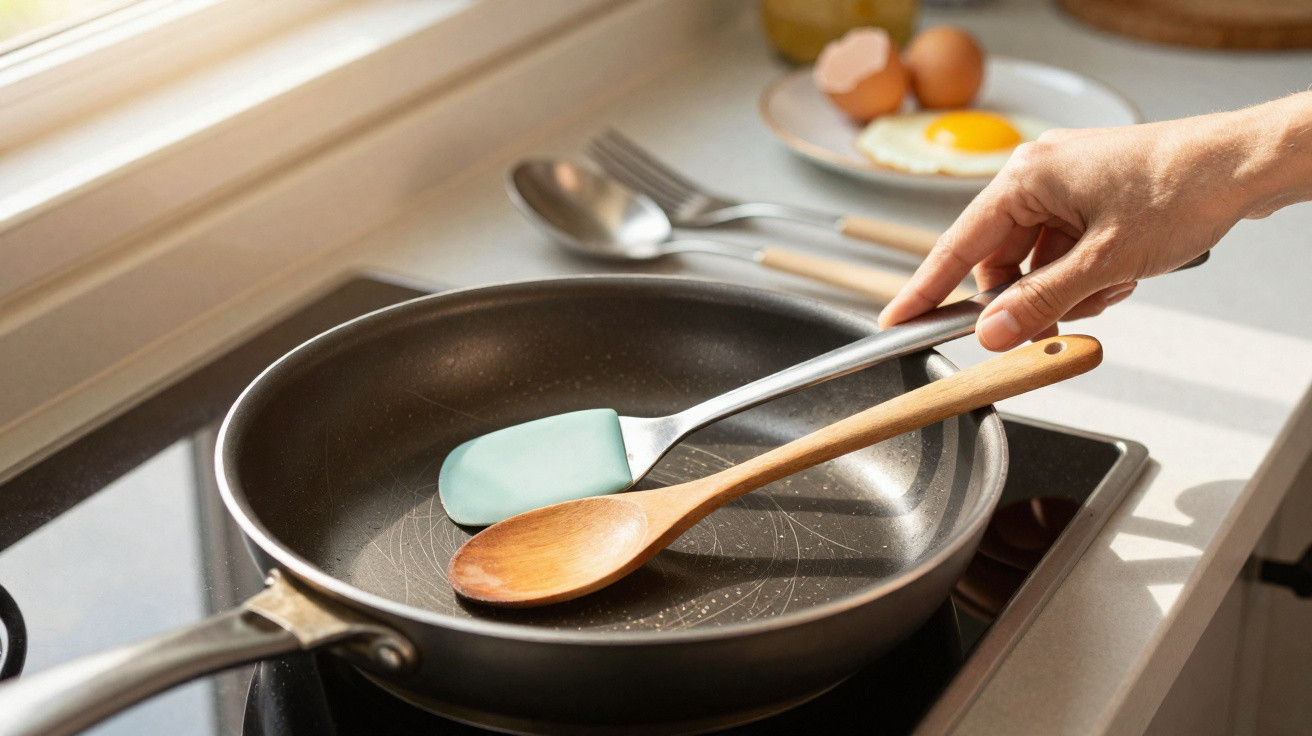
In many kitchens, the day starts with scrambled eggs, pancakes, or a quick vegetable stir-fry. The routine feels automatic: pan on the hob, a little oil, heat on, food in, stir, flip, serve. What most people don’t realise is that the heat - and even the quality of the pan - is often not the real culprit. The damage usually comes from the very tool you reach for without thinking.
The hidden pan killer is in the utensil pot
Almost every kitchen has one: an overstuffed container of wooden spoons, whisks, forks and spatulas sitting right by the cooker. When you’re in a hurry, you grab whatever is sticking out at the top - and all too often, it’s metal.
A metal fork, a stainless-steel whisk, a steel spoon: it all feels convenient, sturdy, even “professional”. The problem is that for non-stick pans, these tools are genuinely harmful.
"Any metal contact on a coated pan acts like fine sandpaper - even if you only want to stir ‘very gently’."
Many people tell themselves, “I’m only touching the food, not the base of the pan.” In practice, it takes very little: a slight press, a small slip, a single over-energetic stir. The edge of the metal catches the base or sidewall - and the first tiny mark appears in the coating.
Why metal and non-stick coatings don’t mix
Most non-stick frying pans have an inner coating based on PTFE - a relatively soft, smooth polymer layer. That’s what allows omelettes, pancakes and fish to slide out cleanly.
Metal utensils, by contrast, are hard, keep their edges, and can even be subtly sharp - think fork tines or the thin lip of a stainless-steel turner. When that hardness repeatedly meets a sensitive surface, the combination simply doesn’t work.
- Metal is much harder than the coating.
- Even light pressure can create fine grooves.
- With each use, the marks deepen.
- The non-stick performance noticeably declines.
It’s a bit like car paintwork: one pass with a key is enough to damage it - even if the scratch looks minor.
What’s really happening in your pan: a miniature crater field
To the naked eye, a new pan’s interior looks smooth, dark and flawless. But under a strong magnifying glass, a frequently used pan that’s been touched by metal would look completely different: a patchwork of fine scoring, small craters and roughened areas.
Invisible micro-scratches - the beginning of the end
At first, the damage is just hairline marks. They’re so small you’ll hardly notice them during washing up. Yet these “invisible” micro-scratches break up the smooth protective layer. Fat, proteins and sugars from food lodge in them, slowly burn on, and form charred little islands.
With every cooking session, more residue gets pushed into these tiny grooves. When washing up, many people then reach - out of frustration - for an abrasive sponge or even a scouring pad to scrub away the burnt spots, which only accelerates the damage.
"Non-stick pans rarely die of old age - they die from fork tines and abrasive sponges."
When the fried egg suddenly sticks
The effects often creep up gradually. First a little egg white clings on, then the first piece of fish sticks, and later the omelette tears when you try to flip it. People often blame “cheap quality” or assume they didn’t use enough fat.
The real reason is that the surface is no longer intact. On roughened patches, food residue can effectively grip on. Where there used to be a water- and fat-repellent layer, you now have a mix of craters, burnt-on deposits and exposed metal.
Unwanted extras in your food: particles coming loose from the pan
Wear and tear has a second side that many prefer not to think about: if the coating starts to flake, it doesn’t vanish. It goes straight into the food.
What ends up on your plate
Tiny black specks in scrambled eggs or sauce; small dark dots you can’t explain - often it isn’t pepper at all, but material from the pan. Detached coating particles are chemically stable and are generally considered largely inert. Still, it’s hardly an appetising thought.
If you cook regularly with heavily scratched pans, there’s a high chance you’re repeatedly ingesting these particles. And there’s another point many people underestimate: beneath the coating there is usually aluminium.
When the base metal is exposed
As soon as the coating shows deeper scrapes or missing patches, bare metal starts to show through. If that metal comes into direct contact with acidic foods - such as tomato sauce, wine, vinegar or lemon juice - some of the metal can transfer into the meal.
Anyone who frequently makes pasta with tomato sauce, braised dishes with wine, or fish with lemon in a badly scratched pan is exposing themselves to unnecessary metal transfer. That is why specialists advise that pans with severe damage and exposed metal should be replaced.
The saviours of your pans: wood and silicone
The good news: protecting your pans doesn’t require much money or effort. The key step is to consistently avoid metal utensils while cooking.
Silicone - flexible, heat-resistant, kind to pans
Modern utensils made from high-quality silicone are far gentler on coatings. The material is flexible, conforms to edges and corners, and won’t scratch the surface. Many designs can withstand temperatures up to around 250 degrees Celsius without any trouble.
A silicone spatula or scraper offers several advantages:
- it hugs the base of the pan and lifts sauce residue cleanly,
- it doesn’t create that harsh scraping noise,
- it keeps its shape, as long as it’s kept away from open flames,
- it is usually easy to clean.
You notice the difference especially when delicately turning pancakes, fried eggs or fish fillets: the surface stays smooth, food releases more easily, and the sound of cooking is noticeably softer.
Wood and bamboo - classics with a rustic feel
If you prefer natural materials, wooden or bamboo spoons, turners and tongs are the obvious choice. They’re sturdy, feel warm in the hand, and are soft enough to protect coatings. Professional kitchens have relied on wood for generations when they need to safeguard sensitive surfaces.
One detail is worth noting: wood is porous. It absorbs moisture and, if poorly cared for, can harbour bacteria. For that reason, wooden turners and spoons should:
- be washed straight after cooking with warm water and a little washing-up liquid,
- not be left soaking in dishwater,
- be dried thoroughly in the air,
- be rubbed occasionally with a small amount of cooking oil to help prevent cracking.
How long non-stick pans last with proper use
Many manufacturers advertise spectacular durability, but in real life the lifespan of your pan mostly depends on how you treat it. If you avoid metal and clean gently, you can use a good pan without issues for several years.
| Behaviour | Effect on lifespan |
|---|---|
| Metal cutlery in the pan | significant reduction, rapid scratch formation |
| Wooden or silicone utensils | noticeably longer usable life |
| Cleaning with an abrasive sponge | surface becomes rough, non-stick performance declines |
| Soft sponge, mild washing-up liquid | coating stays largely intact |
It’s also sensible not to preheat pans empty on the highest setting, because excessive heat can also stress the coating. A medium setting is sufficient in many cases, particularly on modern hobs.
Practical tips for everyday pan-friendly cooking
With a few small habit changes, you can save money over time and spare yourself frustration at the hob. A handful of simple rules helps:
- When a coated pan is on the hob, deliberately put metal utensils aside while you cook.
- Keep wooden and silicone tools within easy reach near the cooker, so choosing the right option becomes automatic.
- When washing up, avoid aggressive abrasives and scouring pads.
- Take heavily scratched pans out of use, especially if the base metal is already visible.
If you love making pancakes or crêpes, you’ll notice very quickly how much difference a simple switch of spatula makes: with a soft utensil, the batter releases cleanly, the edges tear less often, and the pan stays in good condition for far longer.
Coated pans have long been a staple in kitchens - from single-person flats to family homes. Precisely because they make daily cooking so much easier, it’s worth using them with a bit more care. A small rethink when you reach into the utensil pot is often enough to delay expensive replacements by years - and to make sure your morning fried egg slides out effortlessly again.


Comments
No comments yet. Be the first to comment!
Leave a Comment