
The kitchen still carries a hint of garlic, even though the dishwasher finished ages ago. You slide the plate back into the cupboard, reach for your favourite wooden board-the one scored with the marks of countless vegetable soups-and there it is again: that dull blend of onion, fish and a trace of washing-up liquid. You flip the board over, take a sniff, and frown. It was in the suds, in warm water, scrubbed properly. So why does it feel as though it’s cataloguing your last five dinners? Maybe it isn’t the washing-up liquid at all. Maybe your board is quietly telling you something about your kitchen you’ve been ignoring.
Why your chopping board “stores memories”
Anyone who cooks often knows this quiet moment: the tidy-up is done, the kitchen looks spotless, yet the board gives the game away. It sits innocently by the sink, dried but still slightly damp at the edges-and somehow the stubborn aroma of garlic, onion or raw meat clings on in the fibres. It can feel unfair when everything looks so clean. But our brains respond sharply to scent, often more strongly than to visible stains. That’s why the faintest waft from the wood is enough to shatter the whole “freshly cleaned” illusion.
Picture a typical evening. You slice salmon, dice onions, mince garlic-on the same board, perhaps with a quick rinse in between. Then it’s washing-up liquid, hot water, a wipe down, and you’re done for the night. Next morning you cut apple slices for your child, and after the first bite comes the question: “Why does the apple taste like pasta with sauce?” That’s the moment you realise what your board has been doing all along. It’s not merely a work surface; it’s a sponge, a storage medium, an archive for smells. Kitchen hygiene research has been pointing for years to the same issue: porous chopping surfaces can hold on to far more than we like to admit-bacteria, grease, and flavour compounds.
Wood, bamboo, and plenty of plastic boards aren’t perfectly smooth, sealed surfaces. They’re full of tiny pores, hairline cracks and cut grooves where grease molecules and aromatic compounds can cling. Washing-up liquid shifts a lot, but not everything-especially not what’s lodged deep in the score marks. Grease is persistent, smells are persistent, and hot water can even drive them further into the material. Your board is like a diary that gains a new line with every cut. Water and detergent skim what’s on top; the core stays the same. And that’s exactly where the odours remain-only to show up later in your apple, your bread, or your cheese.
How to remove old smells from your chopping board
Start with something simple, but non-negotiable: separate boards by task. Keep one for onion, garlic, fish and meat, and another for fruit, bread and cheese. Colour coding or small symbols make it easier not to mix them up in day-to-day cooking.
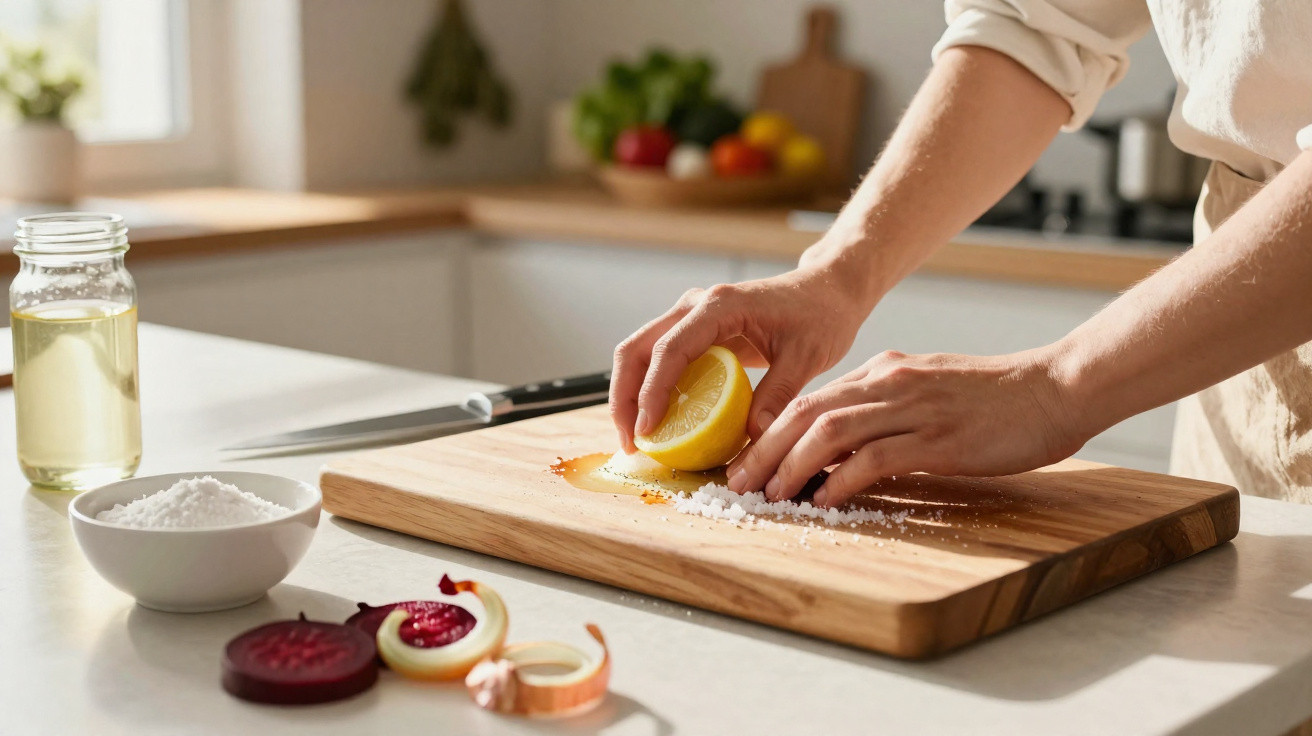
Then comes the real rescue: a combination of salt, bicarbonate of soda, and acid. Scatter coarse salt or bicarbonate of soda over a board that’s still slightly damp. Rub the surface slowly with half a lemon or lime. Leave it for ten minutes, rinse with hot water, and stand the board on its edge to dry. This approach doesn’t just lift grease-it also breaks down the smell-active compounds that have settled deep into the material.
A lot of people treat a board the way they treat a plate: a quick lather, a rinse, done. Wood and thicker plastic boards behave differently. Now and then, they need a more thorough “treatment”, otherwise invisible layers of grease and aromas build up over time. Let’s be honest: hardly anyone does this daily. But if you spend a few minutes once a week, your board will pay you back in the long run-with less of its own smell and a more neutral taste in the food you prepare.
Avoid putting wooden boards in the dishwasher, tempting as it may be. The hot, harsh cycle dries the material out, makes it split faster, and deepens the grooves-exactly the places where smells settle again.
“A clean board isn’t the one that shines-it’s the one that smells of nothing,” a chef once told me, someone who has worked in a professional kitchen for twenty years.
- Use coarse salt or bicarbonate of soda as a mild abrasive-it works like a gentle exfoliant for your board.
- Use lemon or vinegar to neutralise smell-causing compounds.
- Oil wooden boards regularly with a neutral vegetable oil so less moisture and fewer aromas soak in.
- Always dry boards standing on their edge so water and residue can drain away.
- Replace heavily scored boards in good time-deep grooves are magnets for odours and germs.
What your chopping board reveals about your kitchen routine
If you look closely, a chopping board tells you a lot about its owner. Some people keep a heavy wooden board-dark, well-oiled, scarred by years of cooking. Others swap out a thin plastic board from the supermarket every few months. In both cases, the same thing is happening: everyday life leaves traces in the material.
If you cook frequently with garlic and onions, you’ll notice the smell sooner. If fish is a regular feature, that faint, almost metallic note eventually appears in the air. And whenever apple or cucumber tastes slightly “like last night”, it’s a small signal that your care routine has started to lag behind your use.
That may be the most interesting point of all: a stubborn board forces us to think about hygiene differently. Not as a speedy cleaning habit, but as a quiet ritual that genuinely refreshes things. A proper scrub, salt and lemon, a short rest. Once a month, oil the board again-not out of perfectionism, but because the material otherwise dries out like a neglected houseplant. These small actions take minutes, yet they bring a surprising clarity to the kitchen. Suddenly the apple tastes like apple again, the bread like bread-no shadow of yesterday lingering on your tongue.
Maybe next time you sit down to eat, you’ll tell this story: the board that knew too much. The moment you realised washing-up liquid alone isn’t enough. The unexpectedly calming feeling of picking up an old kitchen tool and choosing to care for it-clean it properly, restore it, save it rather than replace it. In a world full of throwaway gadgets, a consciously maintained board can feel almost old-fashioned-and precisely for that reason, oddly modern. After all, who wants their daily life to smell of stale garlic when a little salt, lemon and attention can reset it back to zero?
| Key point | Detail | Benefit for the reader |
|---|---|---|
| Smells lodge deep in the material | Pores, cut grooves and greasy films hold aromatic compounds despite washing-up liquid | Understands why a board can smell even after cleaning, and where the real issue lies |
| Natural methods work better than detergent alone | Salt, bicarbonate of soda, lemon or vinegar lift grease and neutralise odours | Gets practical, low-cost methods for odour-free boards |
| Regular care extends lifespan | Oiling, deeper cleaning, and timely replacement of badly damaged boards | Saves money, improves hygiene, and keeps prepared food tasting as it should |
FAQ:
- Why does my wooden board smell so strongly of garlic? Wood absorbs grease and aromatic compounds into its pores. Garlic contains particularly intense sulphur compounds that settle deep in the material and often aren’t fully removed with simple washing-up liquid.
- Does it help to soak the board for longer in washing-up water? Prolonged soaking can make wood swell and leaves the surface more prone to cracks and grooves. That can make it easier for smells and germs to take hold, rather than disappear.
- What works better for odours: salt or bicarbonate of soda? Both work well, but in different ways. Salt provides mechanical abrasion and absorbs moisture; bicarbonate of soda also has a mild deodorising effect. Many people combine the two for a stronger result.
- Can I put my board in the dishwasher? Wooden boards shouldn’t go in the dishwasher, as heat and detergent can dry them out and cause warping. High-quality plastic boards usually cope better, but over time they can also pick up odours.
- How often should I oil my wooden board? Depending on use, around every four to eight weeks. Use a neutral, food-safe oil (for example, food-grade mineral oil intended for chopping boards or a dedicated care oil), apply a thin layer, leave it to soak in, and wipe away any excess.


Comments
No comments yet. Be the first to comment!
Leave a Comment