
The sponge was already giving me doubts before it even slipped from my hand. That faint grey, musty whiff. The way it always felt wet, as though it hadn’t properly dried in weeks. I lifted it from the sink, felt the slick film against my fingers, and paused for a beat: bin it now, or act like it was still acceptable.
A friend, sitting at the kitchen table and watching the whole drama, simply shrugged and said, “Why don’t you just microwave it?”
I laughed. It sounded like one of those social-media “life hacks” destined to end badly. Who would put a grimy sponge in the same place you warm up soup?
Then she explained it in two short sentences, and it completely reset how I think about cleaning my kitchen.
Ever since, whenever I pull open the microwave door, I remember that tiny, soaked rectangle-and how much it reveals about the unseen dirt we live with. And what we decide not to notice.
That gross sponge on your sink is dirtier than your toilet
You’re likely reading this with a “reliable” sponge of your own in mind. The one that’s lingered far too long: edges splitting, stains from tomato sauce and coffee, plus a mystery shade you stopped questioning.
We run it over the table, then the worktop, then maybe a plate “for a second”. We rinse it under tepid water, wring it out a couple of times, and tell ourselves it’s clean.
In reality, a kitchen sponge can turn into a quiet bacteria Airbnb. It’s warm, it’s damp, and it’s packed with tiny food remnants. A perfect home address for germs.
Researchers at the University of Furtwangen in Germany once analysed used kitchen sponges from ordinary households. In a single sponge, they found tens of billions of bacteria-including types also associated with toilets.
In that study, one sponge contained seven times more bacteria than a dirty kitchen sink. Not because anyone was particularly revolting, but because they did exactly what most of us do: rinse, squeeze, reuse.
Most people have had that uncomfortable moment of realisation: the thing you rely on to clean might actually be spreading more mess than it removes. The figures sound sensational, but they mostly underline an everyday reality we’d rather not examine too closely.
Here’s why it gets so bad. Bacteria thrive on moisture, warmth, and tiny scraps of food-and a sponge offers all three.
Once they settle in, they reproduce quickly. Each time you wipe a chopping board or a mug, you’re effectively transporting that invisible colony around your kitchen.
Of course, you won’t fall ill every time. Immune systems are resilient, and daily life involves constant contact with bacteria anyway. But when raw meat juices, warm conditions, and a tired sponge come together, the risk increases quietly in the background.
That’s where the microwave trick suddenly starts to sound less like a hack and more like common sense.
How microwaving a damp sponge actually helps
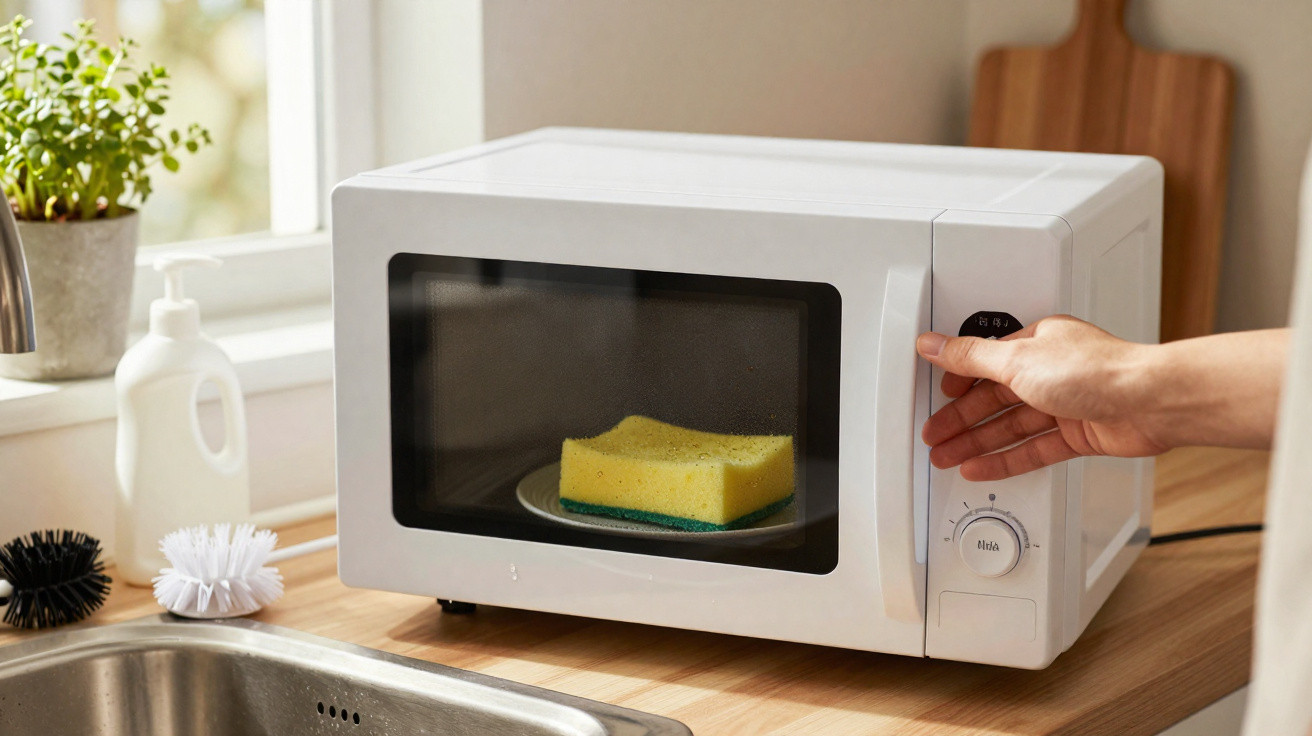
This is the simple routine my friend showed me. Take the sponge, rinse it very well under the tap, and make sure it’s fully soaked with clean water.
Next-and this part matters-put the dripping sponge in the microwave on a clean plate. Close the door and heat it on full power for about 1–2 minutes.
As the water inside the sponge heats, it begins to boil. The resulting steam pushes into the tiny gaps where bacteria hide, and many of them can’t withstand the heat.
When the microwave pings, don’t snatch it out immediately. Leave it for a short moment, because the sponge will be dangerously hot. Once it’s cooled a little, you’ve essentially given it a quick pasteurisation session.
Two common slip-ups make this less effective. First: microwaving a dry sponge, which doesn’t work nearly as well and can even be a fire hazard.
Second: assuming one “microwave cleanse” makes the sponge last forever. It doesn’t. Even with fewer germs, an old, degraded sponge still needs replacing.
And let’s be realistic: hardly anyone manages this every day. Evenings are short, and life is chaotic.
If you do it a few times a week-or after handling raw meat, or after cleaning something especially unpleasant-you’re already making a meaningful improvement. The aim isn’t perfection; it’s avoiding wiping your chopping board with a full-blown bacteria party.
“Microwaving a damp sponge won’t magically turn it into a sterile lab tool,” a food safety specialist once told me, “but it can significantly cut down the microbial load and reduce cross-contamination in everyday kitchens.”
- Always soak the sponge first
Wet, almost dripping. The water is what heats up and does the heavy lifting. - Use short bursts of time
Start with one minute on high. If your microwave is weaker, go up in 20–30 second steps. - Avoid metal or scrub pads with wires
Anything metallic in the microwave is a bad idea. Stick to classic soft sponges. - Let the sponge cool before you touch it
Lift it with tongs or wait a bit. That trapped steam is no joke on bare fingers. - Pair this trick with regular replacement
Microwaving helps with germs, not with holes or bad smells that never leave.
What this tiny ritual quietly changes at home
Once you start microwaving a damp sponge, the kitchen shifts in a small but noticeable way. You become more conscious of the invisible layer of life sitting on every surface.
Not in a paranoid way-just more alert. You pause before wiping up raw chicken juices and then using the same sponge on your child’s cup.
When the microwave beeps, there’s a brief sense of satisfaction too, knowing you’ve just knocked back the bacteria count in the room. It can feel like a tiny reset button in the middle of an ordinary day.
And that slightly unusual habit often leads to other small routines. Washing dishcloths more frequently. Letting the sink properly dry. Keeping one sponge for washing-up and another for everything else.
The microwave isn’t a cure-all, of course. But this one straightforward practice can genuinely change what “clean” means in everyday home life.
| Key point | Detail | Value for the reader |
|---|---|---|
| Microwave only a damp sponge | Saturate with clean water, then heat 1–2 minutes on high | Reduces germs more effectively and avoids fire risk |
| Use the trick regularly, not obsessively | Focus on high-risk moments: after raw meat, sticky messes, or bad smells | Better hygiene without adding stress or unrealistic routines |
| Combine microwaving with replacement | Change sponges every 1–3 weeks, depending on use and odour | Keeps both bacteria levels and overall kitchen hygiene under control |
FAQ:
- Question 1Does microwaving a sponge really kill bacteria, or is it just a myth?
- Answer 1Heating a very wet sponge in the microwave can significantly reduce the number of bacteria, especially those that are sensitive to high temperatures. It doesn’t sterilise it completely, but it does lower the microbial load compared to a sponge that’s only been rinsed under the tap.
- Question 2How often should I microwave my kitchen sponge?
- Answer 2If you cook daily, doing it a few times a week is already a good rhythm. Focus on days when you’ve handled raw meat or cleaned up something particularly dirty. You don’t need to obsess about doing it every single day for the habit to be useful.
- Question 3Can I microwave any type of sponge or scrubber?
- Answer 3Stick to standard, non-metallic sponges. Avoid anything with steel wool, metal fibres, or strange inserts. Some very thin or cheap sponges can deform, so start with shorter heating times and see how they react.
- Question 4My sponge still smells bad after microwaving. What does that mean?
- Answer 4A stubborn, unpleasant smell usually means the sponge has reached the end of its life. Microwaving helps with germs, not with deeply absorbed odours and worn-out material. At that point, the best option is to throw it away and start fresh.
- Question 5Isn’t it gross to put a dirty sponge inside the microwave where I heat food?
- Answer 5Many people feel uneasy about that, which is understandable. You can place the sponge on a dedicated microwave-safe plate and wipe the microwave interior afterward with a clean cloth. The heat mainly acts on the sponge itself, and a quick clean of the microwave keeps everything feeling hygienic.
Comments
No comments yet. Be the first to comment!
Leave a Comment