
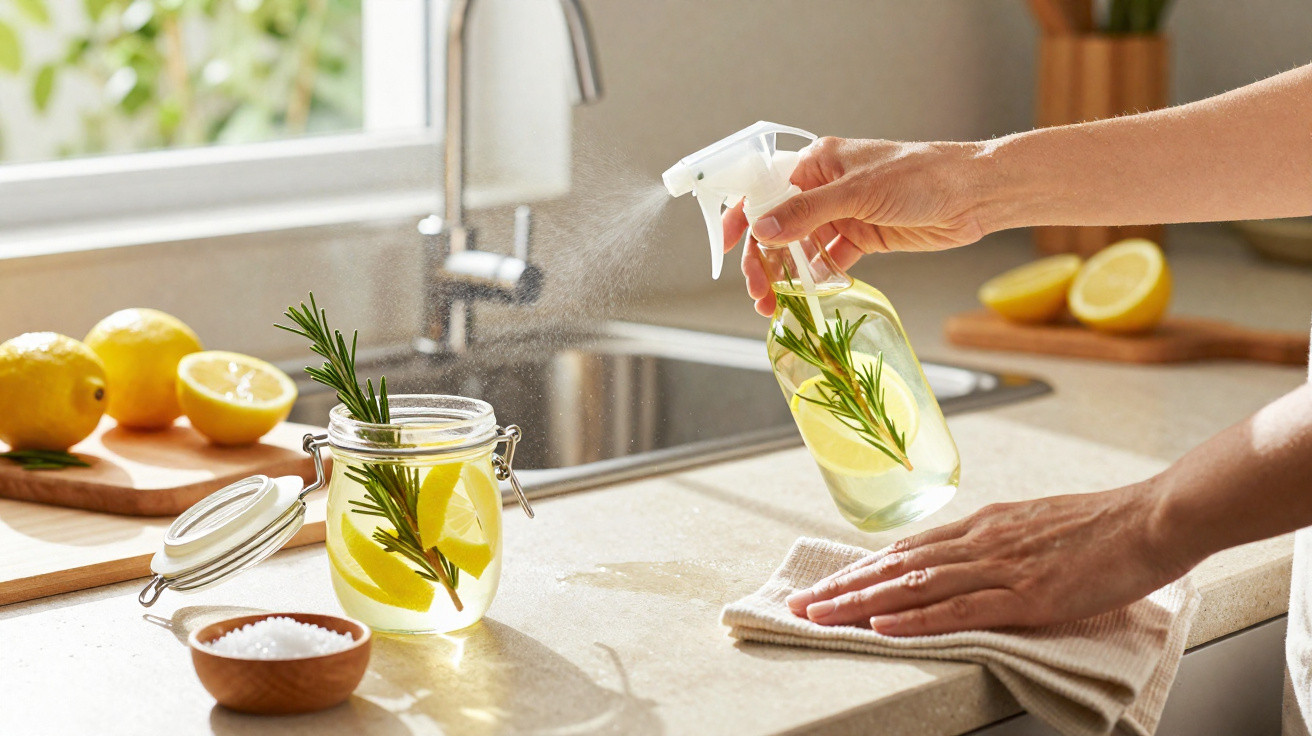
Simmering lemon peel, vinegar and rosemary creates a fragrant solution that can help with everyday cleaning of washable surfaces. The key chemical agent is the acid in vinegar, which can support the removal of light residue, including greasy marks.
Why can this mixture work as a multi-purpose cleaner?
Vinegar contains acetic acid diluted in water, commonly described as a weak acid and fully miscible. That property helps explain why it can be useful for cleaning, while lemon peel and rosemary mainly contribute scent to the mixture.
It tends to perform best as a helper for fresh dirt, light grease marks and day-to-day upkeep. It should not be treated as a universal disinfectant, because typical household strength is limited and the result varies depending on the surface and the type of residue.
Each ingredient plays a different role in the preparation:
- Lemon peel: adds a citrus fragrance to the homemade cleaner.
- Vinegar: provides the acetic acid in the solution.
- Rosemary: contributes a herbal fragrance to the mixture.
- Water: allows the mixture to be simmered and helps disperse the aromatic components.
- Use: supports routine maintenance of washable surfaces.
How do you prepare the lemon, vinegar and rosemary cleaner?
To make it, put water, lemon peel and rosemary sprigs into a pan. Once it reaches the boil, turn off the heat, add the vinegar, and leave it to infuse until cool-keeping control of steam and splashes.
When the liquid has cooled, strain it thoroughly to remove any particles that could block a spray bottle. Pour the solution into a clean container, label the contents, and make only a small quantity-enough for household use over a few days.
Which surfaces can the solution be used on?
On washable worktops, completely cold hobs and typical floors, use it sparingly. Spray onto a cloth, wipe the area, then remove any excess-avoiding leaving moisture sitting on the surface for too long.
Careful application
Test before wiping widely
Apply a small amount to an inconspicuous spot and check whether there is any change in colour or shine.
Use a soft cloth and wipe away any excess so the liquid does not pool on the finish.
Because the acetic acid in vinegar can be corrosive in certain conditions, a spot test in a discreet area is essential before wider use. This precaution helps reduce the risk of staining, loss of shine, or wear to the finish.
Use the cleaner cautiously on:
- Washable worktops that are not made from natural stone;
- Outer surfaces of cookers when they are completely cold;
- Common floor types that are compatible with mildly acidic products;
- Tiles and wall coverings that have been tested first;
- Tables with a durable, non-porous finish.
Where should the homemade cleaner never be used?
Natural stone-such as marble and granite-should not be treated with this solution, as acid-sensitive materials can lose their finish. It is also sensible to avoid unsealed wood, delicate metals and electronic screens, where acidity may cause damage.
Vinegar must never be combined with bleach or any product containing hypochlorite. The reaction can release irritating gases, so the safest rule is to use only one product at a time, keep good ventilation, and prioritise safety.
To reduce the risk of accidents and material damage, follow these precautions:
- Never mix vinegar with bleach;
- Do not apply the solution to marble or granite;
- Avoid electronic, porous or unsealed surfaces;
- Keep the spray bottle labelled and out of children’s reach;
- Carry out a discreet test before each use.
Can this cleaner replace conventional products?
Anyone looking for straightforward alternatives may also want to explore other household uses for lemon, bearing in mind that every material needs its own care. This solution works best when used with moderation, a prior test, and close attention to the finish during daily cleaning.
Its main advantage is convenience for small cleaning jobs, not replacing every product you might use. Respecting incompatible surfaces, avoiding chemical combinations, and mixing only small batches makes use more responsible, helping protect the home and improving everyday safety.


Comments
No comments yet. Be the first to comment!
Leave a Comment