
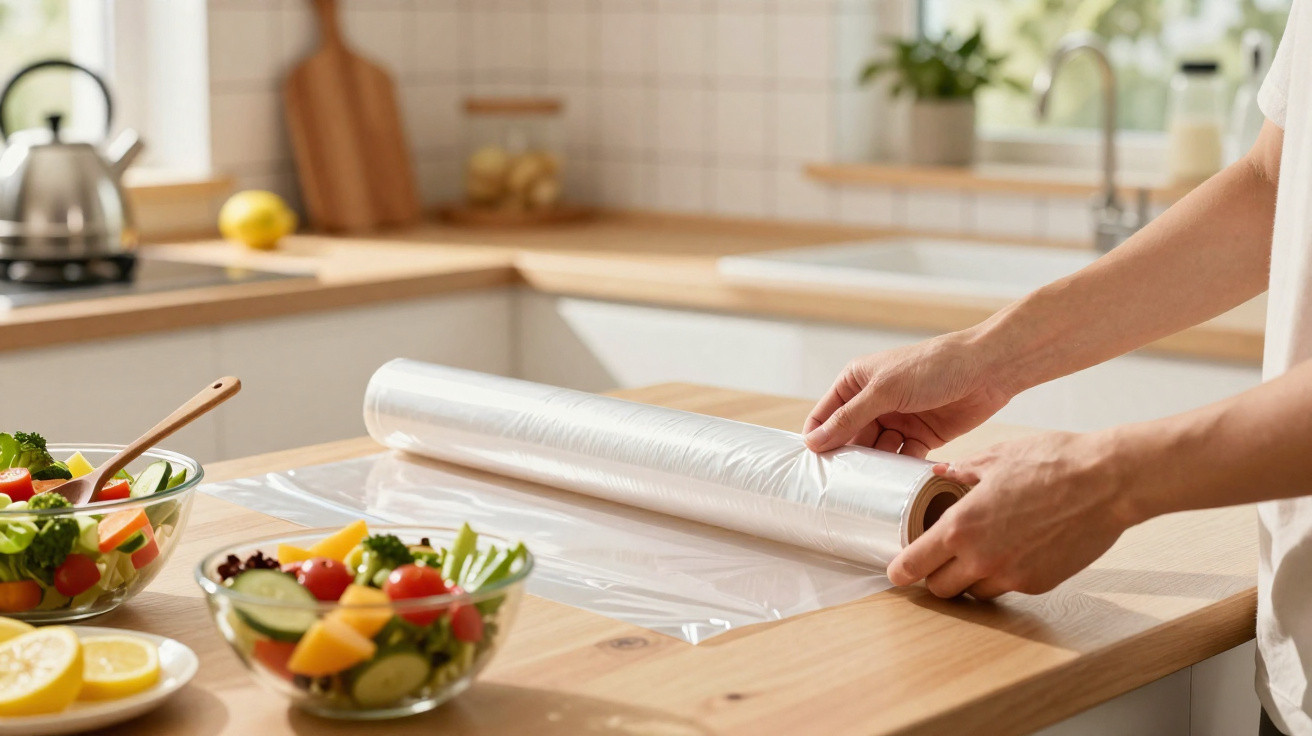
Sunlight slants through the kitchen window. You’re only trying to wrap something from the fridge in a hurry - and you end up wrestling a thin, unseen opponent. The cling film that just peeled off the roll a moment ago now clings to your fingers, the knife, the chopping board. It’s there everywhere, yet it disappears precisely where you need the edge. You rotate the piece of cheese, hunt for the corner, and let out an irritated breath. That quiet, everyday frustration shows up - the kind nobody ever posts on Instagram. In moments like this, the kitchen feels less like home and more like a lab where you fail the same simple test over and over. And you can’t help thinking: isn’t there a ridiculously easy way to get this film under control?
Why cling film sticks everywhere – and never where we need it
Anyone who’s spent time in a professional kitchen knows the soft groan that follows when someone pulls the cling film roll from a drawer. In trained hands, that thin transparent sheet seals bowls neatly; at home it often turns into a crumpled lump. It grabs the worktop, your sleeve, occasionally even your face. Nobody takes a photo of the moment you try to pinch an invisible corner with two fingertips and somehow create even more chaos. And yet this little disaster is standard in most kitchens: a minor everyday mishap that has embarrassingly little to do with “meal-prep perfection” - and a great deal to do with physics.
I once watched a bakery kitchen on a Saturday morning. Trays came out of the oven every minute, the air smelled of cinnamon and yeast, and at the stainless-steel table a young pastry chef was covering dozens of bowls. Her hands moved over the cling film roll just once. No tugging, no searching. A quick pull, the film came away cleanly and lay flat across the bowl. Two seconds and done. While I was still thinking about how much time I waste at home fighting cling film, she smiled and said, “Once you know where it grips, you’ll never search again.” That line stuck with me.
The hidden core of the problem is a combination of static electricity, film thickness, and our own impatience. Cling film picks up static easily on dry surfaces and in dry air, which makes it stick to random places more strongly. Our fingertips have tiny ridges, traces of oil, sometimes a bit of moisture - ideal anchor points for the film. When we poke around frantically for an edge, we increase the contact area and fold the material into itself even more tightly. The more rushed the movement, the harder it becomes to separate. And let’s be honest: nobody deliberately practises using cling film - we just “get on with it” and then act surprised when we lose again.
The easiest method: feel, don’t fiddle
The simplest professional trick doesn’t start with the roll at all - it starts with your hands. Before you go hunting through a tangled wad of cling film, briefly touch something just slightly damp: the cold tap, a piece of kitchen paper with the tiniest drop of water, or the underside of a glass you’ve just rinsed. Not soaking wet - just a hint of moisture. Then bring two fingertips (thumb and forefinger) slowly to the edge of the bunched-up film. Don’t press hard, and don’t pull. Smooth it. With lightly damp fingertips, you can immediately sense where two layers overlap, and they separate almost on their own.
This is where many people make the same mistake: they get impatient. They scrunch the film up, hope for a “reset”, and then tear off an even messier tangle from the roll. The inner voice says, “It’ll be fine - it’ll stick somehow.” It won’t. Instead, you end up with small tears, ragged edges, and you use twice as much material just to cover a bowl. It feels like a quiet, pointless failure in the middle of family life. And the more often it happens, the more likely you are to reach for aluminium foil or disposable lids out of annoyance - even though you know that doesn’t really help anyone.
“Cling film isn’t stubborn - it simply reacts honestly to every hurried movement.” – a head chef who supposedly never fiddles, only “guides”
- Dampen your fingertips very slightly, not wet - this helps you separate layers instead of making them stick.
- With two fingers, glide slowly along the film’s edge; don’t tug, pinch, or tear.
- Always crease the roll’s edge slightly on one side so the starting point is easier to find next time.
- Store the film at room temperature rather than very cold; it keeps it more pliable and predictable.
- If one section is wrinkled, cut off only that part - don’t restart the whole sheet.
How to find the film before it drives you mad
A genuinely calm cling film moment begins one step earlier - before the film has a chance to attach itself to everything. Imagine taking the roll out of the drawer and it’s already “waiting” for you with a small, visible tab. The easiest habit is this: after each tear-off, bend the new edge over slightly, like a tiny curl. That turns an invisible line into a tangible edge. Next time, you run your fingers along the roll and immediately feel where the start is. No searching, no scraping at the cardboard, no wasting half a metre because the beginning vanished again.
Many of us treat the roll like a disposable nuisance: it gets tossed into the drawer, wedged between a whisk and a colander, sometimes even slightly crushed. That’s where the trouble really starts. The cardboard tube warps just a little, the film no longer sits evenly, winding tighter on one side and looser on the other. When you pull, the sheet then skews, catches on the cutting edge, and you’re battling not only static but also an uneven wrap. A blunt truth nobody enjoys hearing: treat your cling film like rubbish and you’ll get rubbish results.
Handling cling film smoothly isn’t a talent - it’s simply a short sequence of small actions you choose to do properly once. Keep the roll in the same place each time, ideally laid straight and clear, with nothing piled on top. After cutting, press both hands briefly across the width against the cutting edge so the line stays tidy and straight. And if a piece does end up stuck everywhere, return to the professional trick: lightly damp fingertips, locate the edge, and “stroke” the layers apart rather than ripping them. What usually smells like “I’ve messed it up again” becomes a small, quiet win in an ordinary day.
| Key point | Detail | Benefit for the reader |
|---|---|---|
| Lightly dampen fingertips | Touch the tap, the underside of a glass, or a damp cloth, then move slowly over the film | Invisible edges become easier to feel; crumpled film separates more easily |
| Store the film with care | Keep the roll straight, protected, and not under pressure in the drawer | Less distortion, cleaner tearing, fewer snags on the cardboard edge |
| “Mark” the edge | After each tear-off, bend the film edge slightly or leave a small tab | Faster start next time; no frustrating searching and picking |
FAQ:
- Why does cling film sometimes stick too much and sometimes not at all? It depends on temperature, humidity, and the surface. Dry, smooth surfaces and dry air encourage static build-up, which makes the film cling more. Greasy or very wet surfaces reduce its grip.
- Does storing cling film in the fridge help? Cooler film can be a bit stiffer and may unroll more precisely, but many people find it harder to shape. It’s best to try what works in your own kitchen.
- How do I stop the film sticking to my hands? Lightly dampen your fingertips, work slowly, and use broader, calmer movements. Fast, tiny motions increase contact points and therefore increase sticking.
- Which surfaces are best for a neat seal? Glass, smooth ceramic, and polished stainless steel help the film adhere evenly. Rough wood or heavily textured containers create folds and gaps more quickly.
- Are there more sustainable alternatives for tricky situations? For frequently used bowls, reusable silicone lids or screw-top jars are worthwhile. For everything else, using film sparingly alongside a few reliable “go-to containers” can significantly reduce consumption.



Comments
No comments yet. Be the first to comment!
Leave a Comment