
The supermarket is packed; it’s Tuesday, with flat grey light beyond the sliding doors. By the checkouts sit those dispensers of disinfectant wipes. A mother yanks one free, gives the trolley handle a quick once-over, and pushes on. The man behind her does the same-half walking, half scrolling on his phone. It looks almost like a reflex, as automatic as tapping your card.
Later, in the kitchen, it’s the same routine: one wipe pulled from the pack, a rapid sweep across the worktop, a brief “Right, clean.” And inside, that small, misleading exhale of relief. On the packet, the instructions are printed in tiny lettering-far too small for real life. We don’t read them; we buy into the promise.
What if that’s exactly where the real mistake begins?
The big illusion: wiping doesn’t automatically mean disinfecting
We all know the feeling: you give something a quick wipe with a disinfectant wipe and, instantly, you feel safer. A pass over the kitchen table, your phone, the door handle-and mentally you tick “germs” off the list. The surface looks spotless, your conscience settles. After all, clean-looking must mean safe.
That’s the heart of the misunderstanding. A disinfectant wipe isn’t a magic eraser that kills everything with a half-hearted swipe. It needs time, it needs moisture, and it needs enough product on the surface. The blunt reality is that in many homes, bacteria and viruses simply remain-just smeared around a bit.
A few months ago, I was sitting with an infection-control specialist in a hospital corridor under harsh fluorescent lighting, slightly overheated. She told me about an internal test series: cleaning trolleys, door handles and bedside tables were wiped exactly the way many people do it at home-one quick pass, just until it looks “decent”. Then samples were taken, grown in the lab, and turned into brightly coloured colonies on Petri dishes.
The results were sobering. On several surfaces, more than half the germs were still detectable even though “disinfecting” wipes had been used. The specialist remarked-dryly-that she sees the same thing in training sessions at nurseries and care homes. Everyone uses wipes. Hardly anyone uses them correctly. And the germs that survive are often the stubborn ones.
At home, the pattern is similar: a fast wipe before eating, a quick once-over after shopping, perhaps the fridge handle too. The only check is visual: does it look fine? What we can’t see is that the active ingredients require contact time-sometimes 30 seconds, sometimes several minutes. If the surface dries too soon or is touched again straight away, the promised effect remains nothing more than a marketing line on the packet.
So why do so many people make the same mistake? Part of it is psychology. Disinfectant wipes feel like a shortcut: no bucket, no cloth, no spray bottle. You reach into the pack, wipe once, done. Our brains love shortcuts, especially in an already overloaded day. In that moment, who is really going to read the small print about contact times and surface coverage?
Add to that the view through the smartphone filter: on social media we see gleaming kitchens, perfectly folded wipes, rapid reels full of “hacks”. Hygiene becomes a stylish gesture rather than a process. Cleaning and disinfecting blur into one. One wipe, one swipe, one like. And let’s be honest: hardly anyone does it every day as thoroughly as the instructions require.
Then there’s the quiet anxiety left behind by the pandemic years. Many people want to “do something” to protect themselves. Disinfectant wipes are tangible, cheap, and still carry that hint of clinical reassurance. In that emotional mode, few stop to question whether their own method is effective. The priority is doing something-even if, in practice, it’s more of a ritual than a real protective measure.
How disinfectant wipes become real protection - not just a prop
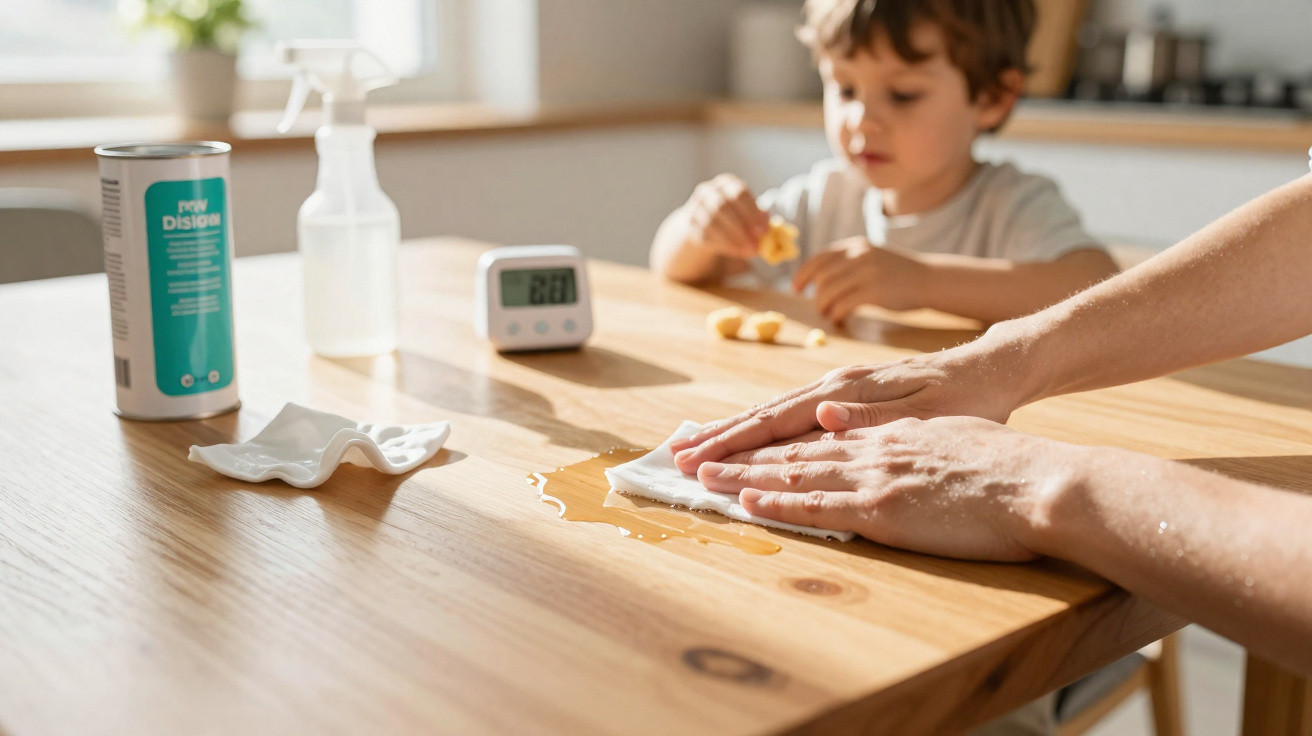
The most important step starts exactly where it becomes inconvenient: contact time. Every pack states how long a surface must remain visibly wet for viruses and bacteria to be inactivated. That might be 30 seconds, 1 minute, or even 5 minutes. A single, fleeting wipe almost never achieves that.
If you mean it seriously, use a separate wipe for each surface, wipe evenly without skimping, and then leave it alone-until it has dried. Don’t buff it dry, don’t polish it with your sleeve, don’t immediately slam the chopping board back down. These wipes function a bit like medicine: wrong dose, wrong use, half the effect. The difference is that in real life nobody reads an “insert” in the bathroom when the children are about to sit down for tea.
One common mistake is the multitasking wipe: first the kitchen table, then the worktop, then quickly the door handle-everything with the same wipe that’s already half dry. In theory you save time and materials. In reality you move germs from A to B, and you may be spreading grease and dirt that blocks effectiveness. Disinfectant wipes are intended for pre-cleaned surfaces, not as a replacement for hot soapy water.
A second classic error is using wipes on porous or unsuitable surfaces. Wood, unsealed stone, and some plastics can be sensitive-or absorb the liquid so that it no longer works on the surface. The chemical name in the small print may sound harmless, but many manufacturers flag limitations there for a reason. Skip that step and you’re working blind.
And then there’s the emotional trap: “If it’s disinfected, I don’t need to clean properly as often.” That quiet voice that says one wipe will do. This is exactly where the benefit flips into its opposite. Dirt, crumbs, grease splashes-those need ordinary cleaning first. Disinfection isn’t a substitute for hygiene; it’s an extra step for specific moments, such as after handling raw meat or when someone in the household is unwell.
“Disinfectant wipes are like seatbelts: they only help if you use them properly - and not everywhere, all the time, out of habit,” a hygiene expert told me drily in an interview.
If you want to make fewer mistakes day to day, a few basic principles help:
- Only disinfect where it genuinely makes sense - for example when someone is ill at home, after contact with raw meat, or in shared areas.
- Clean first, then disinfect - remove visible dirt, then use the wipe and leave the surface visibly wet.
- Don’t “overuse” wipes - one surface, one wipe, rather than blessing the whole room with a single cloth.
- Actually read the pack once - contact time, suitable surfaces, storage advice. Fifteen seconds of attention, far less illusion.
- Less often, but correctly - targeted, effective use beats daily feel-good rituals.
What’s left when we question the disinfection reflex
Perhaps the biggest moment of recognition isn’t the germ count on a Petri dish; it’s the quiet discomfort when you realise: I’m wiping more for reassurance than for results. In many households, disinfectant wipes have quietly become a modern talisman-kept within reach, offering a sense of control, promising safety in a world that often feels unpredictable.
Once you understand the usage mistake, you regain something that isn’t printed on any packet: calm. You don’t have to disinfect every surface; you don’t need to wipe down the entire kitchen after every shop. In most situations-particularly when nobody is ill-normal cleaning is enough. Disinfection then returns to what it was meant to be: a targeted measure, not a lifestyle ritual.
We probably don’t talk enough about how strongly these small routines steer us emotionally. One more wipe, one more swipe, one per cent less worry. When you start looking more carefully, a different thought moves to the foreground: real hygiene is invisible, slow, sometimes boring. Washing hands. Ventilating. Cleaning surfaces. And then, in certain moments, the wipe-properly wet, with enough time, without the illusion.
| Key point | Detail | Benefit for the reader |
|---|---|---|
| Wiping is not the same as disinfecting | Contact time and a visibly wet surface are crucial for effectiveness | Readers understand why their quick wipe often offers very little protection |
| Typical everyday mistakes | One wipe for many surfaces, use on dirt or on unsuitable materials | Clear “aha” moments that help readers challenge their own routines |
| Targeted use instead of constant use | Focus on situations with real risk, combined with normal cleaning | Less stress, less product use, and more genuine hygiene |
FAQ:
- How long does a disinfectant wipe need to work? The contact time is stated on the packet and is usually between 30 seconds and several minutes. The surface must remain visibly wet for that period, otherwise the stated germ reduction will not be achieved.
- Can I use one wipe on multiple surfaces? Technically yes, but it rarely makes sense. The drier the wipe becomes and the more dirt it picks up, the more the disinfection performance drops-and germs can be transferred.
- Is a disinfectant wipe enough instead of normal cleaning? No. Heavy dirt, grease and crumbs must be removed first. Disinfection only works properly on pre-cleaned, preferably smooth surfaces, not as a replacement for hot soapy water.
- Are disinfectant wipes suitable for every surface? Many products are not ideal for untreated wood, natural stone, or sensitive plastics. The manufacturer’s guidance indicates where damage or discolouration may occur.
- When is it really worth using them at home? For example, when someone in the household is ill, after handling raw meat, when cleaning door handles during cold season, or on shared high-touch surfaces-not necessarily in everyday life.
Comments
No comments yet. Be the first to comment!
Leave a Comment