
Dinner was, by all accounts, a success: everyone’s full, everyone’s happy - right up until you glance into the kitchen. In the frying pan, a stubborn black-brown crust has welded itself to the base and looks like it plans to stay there forever. For a second, the thought flashes up: “That’s ruined - I need a new one.” And then you still slide it into the sink, accompanied by a quiet pang of guilt.
We all know that moment. You turn on the tap, leave the pan to soak with a resigned sigh, and promise yourself you’ll “properly” scrub it later. Let’s be honest: hardly anyone keeps that up every single day. Instead, pots and pans pile up, surfaces go steadily duller, the base discolours, and the coating takes a hit. A small, recurring kitchen drama - persistent and irritating.
Right at that point, something unassuming suddenly appears from the back of the cupboard: baking powder. It’s the thing we associate with fluffy cakes, not burnt pans. And yet those white granules hide a kitchen hack that feels almost like cheating.
Why baking powder is suddenly the secret hero of your kitchen
Baking powder is the kind of pantry staple you buy, forget about, and then rediscover in triplicate during a tidy-up. It seems harmless - ordinary, everyday. But inside it is a small chemical ace that can do things to a crusted pan base that washing-up liquid can only dream of.
When baking powder is heated with water, it starts to react. Tiny gas bubbles form - a sort of micro-scale lifting force for grime. Burnt-on residue begins to rise, loosen, and lose its concrete-like grip. Suddenly, something that looked unbeatable starts to shift. That moment feels almost undeservedly easy.
A lot of people are thrown the first time they try it. You don’t get a dramatic foam explosion like an advert. There’s no spectacular fizzing. Instead, it happens quietly, slowly - almost shyly. That’s precisely why the result can be so impressive, and so gentle on your pan.
A chef friend once told me about a Saturday evening when she cooked for six. Plenty of oil, high heat, and a stainless-steel pan that stayed on the hob a touch too long. By the end, the fried potatoes were stuck to the base like welded plates. Classic scene, classic despair.
“I stood there thinking: that pan is finished, I can write it off,” she said. Instead of reaching for wire wool, she remembered a tip from her grandmother: baking powder into the pan, add water, bring it briefly to the boil, then leave it. She did it half-heartedly, already mentally browsing online for replacement kitchen kit.
The next morning she took a wooden spoon, ran it once across the base - and the crust slid away as if it had never truly been there. No battle, no swearing, no scraping noises. Just one quick wipe and a stunned look. “I’ve rarely felt so stupid and so relieved at the same time,” she told me, laughing. From then on, her baking powder wasn’t kept by the flour anymore - it lived within reach next to the sink.
What’s happening here is actually fairly straightforward. Baking powder usually contains sodium hydrogen carbonate and an acidifying agent. With water and heat, it forms a mildly alkaline solution that softens fats and protein residues. The gas release helps lift the layer up, rather than forcing it deeper into the surface.
For enamel, stainless steel, and glass, that’s a blessing. You avoid harsh abrasives that leave fine scratches and gradually make the surface look dull. Even with many non-stick pans, the trick can help - precisely because you need far less scrubbing. The mechanical wear drops, and the pan lasts longer.
Of course, it isn’t a magic spell that catapults every destroyed pan back onto the “new” shelf. If the coating is already flaking or the base is warped, baking powder won’t rescue it. But before you reach that point, it can become a quiet ally - long before you end up frustrated in the cookware aisle.
How the baking powder hack works, step by step
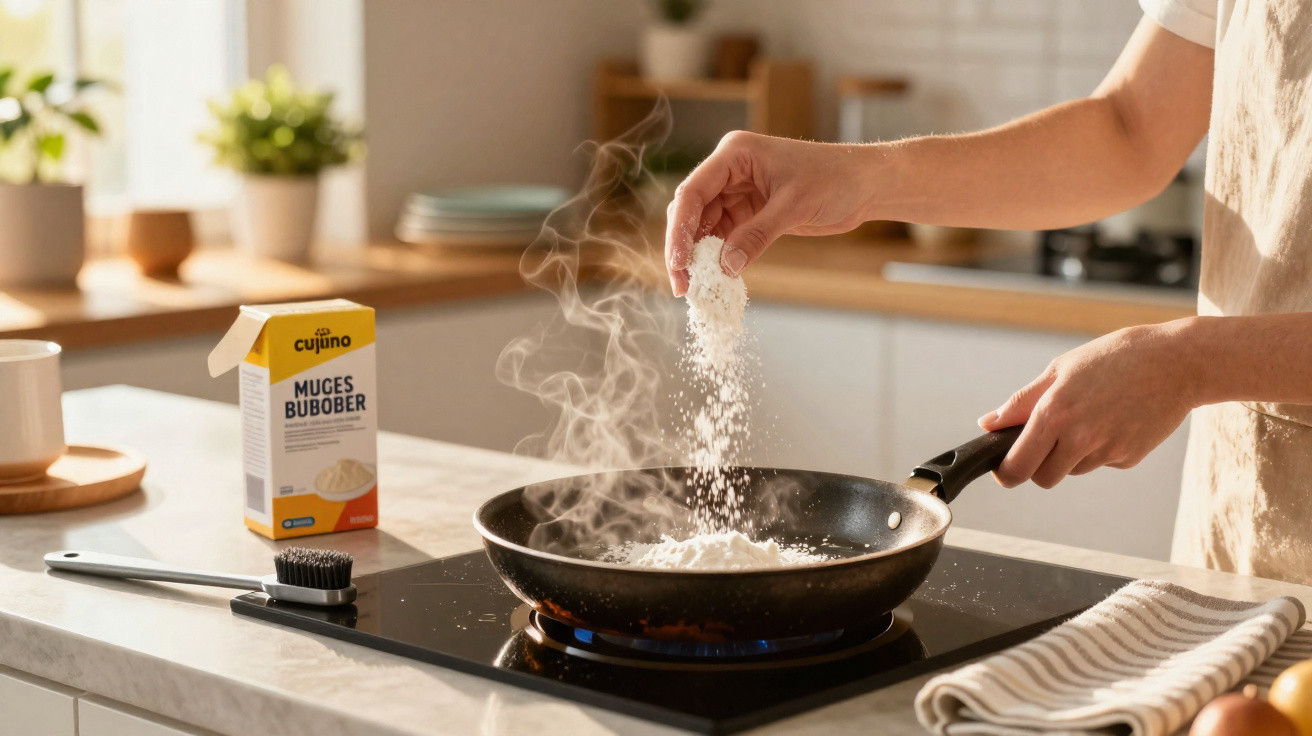
The process is surprisingly simple, which is exactly why it fits real life. Take the dirty pan and remove any loose bits of food - a rough scrape is enough. Then sprinkle one to two sachets of baking powder over the base. The layer doesn’t need to be thick; it just needs to cover the burnt area well.
Now add water. Pour in enough to cover the base properly - roughly 0.5 cm. Put the pan back on the hob and heat it until the water just comes to the boil. No full blast; a medium heat is fine. As soon as you see the first small bubbles, let it simmer gently for a few minutes, then take the pan off the heat.
Next comes the waiting. Let the solution cool and give it time to work - 30 minutes is a good rule of thumb, and for extreme cases, longer. When you run a wooden or silicone spatula across the base, you’ll feel the crust give way and break off in sheets or flakes. Only then rinse with warm water and finish with a soft sponge. It’s not a brute-force job - more like tidying up after the hard work has already been done.
What many people underestimate: the biggest mistake doesn’t happen while cooking, but when cleaning up afterwards. Out of impatience, we grab metal scourers, wire brushes, or extremely harsh cleaners. In the short term it can seem effective; in the long term it ruins almost any pan. The surface becomes rough, food catches faster, and we’re left wondering why nothing works the way it used to.
With the baking powder hack, you slow things down. You shift the effort from your arms to chemistry. At first that can feel oddly passive - almost too relaxed. But it’s exactly that calm approach that can save your cookware. If you notice yourself getting angry while scrubbing, that’s usually a good sign you’re being too aggressive.
A second common stumbling block is not giving it enough time. People pour the solution away after five minutes and feel disappointed. But the reaction isn’t a sprint; it’s more like a leisurely walk. A bit of patience pays off - and in the end saves effort, money, and nerves.
“The best kitchen routine is the one you can actually stick to in real life. Small, simple tricks almost always beat big, perfect plans.”
To make it easier to get started, here’s a compact checklist you can keep in mind next to the hob:
- Always sprinkle baking powder onto the dry, dirty base first
- Use enough water to cover the base well
- Heat gently - not at full power - and don’t leave it unattended
- Leave it to work for at least 30 minutes; longer is better than too short
- Use soft tools: wooden spatula, silicone utensil, soft sponge
What this small hack changes in everyday kitchen life
Once you stop thinking of baking powder as just a baking ingredient and start treating it as a quiet kitchen helper, something shifts. The barrier to rescuing “difficult” pans gets lower. All of a sudden it’s not a big production; it becomes a routine: baking powder, water, a brief boil, leave it, and get on with your evening. The real magic happens while you’re already on the sofa.
It’s striking how quickly the mood in the kitchen can change once that stress factor disappears. Burnt edges go from a disaster to “Fine - annoying, but fixable.” That takes pressure off the cooking itself. You feel more confident turning up the heat, making caramel, chasing crisp crusts, without that inner voice shouting, “Think about the washing-up!”
And there’s another point: if you treat your pans this way instead of throwing them out every few years in frustration, you cook more sustainably, more cheaply, and more consciously. There’s no need for high-tech cleaners or specialist products covered in warning symbols. A simple sachet of baking powder is enough - and it’s often in the cupboard already. Perhaps that’s the most unshowy, but most honest kind of luxury: knowing you can save a lot with very little.
| Key point | Detail | Benefit for the reader |
|---|---|---|
| Baking powder cleaning | Heat baking powder with water, leave to work, then clean gently | Rescues burnt pans without heavy physical effort |
| Pan protection | Avoid wire wool and aggressive abrasive cleaners | Longer lifespan for stainless-steel, enamel, and coated pans |
| Everyday routine that works | The trick can run in the background while you do something else | Less kitchen stress, lower costs, more enjoyment of cooking |
FAQ:
- Can I use the baking powder hack on any pan? It works very well on stainless steel, enamel, and glass. On non-stick pans, be gentle and avoid abrasive sponges so you don’t damage the coating.
- How much baking powder do I need per pan? For a standard pan, one to two sachets is usually enough. What matters is covering the dirty area well, not the exact gram amount.
- How long does the mixture need to sit? At least 30 minutes; for heavy build-up, a few hours or overnight. The longer it sits, the more easily the layer loosens.
- Can I use bicarbonate of soda instead of baking powder? Yes - bicarbonate of soda also works very well because the active component is similar. You don’t need an additional acid; just water and heat.
- Does the trick also work for burnt pots? Yes, the principle is the same. Especially with stainless-steel pots with burnt-on sauce or rice residue, the baking powder hack can work wonders.

Comments
No comments yet. Be the first to comment!
Leave a Comment