
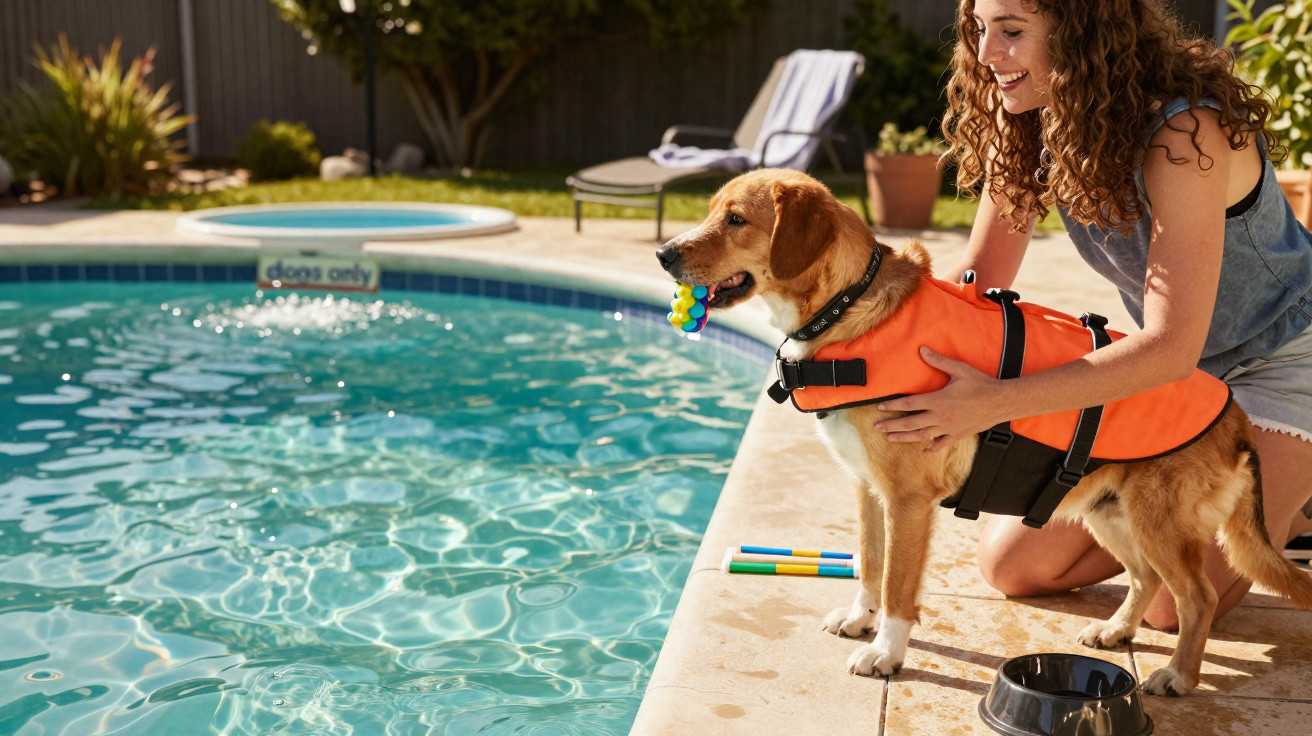
What feels like pure refreshment for people can quickly become risky for four-legged friends.
Many owners take their dog into the water as a matter of course. Especially in high temperatures, it seems sensible: the dog cools down, gets some exercise and looks happy. Yet behind the apparent fun of splashing about sit health concerns, chemical exposure and hazards that are often underestimated – depending on the animal, the pool and the level of supervision.
Why dogs love the pool in the first place
Anyone who knows a water-mad retriever will recognise it: some dogs launch themselves into the water with such enthusiasm they practically dive in headfirst. For them, a dip in the pool can be genuinely worthwhile.
"A well-planned pool visit can combine exercise, cooling down and fun – without overtaxing the dog."
Positive effects of swimming in a pool
- Cooling on hot days: Water reduces body temperature and takes the strain off dogs that struggle in the heat.
- Joint-friendly exercise: Swimming builds muscle without putting heavy load on hips and knees – ideal for heavier or older animals.
- Mental stimulation: A different setting, fresh impressions and shared games – water can engage a dog mentally.
- Building confidence: With gentle guidance, a cautious dog can learn to associate water with something positive.
Particularly for young, healthy and athletic dogs, a short swimming session in the pool can be a useful addition to everyday life – provided the conditions are right.
The underestimated risks of everyday “dog in the pool” life
However harmless a pool may look, there are traps for dogs that many owners do not anticipate. The biggest risk is not the wet surround, but the combination of chemicals, exhaustion and stress.
When fun turns into stress
- Fear and overwhelm: A dog that is “placed” in the water – or even pushed in – can quickly associate the pool with panic.
- Fatigue and drowning risk: Dogs that do not know how to get out may keep swimming until they are completely exhausted.
- Breed-related difficulties: Flat-faced dogs such as pugs, bulldogs or French bulldogs are at a real disadvantage in water.
"Not every dog is a strong swimmer – some, because of their build or breathing, simply don’t stand much chance in the water."
Dogs with a broad chest, short muzzle and little buoyancy have to work hard to stay afloat. At the same time, they struggle to breathe. For these animals, a brief moment of inattention can be enough for a pleasant dip to turn dangerous.
Chemicals in the water: chlorine is not dog food
A clean pool may look hygienic, but what barely affects humans can cause problems for dogs very quickly.
- Ingesting water: Many dogs automatically swallow pool water while swimming – out of curiosity or thirst.
- Gastrointestinal upset: Nausea, vomiting, diarrhoea or increased drooling are common outcomes.
- Irritation of skin and mucous membranes: Red eyes, itchy skin and inflamed ears occur especially in sensitive animals.
The more heavily chlorinated the pool is, or the more additional cleaning agents are used, the higher the risk. For dogs with allergies, skin conditions or ear infections, symptoms can become noticeably worse.
When a dog should never go in the pool
There are clear situations where a pool swim should be off limits – regardless of how much the owner wants their pet to cool down.
- Open wounds or skin disease: Chlorine and other substances irritate the skin and infections may worsen.
- Heart or breathing problems: The strain of cold water, excitement and swimming can be too much.
- Very old, very young or weakened dogs: They chill more quickly and tire far sooner.
- Severe fear of water: An anxious dog does not “get used to it” in a pool – it is more likely to be traumatised.
- No safe way in and out: Without a ramp or wide steps, panic at the pool edge becomes a real risk.
- Overdosed pool chemicals: Strong-smelling, stinging water is a clear warning sign – for people and animals.
"If you constantly have to 'rescue' your dog in the water, then it simply doesn’t belong in that pool."
Under what conditions swimming in a pool is okay for dogs
If you introduce your dog to the pool carefully and with safety in mind, a workable compromise can be possible in some cases. The essentials are control, good water quality and a realistic view of the individual dog.
Checklist: Is your dog allowed in the pool?
| Criterion | Permission for the pool |
|---|---|
| Health status | Only if health is stable, with no open wounds or acute illness |
| Temperament | Calm, curious dog; no panicked fear of water |
| Water quality | Moderate chlorination, no strongly irritating additives, pH within the normal range |
| Entry and exit | Ramp or wide steps the dog can use independently |
| Supervision | The dog is never left alone in or by the pool |
| Aftercare | Rinse with clean water, dry ears and coat thoroughly |
Taking these points seriously reduces the risk significantly. Even so, the rule still stands: a pool is not a paddling adventure playground, but a place where owners must take responsibility.
From what age dogs are allowed in the water
Young dogs should allow their bodies time to develop before doing any serious swimming. Many vets advise starting first, very short and closely supervised introductions to shallow water from around four to five months – and initially in a small, low plastic tub rather than in a large pool.
For puppies in particular, simply cooling their paws is often more than enough. Extended swimming places unnecessary strain on young joints and on an immune system that is not yet fully mature.
Do dog and human share the same pool?
The classic scenario: a family pool in the garden, children in the water and the dog right in the middle of it all. This can work, provided a few basic rules are followed.
- The dog is socially safe: No snapping at boisterous children, no panicked behaviour.
- Everyone involved knows the rules: Nobody pulls the dog in or carries it into the water.
- Water levels are correct: Regular checks of chlorine and pH; no drastic “shock chlorination” while the dog is swimming too.
- The dog gets breaks: Out again after a few minutes, a shaded resting spot, and fresh drinking water.
"Pool water never replaces the bowl. If a dog is allowed to swim, it must always have fresh drinking water alongside – otherwise it will inevitably drink from the pool."
Practical tips for safe pool fun
- Start in the shallow area and get in yourself, rather than sending the dog in first.
- Let the dog decide at its own pace how far it wants to go.
- For uncertain or heavy dogs, use a buoyancy aid with a handle.
- End the session a little early rather than too late – the first signs of fatigue are enough.
- Rinse coat and paws thoroughly with tap water after swimming.
- Dry the ears carefully, especially for dogs with floppy ears.
Alternatives to the pool for dogs struggling in the heat
Not every dog needs to swim to get through summer comfortably. Shallow paddling pools, damp towels on cool tiles, walks in the early morning and shady resting places are often the better choice.
Especially for brachycephalic breeds, very old animals or dogs with existing health conditions, a deliberately “boring” approach is worthwhile: brief cooling of the paws, plenty of rest, and no pressure to swim. That way, summer stays relaxed – for the dog and for the people at the poolside.



Comments
No comments yet. Be the first to comment!
Leave a Comment