
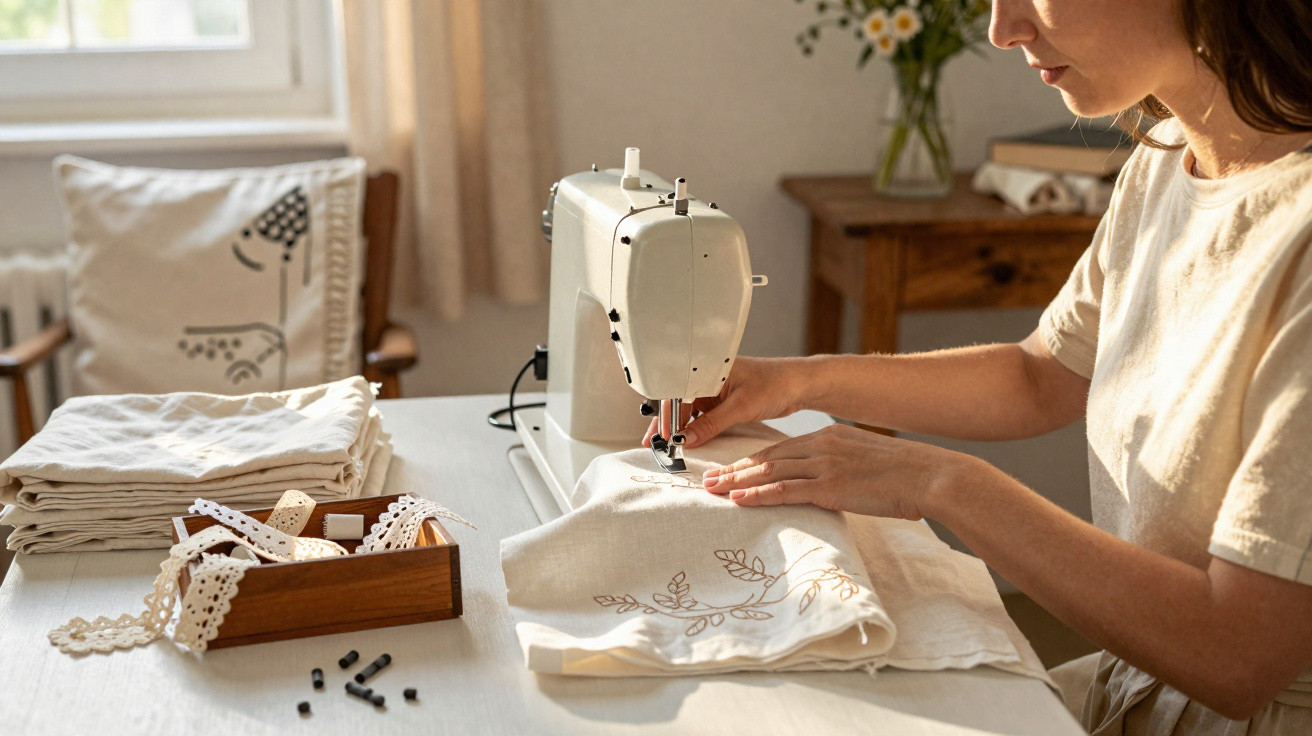
Many households across German-speaking countries have them tucked away: finely embroidered dowry sheets from Gran, folded neatly and left untouched for decades. Rather than letting them gather dust for another generation or sending them off with the next textile collection, you can transform them with a smart cutting-and-sewing approach into clothing, home textiles and accessories that suddenly everyone wants.
Why old linen sheets are fabric gold
The moment you handle an old linen or linen-blend sheet, you can feel how far it is from today’s mass-produced textiles. These fabrics are heavier, more tightly woven and impressively hard-wearing. A lot of these pieces are made from pure linen, or a cotton–linen mix, often weighing well over 200 grams per square metre.
That kind of quality copes easily with washes at 60°C - and sometimes even 90°C. The long natural fibres are less prone to pilling and, with every wash, they soften without falling apart. Linen also has its own built-in temperature regulation: cooling in summer and comfortably warm in winter.
"Cutting into a sheet this good isn’t wasting anything - it’s rescuing a first-class material from being forgotten."
There’s also an issue that concerns more and more people: textile waste. Across European countries alone, hundreds of thousands of tonnes of old clothing and home textiles are discarded every year. Upcycling - reworking existing fabrics - is no longer a quirky niche idea, but a highly practical way to conserve resources while still staying stylish.
Preparation: turning a yellowed heirloom back into bright fabric
Before you even pick up the scissors, the old sheet needs proper treatment. The process breaks down neatly into a few steps:
- Washing: Start with a hot wash to remove dust, odours and storage residue.
- Check the measurements: Once it’s dry, measure again to see whether the fabric has shrunk in the wash.
- Brightening: If it has yellowed, soak it in very hot water with lemon juice - or, for a much stronger option, sodium percarbonate activated in hot water.
- Avoid bleach: Chlorine-based cleaners attack natural fibres, create weak, brittle areas and should be off-limits for this kind of fabric.
- Press it smooth: After drying, iron carefully so you can see the structure and grain clearly.
Only then does the sheet show what it really has to offer: sheen, texture, a dense handle - and, of course, the intricate embroidery that turns many pieces into true one-offs.
Spotting and marking the treasures in the fabric
Next, you’ll want to make purposeful use of the special details. Most dowry sheets have several visual highlights:
- monograms placed in the centre or along the edge
- cutwork insertion strips
- wide, curved hem borders
- fine, even eyelet embroidery
Mark these areas with tailor’s chalk. The key point: don’t cut anything yet. First decide what you want to make, and where those embroidered elements should sit in the final piece.
The large, unembroidered sections are ideal for the front and back of a top, for cushion panels, or for a duvet cover. Border embroidery can later become ready-made hems on sleeves, skirt edges or curtains.
The crucial sewing trick: using embroidery as the focal point
The method itself is straightforward, but it has real impact: the embroidery isn’t chopped off at random - it’s deliberately treated as an insert detail. That single decision changes the entire look.
In practical terms, you lay your pattern piece or paper template on top and position it so motif and function match. For example:
- The monogram sits precisely on a patch chest pocket.
- A cutwork strip becomes the defining edge of a sleeve.
- A wide embroidered hem forms the upper back panel of a blouse.
"The art isn’t in perfect seams, but in placing the existing embellishments intelligently."
Once you’ve found the ideal placement, cut around the chosen area with a generous seam allowance. That gives you room to adjust later. If any section feels thin or fragile, fuse a lightweight interfacing to the reverse before finishing the edges.
An example that wins people over
Imagine a 3-metre-long sheet with a large initial in the centre. A hobby sewist cuts the monogram out as a rectangle, fuses interfacing onto the back, and turns it into a bold patch pocket on a light linen waistcoat. The remaining fabric becomes the front and back panels. Suddenly, the former bed sheet reads like a designer piece with a story.
The same approach works for airy summer blouses, short kimono-style jackets or lightweight coats. The main pattern pieces come from the calm, plain areas, while the embroidery frames necklines, hems or sleeves. You end up wearing something that instantly prompts the question: “Where did you buy that?”
Characterful ideas for home textiles
If you don’t enjoy sewing clothes - or you’re still a beginner - start with home textiles. One or two large sheets can become an impressive range of projects.
| Project | Difficulty level | Special tip |
|---|---|---|
| Duvet cover | Medium | Stitch two sheets right sides together, close three sides, leave an opening on the fourth side and use buttons. |
| Tablecloth | Easy | Let the embroidered borders form the finish; corners with a monogram look like hotel linen. |
| Cushion covers | Easy | Place the monogram or eyelet embroidery centrally, and sew a hotel-style envelope closure instead of a zip. |
| Curtains | Medium | Use the existing hem as a rod pocket, avoiding time-consuming hemming. |
One sheet alone can be enough for several sofa cushions and two smaller curtains. In many period flats with high ceilings, a heavy linen curtain looks more premium than new, thin ready-made alternatives.
Quick accessories for sewing-machine beginners
If you’re short on time or still finding your confidence at the machine, begin with smaller projects such as:
- simple drawstring bags for bread or vegetables
- fabric storage baskets for the bathroom or desk
- glasses cases or e-reader sleeves
- basic scarves made from narrow strips
With accessories in particular, the high-quality embroidery can act like a logo. A small monogram on a plain bag turns a simple piece of fabric into something that looks like it came from a concept store.
What sewing beginners should know
Many people avoid old sheets because they assume the cuts will be complicated. There’s no need. Linen usually behaves well under the needle: it doesn’t slip much and it’s forgiving of small inaccuracies.
A few pointers make getting started easier:
- Always sew with a fresh needle suited to heavier fabrics.
- Cut along the grain so the finished piece won’t twist out of shape.
- Plan generous seam allowances; you can always trim them later.
- Test thread tension on offcuts before putting the main pieces under the machine.
If you want maximum peace of mind, try a new pattern first in an inexpensive practice fabric, and only reach for the heirloom on the second run.
Why the effort is worth it
Old embroidered sheets are more than raw material. They often hold family history. Instead of keeping that story hidden in a cupboard, you can make it visible - as a summer blouse, as a tablecloth for the next family gathering, or as cushions on the sofa.
These items carry not only sentimental value, but genuine practical worth too. Linen is durable, breathable and easy to care for. Sewing garments from it lets you gradually build a small wardrobe of natural fibres that hardly anyone else owns. At the same time, it encourages a more thoughtful relationship with textiles: not everything needs buying new - plenty is already sitting in your cupboards, waiting to be reimagined and remade.

Comments
No comments yet. Be the first to comment!
Leave a Comment