
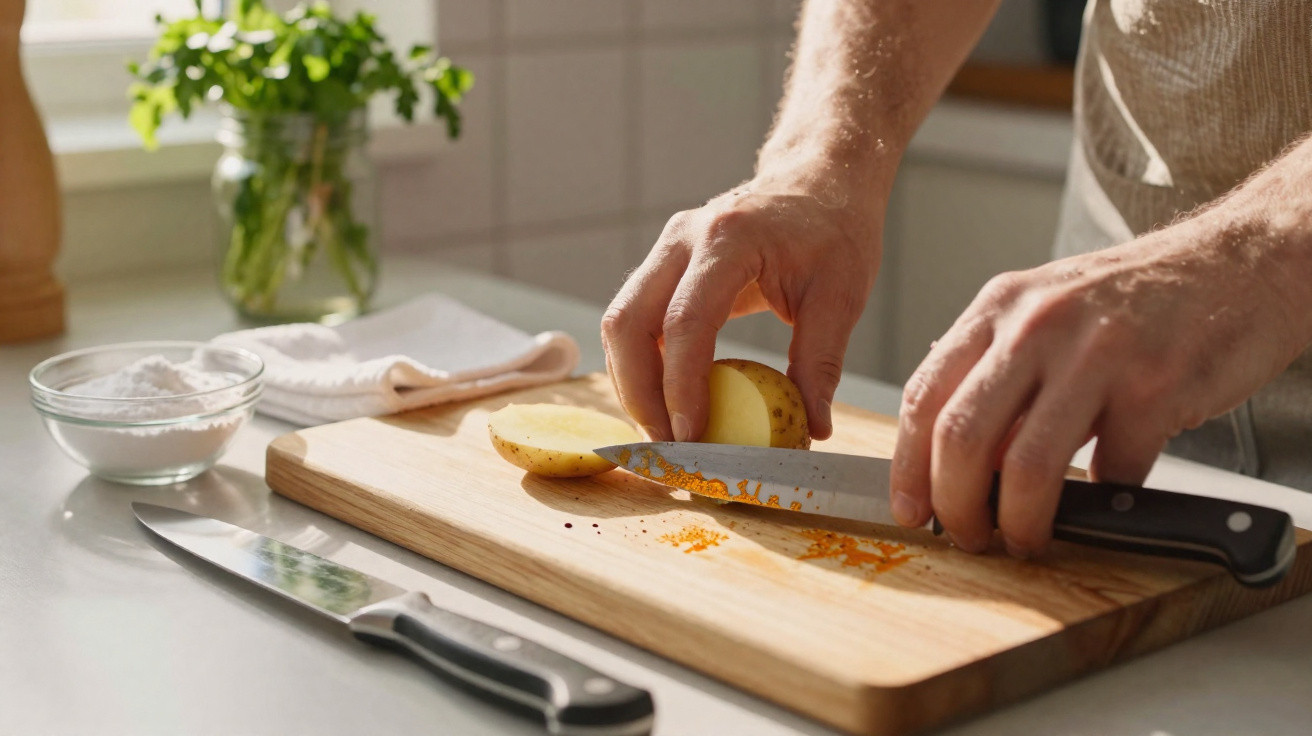
That’s the good knife on the counter - not old, not cheap - and yet there are those orange specks clinging on like a bad mood after rain. Sometimes the answer is so close you overlook it in the vegetable drawer: half a potato.
The morning was dull and overcast. I was barefoot in the kitchen, coffee in hand, and all I needed was to slice some bread. I reached into the knife block, glanced at the blade - rust freckles, fine as summer specks, only without any charm. I grabbed the yellow sponge and scrubbed without much plan, listening to that flat squeak that means: nothing’s shifting. Then I remembered the drawer with the potatoes, and my grandmother - who always smiled when something simple was enough. I cut a potato in half, sprinkled a little bicarbonate of soda over it, and rubbed it over the rust. That was literally it. The scent of raw potato mixed with metal, very faint, oddly nostalgic. A few breaths later, the blade looked different. Half a potato might be all you need.
Rust, steel and a potato: what’s actually happening
Rust doesn’t appear in one dramatic moment; it builds up in small ones: a drop of water by the sink, a knife left on a damp board, air, time. Even stainless steel isn’t a magic cloak - salt and acids still find a way in.
A potato isn’t a miracle cure; it’s everyday chemistry. A little oxalic acid, starch and moisture - and when you add a gentle abrasive partner like salt or bicarbonate of soda, you end up with a paste that loosens rust without punishing the blade.
I once watched a chef pull an old Santoku out of a drawer, the blade dotted with small spots along the middle. He cut a potato, pressed the cut side down with his palm, left it to work for two minutes, then wiped with a cloth. The orange went; the grey stayed. No fuss, no specialist cleaner, no harsh smell. Hundreds of people tell the same small story in forums: if it’s only surface rust, the potato nearly always does the job. When the damage is deeper, it’s more like an invitation than a wrecking ball.
The reason it works is straightforward. Rust is iron oxide - porous and brittle. Mild acids react with it, starch helps hold on to particles, and moisture slightly swells the film. With salt or bicarbonate of soda you get a soft abrasion that lifts the oxide layer without attacking the passive layer on stainless steel.
Anyone who’s scrubbed too hard knows what comes next: micro-scratches that later attract rust again. A potato works more broadly, more calmly, with patience. Gentle, but effective.
How to do it: lifting rust with half a potato
Take a fresh potato and cut it in half crossways. Dust the cut surface with a little bicarbonate of soda or fine salt. Lay the blade flat on a cloth and rub the potato along the rusty areas, working from the spine towards the edge - not the other way round. On thicker spots, leave the damp, starchy surface in contact for two to five minutes, then rub again. Rinse with warm water, dry thoroughly, and apply the thinnest smear of cooking oil or camellia oil. It costs next to nothing, and it brings the blade back to calm.
We all know that moment when we leave the knife “just for a minute” on the draining board after washing up. It comes back to bite. Don’t bear down wildly, or you’ll mark polished finishes. Let the potato do the work, not your fist. Don’t soak knives with wooden handles, and avoid aggressive scouring pads. Deep pitting will remain - at that point only sharpening and regrinding help. Let’s be honest: nobody does that every day. A small care ritual once a week is often enough.
This works best with a simple rhythm: rub, wait, wipe.
“I treat blades like skin: clean gently, dry well, oil lightly,” says an old knife sharpener from the neighbourhood.
And because sometimes a quick look in the kitchen drawer is all it takes, here’s a fast checklist:
- Always work from the spine towards the edge, never across the edge.
- Wipe between passes so rust residue doesn’t spread.
- After treating, dry thoroughly and spread a drop of oil.
- For a mirror finish, choose bicarbonate of soda rather than salt.
- For coated blades, test first in an inconspicuous spot.
What remains: a small trick with a big effect
Half a potato can teach you a lot about home care and staying relaxed. No rare product, no plastic bottle full of promises - just a potato that would otherwise end up in the pan. Removing rust this way shows you that maintenance can be quiet, and that many problems need less force than direction. Never put it in the dishwasher isn’t a dogma; it’s experience in a single sentence.
Maybe you pass the trick on to whoever most enjoys cooking with you. Maybe it turns into a small Sunday ritual, when the kitchen finally settles down. One blade, two minutes, one clean slice each week. That’s what everyday life feels like when it lasts.
| Key point | Detail | Benefit for the reader |
|---|---|---|
| Potato + bicarbonate of soda | Mild acid meets gentle abrasion | Loosens rust without the risk of scratching |
| Direction of movement | From spine to edge, never across | Safer handling, lower risk of injury |
| Finish afterwards | Rinse, dry, lightly oil | Stays rust-free longer, smoother cutting |
FAQ:
- Does it really work on stainless steel? Yes - it works very well on surface rust and light discolouration. The potato’s mild acid and starch lift oxide without destroying the passive layer of stainless steel.
- Can I use salt instead of bicarbonate of soda? Yes, fine salt works. For polished blades, bicarbonate of soda is often kinder; salt can scratch slightly more.
- How often should I use this method? Only when needed. If you dry regularly and add a hint of oil after washing up, you’ll need it far less.
- Will a potato help with deep pitting? No. Deep scars remain. You’ll need professional regrinding or a new sharpening that removes material.
- Is it safe for coated knives? Take care. Test first in an inconspicuous area, as abrasion and mild acid can affect thin coatings.



Comments
No comments yet. Be the first to comment!
Leave a Comment