
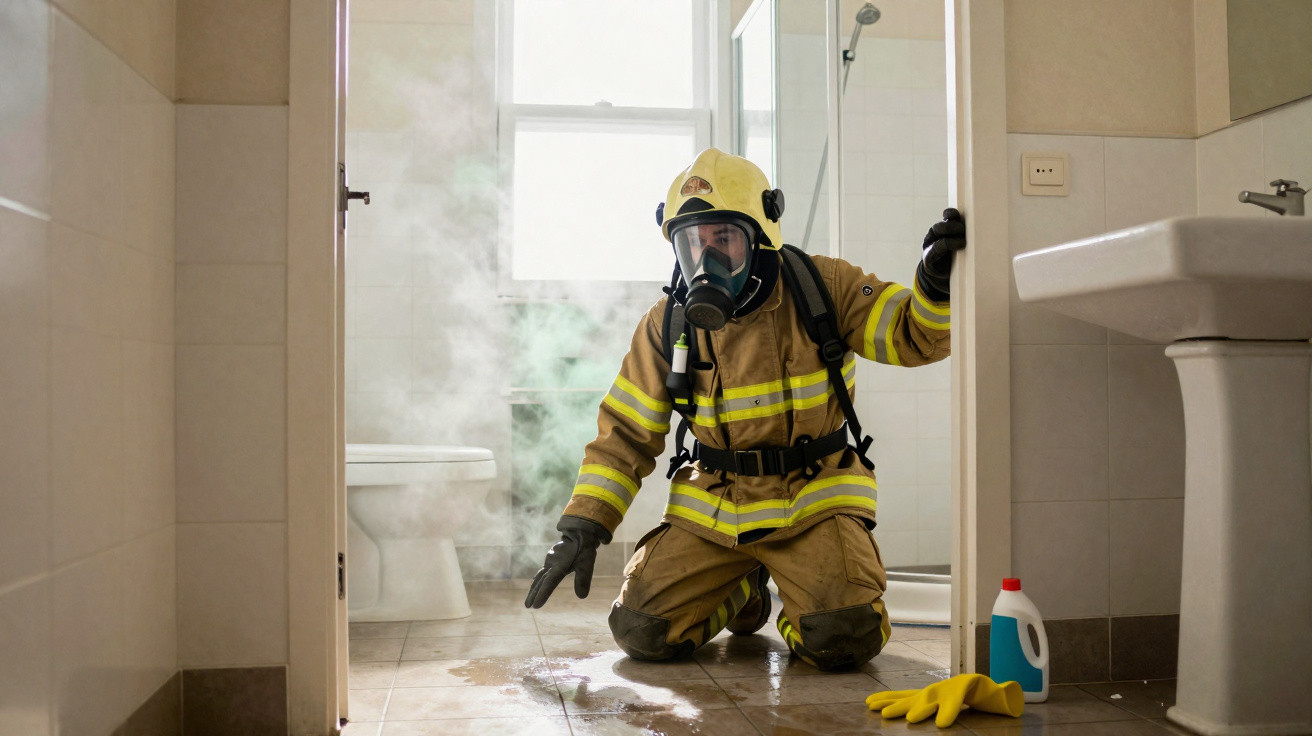
What starts as an ordinary bit of housework ended in Albi, France, with a major response from the fire service. A 35-year-old man poured two everyday cleaning products into a bathroom spray bottle - and moments later he was struggling to breathe, prompting 13 responders to attend with several vehicles. The incident underlines how quickly familiar cleaning habits can turn into a life-threatening situation.
Bathroom cleaning turns into an emergency: what happened in Albi
In the early evening, at around 18:00, a man in the Albi area set out to give his bathroom windows and grout a thorough clean. He reached for two products found in many homes: a chlorine-based cleaner and household vinegar. He decanted both into a hand-held trigger sprayer to tackle stubborn marks and traces of mould.
Within moments of the first sprays, his body reacted. It began with a scratchy throat, followed by severe coughing. The air felt heavy and each breath became painful. In the small, enclosed bathroom with inadequate ventilation, the gas built up quickly. He developed significant shortness of breath and someone called the emergency services.
The fire service in the département of Tarn attended with 13 personnel and three vehicles. At the scene, they removed the 35-year-old from the contaminated room, administered oxygen and then took him to hospital. Inside the bathroom, crews ventilated the space thoroughly and checked whether the gas still posed any danger.
"A seemingly harmless cleaning mix in the bathroom triggers a chemical reaction that ties up an entire fire service unit."
How cleaner and vinegar can suddenly produce chlorine gas
The cause of the incident was the chemical reaction between the chlorine-based cleaner and the acid in vinegar. What many people do not realise is that, when combined, these products can release chlorine gas - a toxic gas that was used as a weapon during the First World War.
The process is straightforward: chlorine-based cleaners typically contain sodium hypochlorite or similar compounds. When that substance meets an acid such as acetic acid (the acid in vinegar), chlorine compounds are formed immediately and escape into the air as a gas. The gas can appear colourless to yellowish and may not be recognised straight away by non-specialists.
In a poorly ventilated space - such as a typical small bathroom or WC - the concentration can rise rapidly. The body can react very strongly even at low levels. Mucous membranes swell, the airways tighten and the eyes sting.
Typical symptoms after inhaling chlorine gas
- sudden burning in the nose and throat
- sharp coughing, sometimes with shortness of breath
- watering eyes and intense eye irritation
- tightness in the chest
- dizziness, headaches, nausea
Depending on how long and how intensely someone is exposed, chlorine gas can cause serious damage to the lungs. In severe cases, there is a risk of pulmonary oedema, where fluid enters the lung tissue and severely restricts breathing.
Why accidents like this happen so easily
In everyday life, many people reach for several cleaners at once because they want to remove stubborn grime “extra thoroughly”. Chlorine-based products are seen as powerful against mould, while vinegar is viewed as a natural remedy for limescale. Packaging does include warnings, but these can be overlooked in the middle of a routine clean.
Another factor is that cleaning products are increasingly poured into empty spray bottles to mist surfaces more precisely. That is exactly what happened in Albi. A few sprays are enough to create a noticeable gas cloud in a compact bathroom. Because it sits at breathing height, it ends up right where a person inhales.
There is also a psychological element: household chemicals are often underestimated. They sit on supermarket shelves and feel familiar and harmless. It is easy to forget that some contain aggressive substances that, in a laboratory setting, would only be handled with goggles and gloves.
What you should never mix
The Albi case is a clear example of a problem that also occurs in German households. Certain combinations are particularly risky:
| Combination | Hazard |
|---|---|
| Chlorine-based cleaner + vinegar or descaler | Formation of chlorine gas, irritates lungs and eyes |
| Chlorine-based cleaner + acid-based toilet cleaner | Highly toxic fumes, risk of airway irritation |
| Ammonia-based glass cleaner + chlorine-based cleaner | Formation of chloramines, irritating gases |
| Multiple descalers from different brands | Unpredictable reactions, stronger acidic vapours |
One rule of thumb helps in day-to-day cleaning: never mix household cleaners. If you do need to use more than one product, apply them one after another, rinse thoroughly with water in between, and ventilate well.
How to respond correctly if the air starts “burning”
If unpleasant fumes develop while cleaning, every minute matters. This simple checklist can help:
- Stop cleaning immediately and put the spray bottle down.
- Open windows and doors wide to create a through-draught.
- Leave the room and do not re-enter until it has been well ventilated.
- Move the affected person into fresh air and encourage calm breathing.
- If there is shortness of breath, severe coughing or burning eyes, call the emergency number.
Anyone wearing contact lenses should remove them. Eyes can be rinsed with lukewarm water. Do not try additional home remedies or attempt to “neutralise” the chemicals - the reaction occurs in the air and in the airways, not simply on a surface in the bathroom.
What the Albi case means for German households
The incident shows how thin the line is between everyday life and a genuine emergency. Almost every flat has a small bathroom, often with only a tiny window. That is precisely where descalers, mould removers and WC gels are used most frequently.
If you clean with trigger sprayers in these spaces, three straightforward rules are worth remembering:
- Use only one product per cleaning pass and per surface.
- Between different products, always rinse with plenty of water.
- When spraying, keep the window open, the door open and the extractor fan on.
Parents should also make sure children understand early on that cleaning products are not “toys”. Teenagers in particular can be tempted to get creative during a spring clean - a splash of this, a squirt of that - and the mix of everyday “know-how” and a willingness to experiment can end dangerously.
How dangerous is chlorine gas, really?
How hazardous chlorine gas is depends mainly on two factors: concentration and duration of exposure. At low levels, it tends to cause irritation above all else. If someone ventilates quickly and leaves the room, they often get away with coughing and streaming eyes.
At higher concentrations, the gas molecules attack the mucous membranes of the airways. In the lungs, it can cause a kind of chemical burn. The result may be long-term damage to the respiratory system - and, with extreme exposure, it can be life-threatening.
Medical guidance therefore recommends seeking medical advice after a significant exposure, even if symptoms initially ease. Some problems, including fluid build-up in the lungs, can appear with a delay.
"Household cleaners seem harmless - but combining them can produce effects that feel more like a chemistry lab than a bathroom."
The next time you reach for cleaning products, it is worth pausing to consider what is already on the surface and whether the room is well ventilated. The Albi case shows that just a few sprays can be enough to trigger an emergency call-out - and that is an experience no one wants in their own bathroom.

Comments
No comments yet. Be the first to comment!
Leave a Comment