
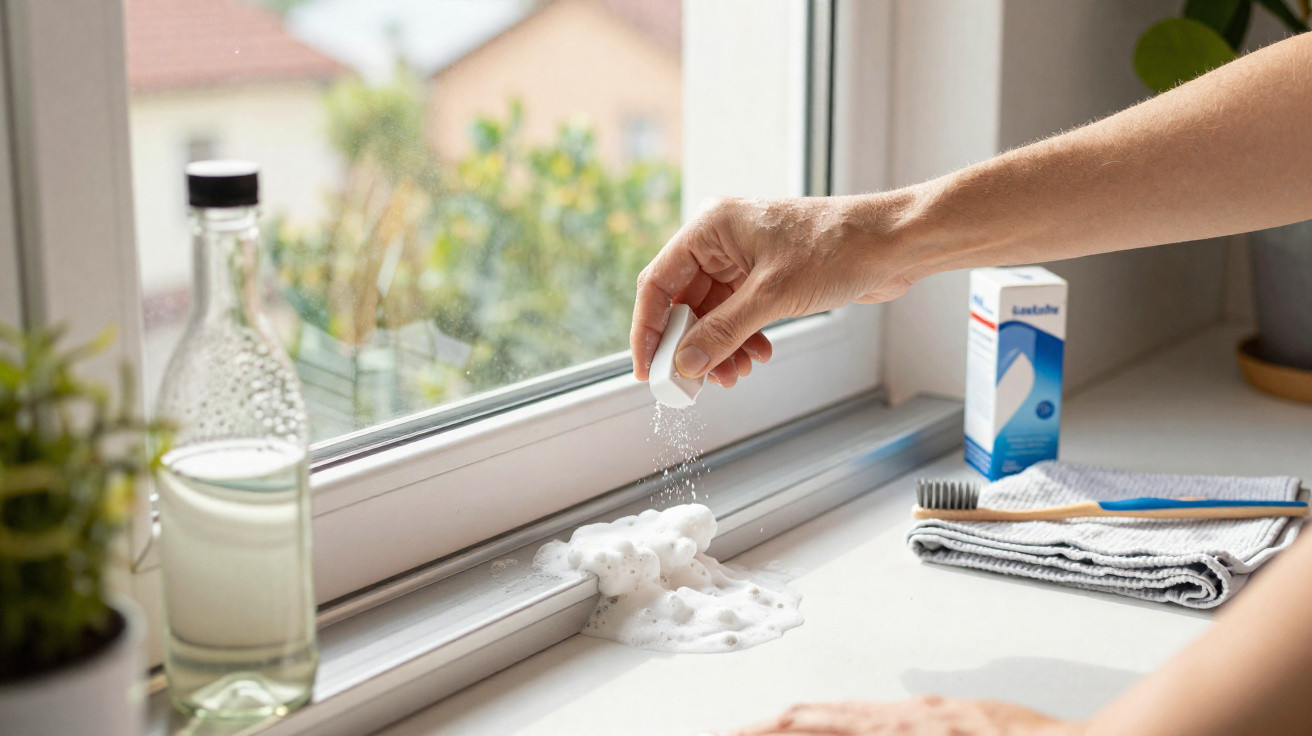
Many homeowners and flat owners assume that stiff, sticking sliding windows automatically mean broken fittings or an expensive repair. In reality, the culprit is often right in front of you - down in the bottom track. With a simple household mix from the kitchen cupboard, you can loosen the grime there in just a few minutes, with no screwdriver, no specialist cleaners and no call-out.
Why your sliding windows suddenly start sticking
A sliding window that used to glide smoothly but now jams is a quick route to frustration. You pull harder, push from the side, rock the pane back and forth - and often end up making it worse.
"In most cases, it’s not the mechanism that’s broken, but dirt in the lower track that’s the real trigger."
Over time, a combination builds up in the bottom channel, such as:
- fine dust and road dirt
- grains of sand from a balcony, patio or your shoes
- pet hair and fluff
- crumbs and sticky residue from cleaning products or kitchen grease
As the window is slid back and forth, this build-up gets compacted. It turns into a kind of paste that:
- slows the small rollers (gliders or carriages)
- slightly twists the window out of true
- causes squeaking noises and jerky movement
If you then pull with full force, you push the debris deeper into the corners of the track. Over time, the rollers can wear down or the channel can become scored. Another common mistake is pouring oil or cooking fat into the track “to help it glide”. It only helps briefly, then turns the area into a proper dust trap.
The quiet household hero: baking soda and household vinegar
Instead of buying expensive specialist products, a simple duo found in most kitchens is enough: bicarbonate of soda (often sold as baking soda) and clear household vinegar (water-based).
"The combination of gently abrasive soda and foaming vinegar lifts dirt out of even the finest grooves in the track."
What’s going on here:
- The powder acts as a mild abrasive, shifting baked-on residue without scratching the metal or plastic of the track.
- The vinegar reacts with the soda to create foam. The bubbles work into tiny gaps and loosen dirt that’s stuck fast.
- Lightly greasy residues - for example cooking grease or natural skin oils - soften and wipe away more easily.
The result is that the mixed debris rises to the surface, making it straightforward to remove from the channel. This is particularly useful with profiles that a normal sponge edge simply cannot reach.
That said, this method fixes dirt-related sticking, not mechanical faults. If the track is bent, a roller is cracked, or the sash is misaligned overall, even the best household trick will only help so much. In that case, adjustment or replacement parts are needed.
The five-minute plan for smooth, jerk-free sliding windows
If you follow a clear process, you’ll notice on the first attempt how much more freely the pane moves again. You only need a handful of basic items that most homes already have.
What you’ll need
- about 20 grams of bicarbonate of soda (baking soda)
- about 50 millilitres of clear household vinegar
- an old, clean toothbrush
- a microfibre cloth, lightly damp
- optional: a vacuum cleaner with a narrow nozzle
Step 1: Vacuum up loose debris
Before using the mixture, it’s worth doing a quick pass with the vacuum cleaner. With a narrow attachment you can remove crumbs, sand and hair from the visible areas, so the larger particles don’t end up in the cleaning liquid and get spread around again later.
Step 2: Sprinkle the powder precisely into the track
Now bring in the bicarbonate of soda. Rather than scattering it everywhere, work with accuracy:
- Inspect the track closely and look for particularly dark or worn-looking areas.
- Sprinkle a thin line of powder along those sections, especially into corners and up against stops.
- With a folded piece of paper, you can guide the powder like a mini funnel into tight grooves.
A thick layer does not help. The powder should sit in the grooves, not form a mound on the surface.
Step 3: Add the vinegar in a controlled way
Next, carefully pour the vinegar over the line of powder. A thin stream is enough - the channel should not be left sitting in a pool of liquid. The foaming starts immediately, which is exactly what you want.
"Leave it for five minutes without moving the window - during this time, the foam loosens the baked-on layer inside the track."
If the area is heavily soiled, a second small splash of vinegar after two or three minutes can intensify the effect. However, the track should never be completely flooded, otherwise seals or nearby surfaces may be softened unnecessarily.
Step 4: Scrub with the toothbrush
After the waiting time, start brushing:
- Run the toothbrush along the track, first lengthways.
- Then work deliberately into corners and recesses where the bristles can hook in.
- Gradually move the loosened grime towards the centre or to one side, where it’s easier to lift out.
Compared with a coarse sponge, a toothbrush reaches narrow channels between the frame and the base - exactly where the rollers run.
Step 5: Wipe up, then dry thoroughly
Dampen the microfibre cloth slightly and wipe out the loosened dirt. If the cloth darkens quickly, rinse it out and run it through the track again. Finally, wipe once more with a dry section of the cloth or a second clean cloth.
"Only a truly dry track stays clean for longer - leftover moisture acts like a magnet for new dust."
Once everything is dry, slide the window or sliding door slowly back and forth. Many people are surprised at how quietly and effortlessly the sash moves again. In many cases, any extra lubricant becomes unnecessary.
Does a clean track still need lubrication?
The obvious question is whether you should follow cleaning with oil or silicone. The clear answer from the perspective of many installers is to be cautious. Thin oils attract dust and, over time, form a sticky layer all over again.
| Option | Advantage | Disadvantage |
|---|---|---|
| Household oil | briefly improves glide | quickly binds with dust, difficult to clean |
| Silicone spray | thin film, relatively low-dust | can affect seals, slippery surfaces if overapplied |
| Clean, dry track | natural running, no sticky films | not sufficient on its own if the mechanism is damaged |
In many flats and houses, a thoroughly cleaned, dry profile is completely sufficient. The rollers are designed for that: they should run on a hard, clean surface - not swim in an oil bath.
Regular mini-maintenance instead of a big struggle
If you keep an eye on the track, you can avoid later “brute force” attempts. A small routine is enough:
- once a month, vacuum the tracks
- if you can see build-up, wipe it over with a damp cloth
- keep an old toothbrush with your cleaning supplies - for corners, tracks and cupboard doors
This is particularly worthwhile in high-traffic rooms, kitchens or at large balcony windows. In those areas, greasy particles and road dirt end up in the track far faster than most people expect.
If a spotless channel still doesn’t help, take a closer look: does the sash tip forwards slightly as you slide it? Does it always catch at the same point? Are there obvious cracking or grinding sounds? If so, worn rollers, bent running tracks or incorrectly set fittings are likely. In difficult cases - for example with large glass fronts - a specialist should adjust it before more wear occurs.
One more point that’s often underestimated: dirt in the track can also put long-term strain on seals and frames. Tiny grains of sand act like sandpaper when the construction repeatedly rolls over them. Cleaning early therefore extends not only ease of use, but also the service life of the entire window or door system.



Comments
No comments yet. Be the first to comment!
Leave a Comment