
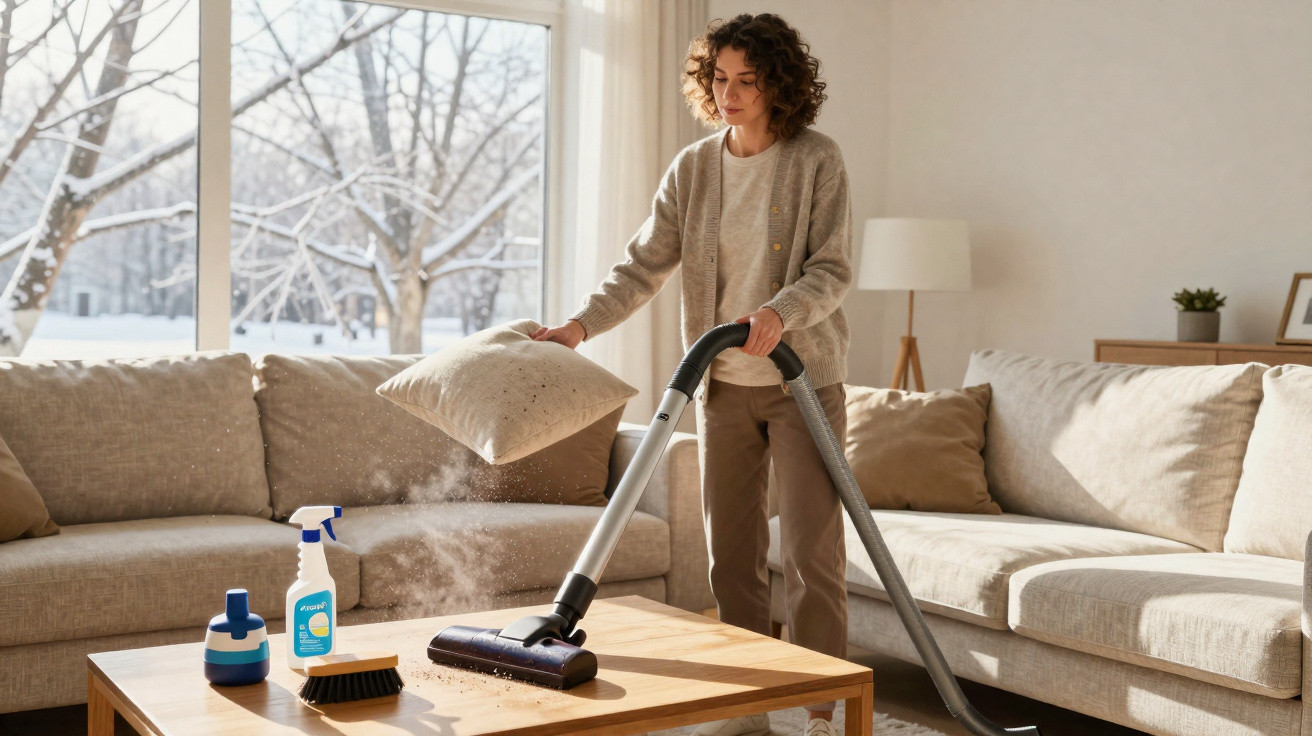
Some time each winter - often once you’ve got through the second box of tissues - you start pointing the finger at anything and everything: the weather, the children, work, even the dog. You wake with a woolly head, scratchy eyes and a nose that feels unreliable, and you reassure yourself, "It’s just the season." Outdoors, the air bites with cold dampness; indoors, the radiators tick and hiss, and the house is warm yet a touch stale, as though it hasn’t properly breathed since October. You crack a window for five minutes, shiver theatrically, then close it again. Back under the blanket. Back to the snuffling.
What’s really happening is that winter encourages us to live in tightly shut homes where dust, pet dander and tiny remnants of everyday life drift around unnoticed. We burn candles, switch on diffusers, spritz a pleasantly scented cleaner and cross our fingers. Yet the very habits that make a home feel cosy can also quietly irritate your airways. And when allergy specialists were asked which winter cleaning job matters most, they all landed on the same answer - and it isn’t the one most people expect.
The hidden allergen factory in your living room
You’d assume the biggest culprits would be the obvious ones: carpets, curtains, perhaps that dog bed with the faint aroma of biscuits and wet leaves. They certainly contribute. But allergists and environmental health professionals increasingly say one winter task outperforms the rest for tackling allergens you don’t see: giving your soft furnishings and upholstery a deep clean. Not a quick once-over with the vacuum, but a patient, thorough, slightly dull session with the sofa, mattress, cushions and any fabric-covered chairs.
In winter it adds up in an unflattering way. We sit, doze, binge-watch and work from home on the same surfaces that rarely receive more than a brief tidy or a rearrangement of cushions. Each sneeze, every flake of skin, every strand of pet hair, every crumb from a late-night biscuit disappears into the fibres and stays there. You don’t notice the accumulation because nothing looks dramatically filthy: no glaring stain, no obvious grime - just a sofa that vaguely smells of fabric conditioner and roast dinner.
If you ask an allergy clinician where dust mites thrive, the answer is predictable: mattresses, pillows, sofas and upholstered chairs. Anywhere warm, a little humid from breath and sweat, and seldom deep-cleaned. It’s like a luxury hotel for microscopic freeloaders. Come winter, with windows kept shut, central heating running and more hours spent pressed against these fabrics, your exposure to those allergens rises.
Why winter makes soft furnishings more dangerous
A subtle change arrives in November. The clocks go back, evenings feel tighter, and home becomes both sanctuary and snare. With less fresh air circulating, allergens linger. Sofa cushions trap dust, then your weight and movement force it back out in tiny, invisible puffs whenever you sit down. You don’t see the cloud; you just feel a tickle in your throat five minutes into a Netflix episode.
And honestly, hardly anyone hauls the sofa around each week, unzips every cover, vacuums every seam and then steam-cleans the whole lot. Most people congratulate themselves if they shake out a throw once a month and run the hoover loosely over the seats before guests arrive. Upholstery gets treated like stage scenery - as if it simply exists without changing. Specialists say that if you could view what gathers in a family sofa over one winter under harsh forensic lighting, you’d be tempted to sleep on the floor.
The expert verdict: the one task that makes people say “Oh wow”
Allergy consultants describe a familiar storyline: patients arrive convinced they’re reacting to cold weather, or suffering from a mysterious "winter bug that never goes away". They’ve experimented with toothpaste, washing powder and even diet. Then someone asks, almost offhand, "When was the last time you properly cleaned your mattress and sofa?" The reply is often an awkward laugh followed by, "Er… when we bought it?".
In controlled assessments and home visits, one piece of advice repeatedly proves itself in day-to-day life: a proper winter deep-clean of all the main soft furnishings. This is not being sold as a cure-all for asthma or long-standing allergies, and it’s certainly not magic. It’s closer to switching off a tap that’s been steadily releasing irritants into your indoor air around the clock. People often report waking up less blocked-up, or noticing their “constant cold” no longer feels quite so constant.
Most of us have seen the moment you turn a mattress and a little bloom of stale dust lifts into the air, carrying the faint scent of old nights and half-remembered dreams. That’s the part you can see. The concern for experts is what remains invisible: mite droppings, microscopic skin fragments, and pet dander that no longer resembles fur. Those particles aren’t impressed by freshly laundered sheets that smell of lavender - they sit deeper down, in layers we almost never disturb.
Mattress vs sofa: which is worse?
Ask a specialist to choose the single most important winter item to deep-clean and they’ll often pause between the mattress and the sofa. The mattress has the edge on sheer contact time: roughly eight hours a night with your face close to whatever is inside. The sofa has the edge on variety: pets, snacks, shoes, visitors and children all adding to its hidden ecosystem. In truth, they function as a two-person act - a double source of allergens.
What pushes experts to talk about “soft furnishings” as a group is how routinely they’re overlooked. Carpets get vacuumed. Bedding goes in the wash. Curtains, now and then, make it into the machine. Sofas, armchairs and mattresses? They’re the forgotten middle child of housework - constantly used and rarely given serious attention. So when someone finally does a full winter deep-clean, the impact can feel surprisingly dramatic for such an unglamorous job.
What a proper winter deep-clean actually looks like
You can’t control the winter air outdoors, and you can’t fully prevent central heating from drying out your nose. But within your own walls, there’s a routine experts quietly recommend. It doesn’t rely on expensive kit or a TikTok-famous trick - just persistence and an afternoon you’d rather spend doing almost anything else.
The expert-style routine (translated into real life)
In an ideal world, it goes like this: remove every washable cover from sofas, armchairs and cushions. Launder them on a hot programme - as hot as the care label allows. While they’re in the wash, vacuum every exposed surface with an upholstery tool, taking time over seams, corners and the spaces beneath cushions. Then, if you have one, use a steam cleaner or upholstery machine to work into the deeper layers, and let everything dry completely before reassembling.
For mattresses, allergy specialists advise vacuuming slowly and systematically on both sides, then adding a mattress protector specifically made to block dust mites. Some recommend a winter "airing day": pull back the bedding, switch the heating off, open a window for about half an hour and let cold, dry air reach the mattress surface. It can feel old-fashioned - like something your grandmother did because "fresh air is good for you" - but there’s solid reasoning behind it. Less moisture makes conditions tougher for mites.
Of course, real life may look more like this: one Saturday you finally hoover the mattress, flip it with a grunt, and vow to tackle the sofa next weekend. Even that counts. Experts emphasise that doing something is better than doing nothing, particularly in winter, when every bit you remove is one less irritant drifting around the living room.
The emotional side of hidden allergens
There’s an odd intimacy in deep-cleaning the places where you sleep and sprawl. You find biscuit crumbs from last Christmas, a missing Lego head, a hair tie, a few small coins, a faded receipt from a takeaway you barely remember. They’re little archaeological layers of your life. If you thump a cushion a bit too enthusiastically, a dusty, old-fabric smell can rise up. You’re reminded how much has unfolded on that sofa: naps and rows, tears and children’s fevers, Sunday lunches, late-night scrolling in the dark.
Allergy professionals speak in terms of triggers, exposures and counts, yet beneath that is a gentler point: looking after your surroundings can, quietly, be a way of looking after your body. Not in a pristine, influencer-clean-home way - more in a "my lungs live here" way. The winter clean shifts from embarrassment ("my house is dirty") to relief ("maybe I can breathe a bit easier by Tuesday").
Guilt can creep in too, especially if your child or partner has been sniffling for weeks and you suddenly realise the mattress hasn’t been properly cleaned in years. You imagine them lying there every night, breathing in a slow build-up from seasons past. It’s an unpleasant picture. Still, there’s something empowering about understanding the link: this is one lever you can pull that science genuinely supports.
Why this matters more than perfect floors and shiny worktops
If you ask people what a “clean home” looks like, many will describe gleaming kitchen counters, a sparkling bathroom and no stray socks on the floor. Those wins feel satisfying, but from an allergen perspective they’re largely cosmetic. Experts privately wince when someone disinfects every hard surface while sitting on a sofa that hasn’t been deep-cleaned since the last World Cup. A spotless worktop can feel reassuring, but dust mites in a favourite armchair may be the bigger problem.
Our brains prioritise what we can see. A smear on a mirror annoys us more than invisible particles in the air. That’s why this particular winter job rarely climbs anyone’s to-do list; it doesn’t deliver the instant satisfaction of a shining sink. What it offers instead is quieter: fewer sneezes, calmer airways, perhaps fewer headaches, and a home that feels subtly easier to breathe in. Not glamorous - simply kinder.
One allergy consultant summed it up to a patient complaining about endless winter colds: “If you only have energy for one big winter clean, choose your bed and sofa over your bathroom tiles.” It sounded almost like heresy, as though it broke an unwritten rule of housework. The patient tried it, came back months later, and admitted the “cold” that used to linger for six weeks every winter… simply didn’t arrive in the same way.
Turning it into a small winter ritual, not a punishment
If the idea of taking on every soft surface in the house fills you with dread, you’re in good company. The best approach is to scale it down until it feels manageable - like getting the home ready to hibernate. One room at a time, one item at a time. Do the sofa today, the mattress next weekend, and later on the children’s beanbags that smell faintly of popcorn and feet. No gold stars, no judgement.
Some households make it a once-a-winter tradition. On the first truly cold weekend - when stepping outside feels more like a challenge than a plan - they choose a day and call it "air-out day" or something similarly half-silly. Windows are opened in short bursts, bedding is stripped, hoovers whine, and the music goes a bit too loud to make it tolerable. Children bounce on mattresses to “help shake them out”. There’s grumbling, there’s dust, and there are likely a few arguments. But there’s also a quiet satisfaction when everyone flops onto a sofa that smells less like last year and more like nothing at all.
Then, a week later, you may spot a small change. Your nose isn’t quite as blocked on waking. Your partner’s snoring drops a notch. The child who coughed every night now coughs every other night. No miracle - just a slight, noticeable shift, like cracking a window in a stuffy room.
The small, unglamorous task that changes the air you live in
When specialists talk about winter allergens, it can sound dramatic: dust mites, dander, mould spores, volatile compounds. The language feels clinical and far away. Yet the reality is right where you live. It’s in the fabric against your skin, in the cushion you cling to when you’re exhausted, in the mattress that holds you up after a day you barely got through.
Winter brings plenty you can’t control: grey skies, freezing waits at the bus stop, coughs on the train, and that cold that seems to seep through your clothes and refuse to leave. This one small action - giving your soft furnishings a proper, unapologetic deep-clean - sits firmly in the “can do” column. It isn’t stylish, and it won’t make it onto Instagram. Even so, experts say it’s the single most effective winter cleaning job for cutting the hidden allergens that quietly wear you down.
Perhaps that’s the real winter reset - not a gym membership or an elaborate meal plan, but reclaiming the air in your own home, one stubborn sofa cushion and heavy mattress at a time. It’s slow, a bit tedious, and not remotely glamorous. Still, somewhere between the hoover tracks and the fresh pillowcases is a simple relief: tonight, when you sink into softness, your lungs won’t have to work quite as hard.



Comments
No comments yet. Be the first to comment!
Leave a Comment