
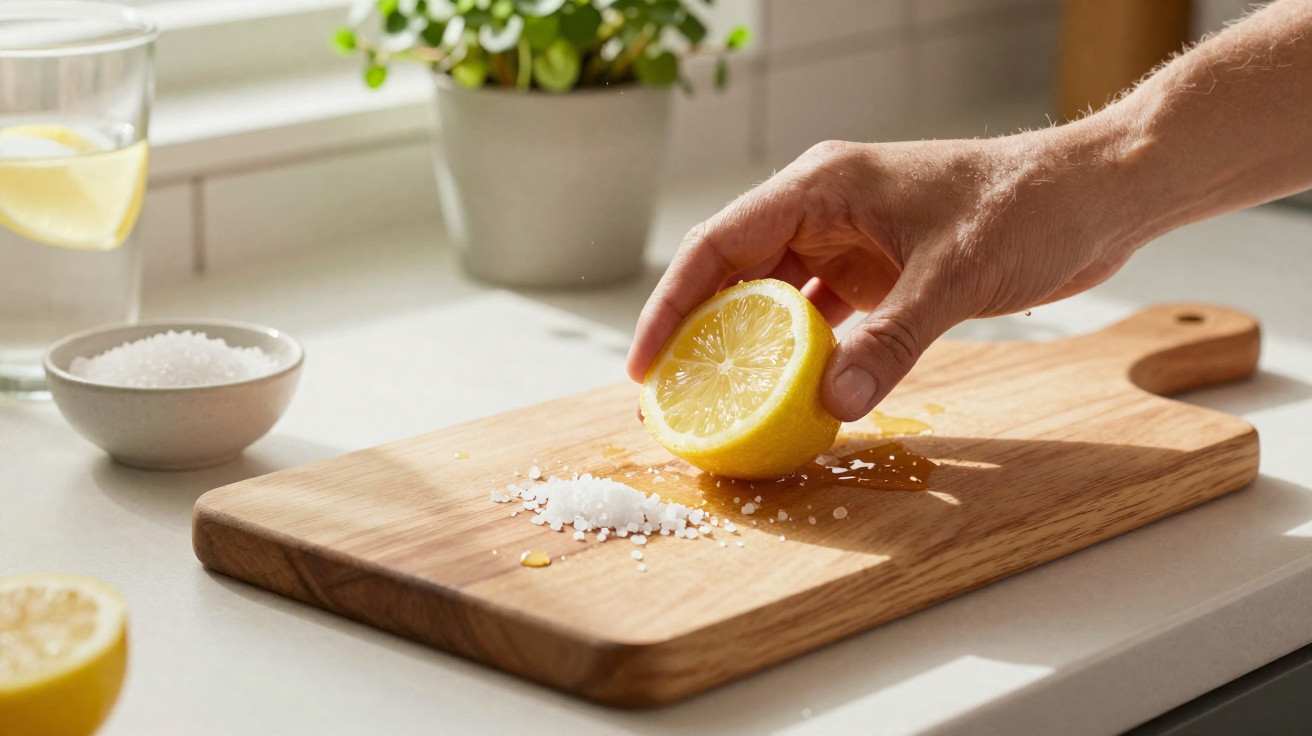
I rinse, scrub, rinse again. Still nothing. The wood has drunk the day in like a diary no one is meant to read. Then my eyes land on the fruit bowl. A lemon. Coarse salt. I cut the lemon in half, give it a gentle squeeze, hear the salt crunch, and start scouring. A little juice runs over my fingers; it smells of summer and a freshly cleaned kitchen. After a minute of this simple ritual, the board looks lighter, and even my nose seems to unclench. We all know that moment when an old household tip suddenly feels more modern than any specialist product. And then the question arrives, as sharp as lemon juice on a tiny cut: why does it work so well?
The quiet chemistry on the board: why lemon and salt work together
Half a lemon brings acidity that bites into grease and nudges protein residue loose. Coarse salt acts like a gentle abrasive, lifting the surface without gouging it. Put together, they become a small, hand-warm cleaning force that shifts stubborn smells. I like the brief fizz when juice meets salt, and how the grain looks clearer afterwards. There’s more common sense in this pairing than in many a bottle under the sink.
I saw it again the other day at my neighbour’s: fish had been marinated, parsley chopped, a dash of soy sauce splashed about - and the board still carried last night with it. She glanced, defeated, towards the washing-up liquid; I simply passed over the lemon and the salt grinder. Two minutes later the wood looked brighter, and all you could smell was citrus. At the same time, the whole kitchen felt lighter. We laughed because it was so unremarkable. The difference was immediate.
What’s happening is straightforward. Citric acid lowers the pH, cuts through fat, and loosens protein leftovers that cause unpleasant odours. Salt works as a fine scouring grain, pulling up the thin layer of oil and colour pigments and giving the acid something to grip. Citrus peel also contains essential oils such as limonene, which bond with fats and help carry them away. Wood has tiny capillaries that hold on to smells; the salty, acidic mix seeps in, loosens what’s trapped, and then rinses back out. It isn’t magic - just a friendly short circuit between cooking and chemistry.
How to do it in two minutes: the lemon-plus-salt ritual
Scatter coarse salt over the dry board - be generous. Hold a halved lemon like a small hand scrubber, press lightly, and work across the surface in steady passes. Do two runs lengthways, one run across the grain, then leave it to sit for a minute. Wipe it off and rinse with cool water. Stand the board upright to dry so air reaches both sides. Those two minutes make a noticeable difference to your board.
Do use truly coarse salt; fine salt quickly turns into a slippery paste. Don’t leave wooden boards soaking in water - it can warp them and raise the fibres. If the board has deep knife marks, this helps, but it won’t perform miracles; sooner or later a board needs sanding, or retirement. And for boards that regularly touch raw meat, this ritual alone isn’t a complete hygiene plan. Plainly: let’s be honest - hardly anyone does that perfectly every day.
Sometimes a small sentence is enough to create trust - like this one from a chef who genuinely cares for her boards.
“Lemon and salt are my fire brigade: they arrive fast, clean up, smell good - and then they’re gone again.”
- Coarse sea salt or rock salt works better than fine table salt.
- For turmeric: start with salt and lemon, then give the board a short spell in the sun - light helps pigments fade.
- Once dry, rub in a little neutral cooking oil from time to time to seal the pores.
- Plastic boards can benefit too, although staining often sits deeper there.
- For raw-meat days: add hot water and a disinfection step.
A small ritual that keeps paying off
If a kitchen tool had a voice, a chopping board would probably say it softly: I only need a bit of care. Lemon and salt provide the kind of attention that costs little and changes things straight away. Once you’ve watched a grey film lift and noticed odours vanish, you develop a clearer sense of what “clean” means in everyday life. It isn’t a deep-clean marathon; it’s a short, warm moment at the sink. And that’s precisely why it’s easy to pass on - weekly, without drama, with a lingering scent. In the end, what matters is how often you can talk yourself into those two minutes. In the end, what counts is what you’re happy to do each day.
| Key point | Detail | Benefit for the reader |
|---|---|---|
| Acid + abrasion | Citric acid loosens fat/proteins; salt scrubs away the film | Deep clean without harsh chemicals |
| Odour stop | pH change and essential oils neutralise lingering smells | A fresher kitchen instead of an onion cloud |
| Care routine | 2 minutes scrubbing, dry upright, oil occasionally | Longer life for the board |
FAQ:
- Does the method work on plastic boards too? Yes - grease and smells often lift well. Deep discolouration in micro-scratches can sometimes remain visible.
- Does lemon and salt help with turmeric or beetroot stains? Often, yes. After that, try a brief spell of sunlight or a little bicarbonate of soda paste to brighten pigments further.
- Is it enough for boards that have touched raw meat? For cleaning, yes; for disinfection, not on its own. Add hot water and a suitable hygiene product, or use a separate plastic board.
- Can I use baking powder or bicarbonate of soda instead of salt? Bicarbonate of soda is mildly abrasive and binds odours, but it reacts differently from salt. For wood, the lemon + coarse salt combination usually has better grip.
- How often should I treat my wooden board this way? Straight away after strongly scented foods; otherwise as needed. Oiling once a month with a neutral cooking oil keeps the board supple.



Comments
No comments yet. Be the first to comment!
Leave a Comment