
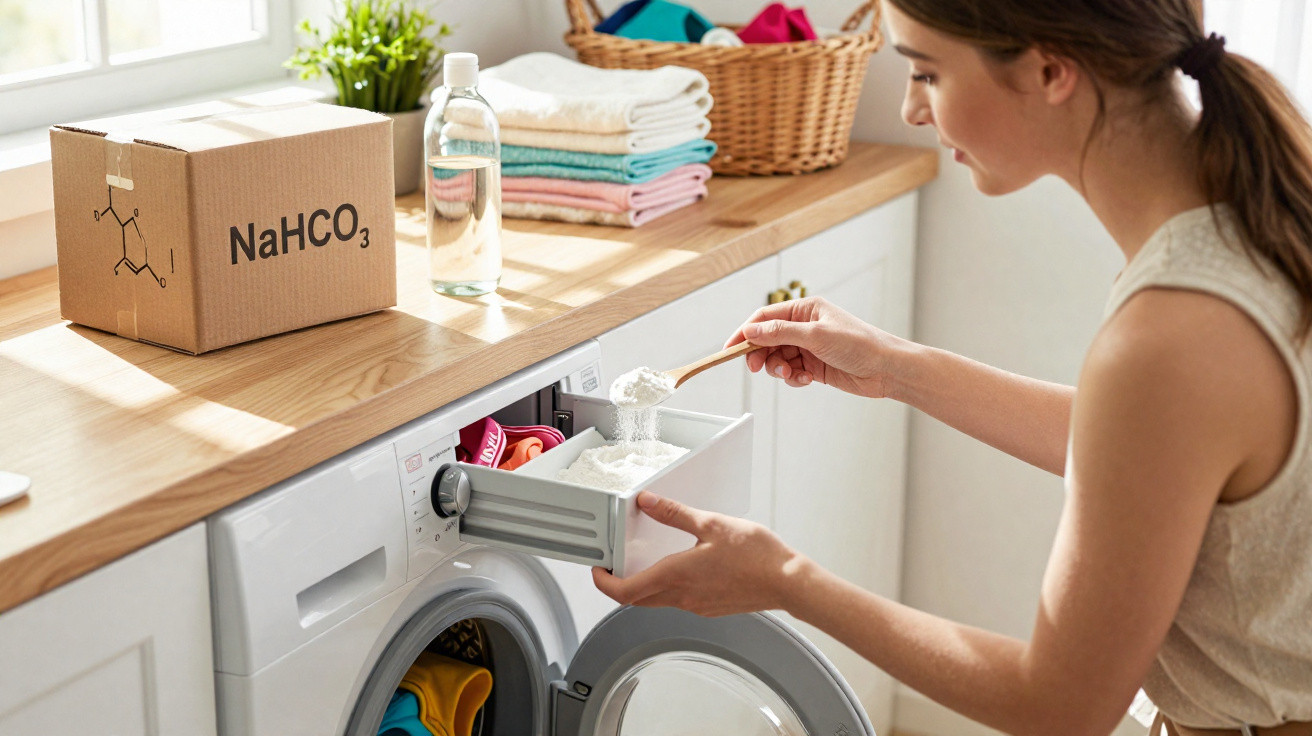
The fix is often already sitting in the kitchen cupboard rather than in the next “miracle” product: plain bicarbonate of soda - more precisely, sodium bicarbonate. Used in the right amount, it changes how your detergent performs, reduces odours, and can even be beneficial for the machine itself. That said, it only works well if you follow a few basic rules.
Why bicarbonate of soda in the washing machine makes a difference
Bicarbonate of soda is not a complete detergent; it’s a supporting player. Its job is to help your usual detergent work more effectively. It nudges the water’s pH slightly towards alkaline, which can make fats and grime loosen more readily and allows certain surfactants in detergents to do their job more efficiently.
"Bicarbonate of soda doesn’t replace detergent - it boosts its performance and helps laundry come out softer and fresher."
There’s another advantage: many smells come from acidic breakdown products in sweat, or from bacterial residue trapped in fabric. Bicarbonate of soda can neutralise these odours rather than simply masking them with fragrance. That’s why it’s particularly useful for:
- Sportswear with stubborn sweat smells
- Towels that quickly turn musty
- Bed linen that has sat in the laundry basket for a while
- Everyday clothes that smell “clean, but somehow not fresh”
Many people also find that towels feel noticeably less stiff when washed with bicarbonate of soda. Part of that comes from detergent residue rinsing out more thoroughly, and part from its mild water-softening effect.
How to dose bicarbonate of soda correctly on a normal wash
The key rule is: small amounts, used consistently. If you start tipping in whole cups, you risk leaving residue on fabrics and triggering skin irritation.
Standard load: everyday laundry up to 5 kg
For a typical machine load of around 5 kg, you only need:
- 1 heaped tablespoon of bicarbonate of soda (approx. 20–25 g)
- your normal amount of detergent - ideally reduced slightly
- a wash temperature between 30 and 60 °C
You can add the spoonful of bicarbonate of soda straight into the drum on top of the laundry, or put it into the detergent drawer. Either method works; it mostly depends on how your machine rinses and which programmes you run.
When the smell is really strong: sports and workwear
For laundry with heavy odours, you can use bicarbonate of soda in two stages:
- Add 1 tablespoon of bicarbonate of soda with the detergent into the drum or detergent drawer.
- Put 1 additional tablespoon into the fabric softener compartment so it runs through during the final rinse.
This can noticeably increase the odour-neutralising effect. Important: if you have sensitive skin, start with less and see how you tolerate it.
Larger machines: 7–8 kg when fully loaded
If your drum is bigger and you genuinely fill it, you can increase the total amount to up to two tablespoons of bicarbonate of soda. Using more rarely adds much benefit, but it does raise the risk of build-up and slightly alkaline residue on fibres.
Where to put bicarbonate of soda: three sensible options
Where you add it can be adjusted to suit your aim:
- Directly into the drum: it acts immediately on the laundry, which is ideal for strong odours or visible dirt.
- Into the detergent drawer: a good choice for long or Eco programmes, as the powder dissolves evenly alongside the detergent.
- Into the fabric softener drawer: only if you skip conventional softener and want laundry that’s as neutral and skin-friendly as possible.
If you’re washing delicate items or baby clothes, many people prefer this last option: instead of a heavily fragranced softener, a mild bicarbonate of soda solution in the rinse can help reduce residues.
A wellness programme for the machine: bicarbonate of soda as a “spa” for the drum
It’s not only textiles that benefit - the machine can too. In damp homes, or when the door is often left shut, appliances can quickly develop a stale smell.
Every four to eight weeks, it’s worth running a cleaning cycle with bicarbonate of soda:
- Sprinkle 100–150 g of bicarbonate of soda directly into the empty drum.
- Run a long, hot wash (60–90 °C, depending on the machine).
- When the cycle finishes, leave the door ajar so the interior can dry out.
You can also maintain a few problem spots by hand: the rubber seal, the detergent drawer, and the folds around the door. Those areas often collect a mix of detergent residue, limescale and dirt - perfect conditions for unpleasant odours.
A bowl of lukewarm water with a little bicarbonate of soda is useful here: dip in a cloth, wipe the seals, then rinse with clean water afterwards. For heavy limescale, bicarbonate of soda on its own isn’t enough - you’ll need some acid, such as vinegar or citric acid.
Team bicarbonate of soda and vinegar: only effective when kept separate
A common internet tip is to pour bicarbonate of soda and vinegar into the machine at the same time. From a chemistry point of view, that’s not very helpful: a base meets an acid, it foams briefly, and what remains is a largely neutral solution without much cleaning power.
"Bicarbonate of soda and vinegar work well - but one after the other, not in the same compartment or at the same moment."
Here’s how to use the pair sensibly:
- In the main wash: use bicarbonate of soda with the detergent to support cleaning performance and odour neutralisation.
- In the rinse: instead of fabric softener, add a mixture of water and clear vinegar - or better, a 15–20% citric acid solution - to the fabric softener drawer (approx. 100–200 ml).
In this set-up, bicarbonate of soda mainly targets odours and overall wash performance, while the acidic rinse helps dissolve fresh limescale film and acts like a natural fabric softener. Many towels feel softer afterwards, without an artificial cloud of fragrance.
Where bicarbonate of soda doesn’t belong: sensitive fabrics and everyday pitfalls
Bicarbonate of soda is a mild alkali - gentler than many strong cleaners, but not suitable for every fibre. These materials in particular can react badly:
- Wool
- Silk
- Fine, heavily finished fabrics
- Some high-tech performance textiles with special coatings
With repeated exposure to alkaline substances, these fabrics can lose structure or protective finishes. If you’re caring for expensive outdoor jackets or wool jumpers, check the care label carefully and, if in doubt, avoid using bicarbonate of soda in the machine.
For people with sensitive skin, moderate use can be helpful because it may allow you to cut back on strongly perfumed products. However, if you notice itching or tightness after washing, you should:
- reduce the amount of bicarbonate of soda again,
- choose an extra rinse,
- avoid heavily scented fabric softeners.
Frequently asked questions about bicarbonate of soda in the washing machine
| Question | Short answer |
|---|---|
| Can bicarbonate of soda completely replace detergent? | No for heavily soiled laundry. At most, it’s enough for cleaning cloths or very light soiling. |
| Does bicarbonate of soda damage the machine? | Not in small amounts. Typical dosages are unproblematic and can reduce odours in the appliance. |
| Is supermarket bicarbonate of soda good enough? | Yes, as long as it’s pure sodium bicarbonate, as found in standard household or food-grade bicarbonate of soda. |
| Does more bicarbonate of soda work better? | No. Overdosing brings little extra benefit and can leave residue on textiles. |
Background: what bicarbonate of soda actually does chemically
For anyone who wants the detail: bicarbonate of soda (sodium bicarbonate) reacts with acids and releases carbon dioxide. In a washing machine, it mainly acts as a pH buffer and a mild water-softening component. That can help certain detergent ingredients attach more effectively to grease and dirt particles.
The odour-neutralising effect comes from the fact that many unpleasant smells are based on acidic compounds. Alkaline substances such as bicarbonate of soda can partially bind or transform them, making them less noticeable. It isn’t magic, but it is clearly noticeable in many everyday situations - especially if strongly perfumed products were previously only masking smells rather than properly cleaning.
Practical everyday ideas and sensible combinations
Once bicarbonate of soda becomes part of your routine, you’ll often spot other ways to use it. A few common examples:
- Add a teaspoon of bicarbonate of soda to soak water for musty sports tops before they go into the machine.
- Wash towels that smell strongly of chlorine (after the pool) or feel damp and musty by using bicarbonate of soda in the main wash and rinsing with a citric acid solution.
- Wash cotton bed linen regularly with bicarbonate of soda to gradually reduce the build-up of “sweat film”.
It makes sense as a partner to conventional detergents, not as a replacement. Bleach, enzymes and modern surfactants do the main heavy lifting; bicarbonate of soda supports the process in the background. Keeping that in mind often leads, after just a few washes, to noticeably softer textiles, a more neutral-smelling drum, and less need for extra fragrance boosters from the supermarket.


Comments
No comments yet. Be the first to comment!
Leave a Comment