
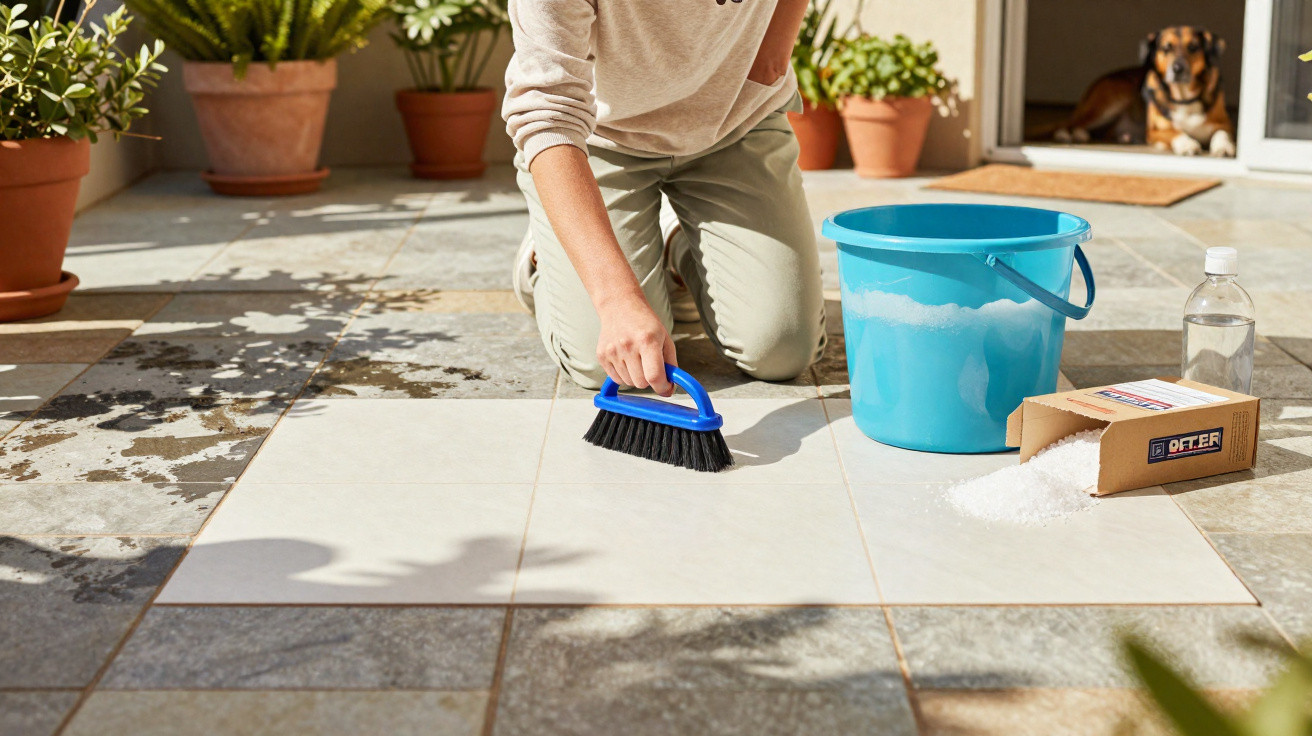
Plenty of people reach for the pressure washer on autopilot, or grab harsh chemicals from the DIY shop. A British DIYer shows there’s a far simpler, quieter approach that’s kinder to the environment, pets and the stone itself: two everyday cupboard staples, a bit of time and a stiff scrubbing brush.
Why patios look so bad after winter
After months of rain, frost and weak sunshine, patio slabs end up coated in a cocktail of algae, moss, lichen and everyday road grime. If you leave metal furniture outside, you’ll often see unattractive rust rings around chair and table legs as well. Pale paving quickly starts to look blotchy and “tired”.
The usual response is predictable: roll out the pressure washer, hit it with chemicals and “blast everything off”. Over time, though, that habit tends to create fresh problems.
- A pressure washer jet can wash jointing material out of the gaps and roughen the surface.
- Strong cleaners can attack jointing mortar and some natural stones.
- Dirt may come off initially, but a roughened surface picks up grime more quickly afterwards.
Many people now swear by household staples such as vinegar-based cleaner. It can help against limescale and some surface build-up, but it’s still an acid. On delicate stone it may leave faint etching marks that you only notice later when the light catches it. The soil life around your patio also doesn’t particularly enjoy repeated acid treatment.
"If you work with high pressure and aggressive products every year, you’ll end up damaging your patio in the long run."
The simple two-product trick for clean slabs
The British DIY channel “Fix it with Fowlers” demonstrates an alternative that sounds almost too ordinary to be effective: a bag of soda crystals, a squirt of washing-up liquid, plus a scrubbing brush and a little patience. For many standard patios, that’s genuinely all you need.
What soda crystals actually are
Soda crystals-also sold as washing soda-are a traditional household helper from before the era of specialist cleaners. They’re an alkaline salt that helps cut through grease and loosen organic grime. Important: this is not the same as bicarbonate of soda (used in baking) and definitely not the same as caustic drain cleaner based on sodium hydroxide.
- help dissolve greasy films and barbecue residue
- soften algae layers and ingrained dirt
- are notably less aggressive than many specialist patio cleaners
Alongside that, you use ordinary washing-up liquid. From the kitchen you already know what it does: it breaks down fats and oils so they rinse away more easily with water. On patios it’s especially useful for barbecue grease, soot and traffic-film-type grime.
Step-by-step: how the method works
The prep work matters almost more than the cleaner. If you simply pour something on and hope for the best, you’re more likely to end up with streaks.
- Clear the joints: Use a patio joint scraper or a small spade to remove weeds and loose soil.
- Sweep thoroughly: With a stiff broom, sweep away dust, sand and larger debris.
- Dampen the slabs: Use a garden hose or watering can to wet the area evenly.
- Scatter soda crystals: Sprinkle a thin layer over the wet surface-there’s no need for thick piles.
- Add washing-up liquid: Apply a few thin lines or several small squirts across the slabs.
- Scrub firmly: Work it in with a stiff scrubbing brush and scrub the joints too.
Then comes the slightly counter-intuitive part: don’t rinse straight away-let it work. The DIYer leaves the mix on the slabs for up to 48 hours before rinsing again with clean water. Over that time, part of the build-up loosens on its own.
"If you give the cleaner time, you save effort afterwards-the patio comes up cleaner, without the roar of a machine."
Safety and common mistakes when cleaning patios
Soda crystals are considered relatively gentle for household use, but they’re still clearly alkaline. In other words, you don’t need to spread half a kilo in one go. A light sprinkle-or a bucket of hot water with a few tablespoons dissolved in-will be plenty for many domestic areas.
What homeowners should watch out for
- Avoid contact with eyes and skin: Short rubber gloves are a sensible precaution.
- Keep children and pets away: While the surface is wet, it’s best that nobody walks across it.
- Do a test patch: With sensitive natural stone, try an inconspicuous area first.
- Rinse thoroughly: After the dwell time, flush with plenty of water so no residue remains.
A common mistake is mixing multiple products-vinegar in one spot, bleach cleaner in another, maybe a stone cleaner on top. These random combinations can damage the stone and can also harm your lungs if gases form. Stick to one method per pass, and make sure the area is well ventilated.
When a pressure washer still makes sense
Heavily tarred-over joints, baked-on mud or decades of build-up can be hard to shift by hand. In those cases, a pressure washer can help-but only if you use it carefully:
- use a wide fan nozzle rather than a pinpoint jet
- increase the distance from the ground-don’t work right up close
- clean joints on an angle and at lower power
- top up or replace jointing material afterwards if a lot has been washed out
If you pre-treat with soda crystals and washing-up liquid first, you’ll often need far less pressure at the end because the dirt has already been loosened.
How to keep your patio cleaner for longer
Even the best cleaner doesn’t help much if everything turns green again a few weeks later. With a small routine, you can keep the workload down.
| Measure | Frequency | Benefit |
|---|---|---|
| Sweep with a stiff broom | every 1–2 weeks | removes leaves and dust, leaving less “food” for algae |
| Light clean with warm water and washing-up liquid | as needed, roughly monthly | lifts grease films and fresh marks early |
| Two-product deep clean with soda crystals | 1–2 times per year | resets the surface before algae gets deeply embedded |
| Move garden furniture | a few times per season | prevents permanent shade patches and rust zones |
If you schedule a lighter round with soda crystals and washing-up liquid in autumn, spring starts feel much easier. The usual black and green film is often far less noticeable.
Which paving is suitable-and where to be cautious
This method is aimed mainly at common concrete slabs and many ceramic finishes. With natural stone, it’s worth taking a closer look:
- Concrete slabs: Generally fine, as long as the joints aren’t already crumbling.
- Ceramic patio tiles: Usually unproblematic, but keep an eye on the joints.
- Sandstone, limestone, marble: Test a small area first and use a softer brush.
- Clay pavers: Often robust, but watch for efflorescence and colour changes.
Alkaline products such as soda crystals can, depending on strength, roughen or discolour certain natural stones. In that situation, the safer option is a diluted bucket solution with a shorter dwell time, rather than dry scattering and leaving it for two days.
More than looks: environment, pets and your budget
Getting the patio looking “like new” is only part of it. By avoiding aggressive cleaners, you also protect what grows and lives around the paving. A mix of soda crystals and washing-up liquid generally breaks down more readily than specialist concrete chemicals that can end up in drains or garden beds.
For pet owners, it’s a particularly sensitive issue. Dogs and cats pad across wet slabs and later lick their paws. Using a product combination that avoids strong acids and chlorine-and leaves no residue in puddles after thorough rinsing-reduces the risk significantly.
Finally, cost matters. Soda crystals are only a few pounds per pack in supermarkets or chemists, and most people already have washing-up liquid at home. Compared with specialist cleaners-or buying a new pressure washer-this is kinder to the household budget, and to the neighbours who don’t want to listen to engine noise for hours on a sunny weekend.

Comments
No comments yet. Be the first to comment!
Leave a Comment